
.jpg)

A leadership team I worked with used to spend 40 minutes on the same issue every single week. Everyone had something to say, and the conversation would wander from the problem to another related problem to a story about a client to a debate about a tool or platform they use. Then the clock would run out, and they'd agree to "pick this up again next week." And they did. The same 40 minutes all over again, but still no resolution.
If you've ever sat in a meeting like that, you already know the strange part: It doesn't feel like nothing is happening. It feels busy. Everyone's engaged, opinions are flying, and people really do care. That's exactly why the deeper issue is so hard to see clearly. But the reality is, a lot of talking about an issue isn't the same thing as solving an issue.
What Causes IDS® to Break Down?
The problem the team was facing wasn't the issue itself. It was how they approached the IDS discipline.
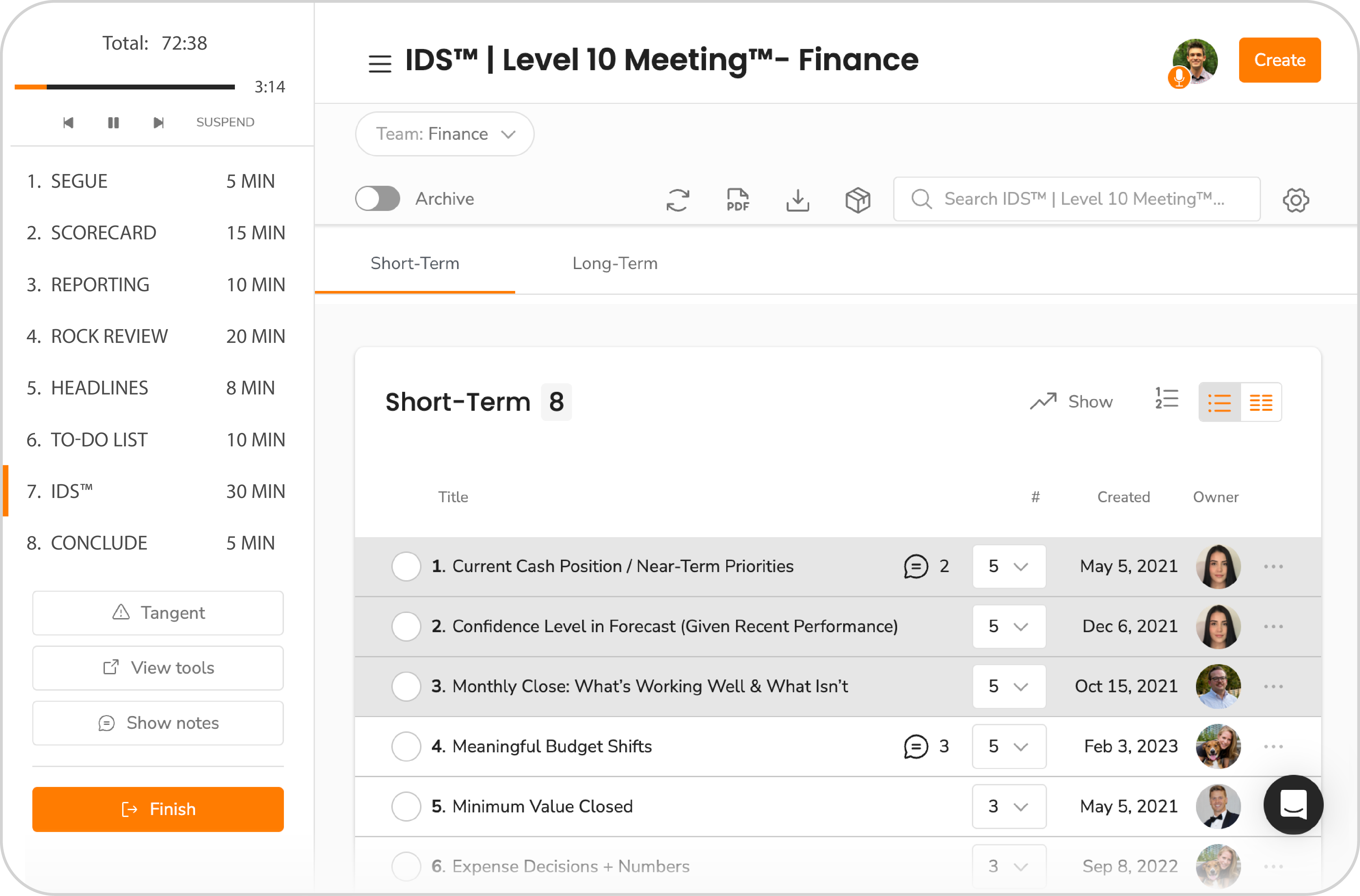
IDS stands for Identify, Discuss (or as I like to say Decide), and Solve, and it's the engine of the Level 10 Meeting®. It's where a leadership team takes its list of issues, sorts them into short-term issues and long-term issues (the ones that don't need solving inside the 90-day quarter they're in), prioritizes the top three, and then knocks them down one by one until they're actually resolved. When it works, issues go in and decisions come out. When it's stuck, you get a long discussion with no decision, no action, and nothing that leads to a real conclusion.
And nine times out of ten, a stuck IDS comes down to two breakdowns hiding underneath all that energy.
The first breakdown: Teams skip Identify and jump straight to Discuss.
Even though a lot of teams don't realize it at first, Identify is the most important part of IDS because it's where you figure out what the problem really is.
Here's how it might look: A number goes red on the Scorecard, let's say a conversion rate like close rate, and the team drops it onto the Issues List, exactly as they should. (A metric that's off track, especially two or three weeks running, belongs at the top of that list.) But the second the team opens the issue, they start debating fixes to the close rate without anyone pausing to ask the simplest, most powerful questions in the meeting: Can you state the issue in one sentence? What's actually going on here? What is this a symptom of?
Because the close rate being down isn't the issue to solve. It's the flag telling you an issue exists. The real issue lives underneath it, and uncovering that is the entire job of Identify.
When you skip that first step, you get five people who are passionately solving five slightly different problems under the same heading. You can debate a red number forever and never actually touch the thing causing it. Is it a people issue? A structure issue? A process or system issue? A training issue? If it’s multiple things, you’ve got to slow down and identify them separately. Add each of them to the list as separate issues.
The second breakdown: No one ever Solves.
A lot of teams confuse "we talked about it" with "we decided." Or they did decide, but no one was clear on who owned the action items that came out of the decision. So the issue stays open or gets delayed by confusion and assumptions. Then it comes back again next week wearing the same clothes. Ugh. The worst.
A Solve needs to leave the room with something concrete. What did we decide? Who owns the next action? What needs to get done, and by when? If the team can’t answer those questions clearly, the issue probably isn’t finished.
Notice that neither of these breakdowns is a discipline problem in the sense of people being lazy. These teams aren't lazy at all. They're simply skipping steps they don't realize are steps. But these are disciplines, and they take time, practice, and intentionality to master. When you do them right, they change the way you work and the way you execute.
How to Get Unstuck
Getting unstuck comes down to protecting the sequence and the discipline of IDS. You should aim to be regularly solving 8+ issues in a 60-minute Issues section of an L10™. Here are four simple practices to do it.
-
Prioritize before you discuss: Before you touch a single issue, pick the top three, and don't avoid the hard ones. As a rule, any off-track Scorecard activity or Rock should always be near the top. This one habit puts your team's best energy on what matters most instead of on whatever topic happens to be at the top of the list that day or that week.
-
Spend real time on Identify: I cannot stress this enough. If you take nothing else from this article, remember this: When you open an issue, resist the urge to rush into solving it. The first thing I have teams do is name the issue in one simple sentence that says who's raising it, who owns it, and what's actually wrong. No solution baked in and no long, emotionally driven story. The IDS methodology loosely recommends spending roughly 70% of the time identifying the problem, 15% discussing, and the remaining 15% on identifying the solution. This distribution emphasizes the critical role of problem identification in the process. Spend the time here. Be okay with the discomfort. This isn't a personal attack. It's simply how you drill down together, take action, and resolve the problems standing in your way. Two extra minutes on Identify saves twenty on Discuss.
-
Stay on one issue, and give the team permission to call out tangents: The teams that talk over each other aren’t necessarily undisciplined. They just don’t have an agreed way to catch a tangent in the moment. Give them one. I tell teams to pick a word that anyone in the room can use when the conversation wanders off. I’ve had teams literally shout, “Squirrel!” It sounds silly, and that’s why it works. It gives anyone permission to pull the group back without making it personal. (If you’re running the meeting in Ninety, use the Tangent Button to flag when the conversation gets off track and bring the team back to the issue at hand.) Once you’re on the right issue, keep the discussion additive. Each person should bring something new. When people start repeating points or adding “I agree,” the discussion is usually done. Repetition can feel like progress, but it usually just delays the decision. Let everyone be heard, then move on.
-
Force a Solve that includes an owner, To-Do, and date: An issue isn't solved just because it feels like it is. It's easy to confuse talking about a problem with doing something about it. Effort isn't the same as results, and nothing is actually accomplished until you reach a Solve. A true Solve has a specific shape: Someone owns the next action with a To-Do and a due date. If you can't name who's doing what by when, you're not finished. You've just had a nice conversation. Say it out loud, write it down, and move to the next issue.
Field Note: Here's a trap I watch for: People recognize the tangent and take it anyway. "I know this might be a tangent, but I'm going to say it anyway…" Announcing a bad habit doesn't excuse it. Acknowledging a flaw shows self-awareness, but it doesn't fix the behavior or remove your responsibility to stay on track. Notice whether your team does this.
What if an Issue Is Too Big to Solve in One Meeting?
Sometimes a team stalls on the same issue week after week or avoids it altogether because solving it is going to take a lot more than a single To-Do. It's really a multi-part problem or a full-blown Rock. When that's the case, don't try to swallow it whole. Instead ask: Which part of this needs to be handled first to reduce the negative impact on the business? Then IDS that piece.
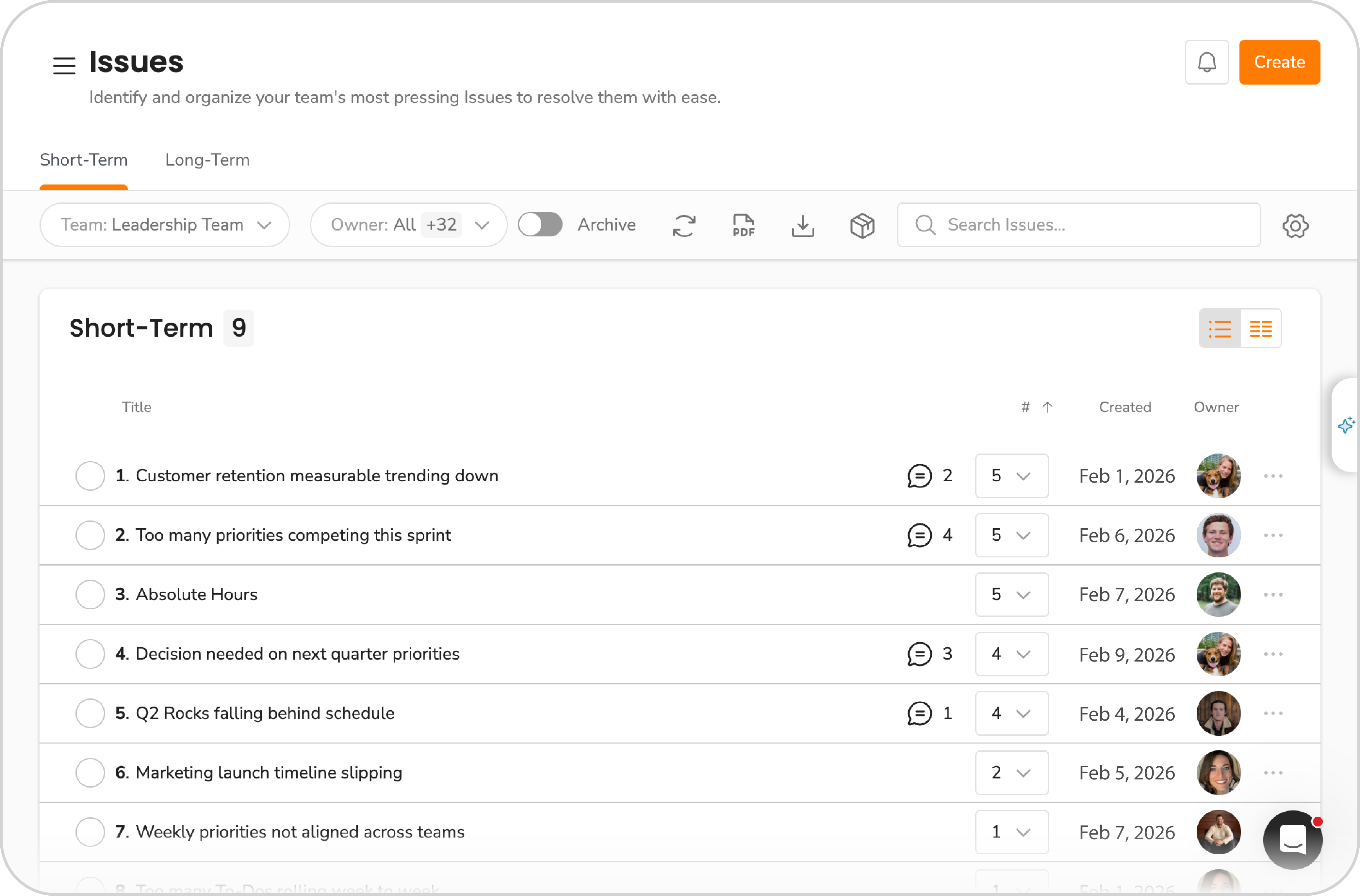
From there, right-size the rest. If a slice of it can be solved this quarter without disrupting your Rock commitments, take that slice and get on it. Park the remaining parts on your Long-Term Issues List, the holding place for issues that don't need solving inside this 90-day window. When you set Rocks for the next quarter, you pull that list back up so nothing falls through the cracks, and the bigger pieces can become Rocks.
If you aren't sure where an issue belongs, weigh it against the bigger picture: How does solving, or not prioritizing, this issue affect your 1-Year Plan? It's completely fine if an issue turns into several additional issues. Just add them to the list and ask the originator which one should be the first to focus on.
That's the payoff of these disciplines: They strengthen your ability to predict and plan the business instead of reacting to the same oversized issue every single week.
Field note: With the team I mentioned, the fix wasn't a new agenda or a stricter timer. It was first observing and auditing their L10 and then coaching whoever was running the meeting to notice the tangent in the room as it happened, to feel the conversation drifting and gently steer it back to IDS. That's a facilitation skill, not a process document. Once they could catch the drift in real time, the forty-minute issues started closing in ten.
Protecting IDS
If your team discusses the same issues every week, it's usually because of sequence. Check that you're not skipping Identify or never really Solving.
In every Level 10 Meeting, prioritize the issues that most affect your 90-day goals and business performance so your best energy goes to the work that moves your company forward. Then spend more time defining the issue than you think you need to. State it in one sentence before anyone discusses it. And end every issue with an owner, a To-Do, and a date. That single habit is the difference between a meeting that ends in a decision and a meeting that turns into a vent session.
A stuck IDS is one of the most fixable problems in a leadership team because the fix doesn't come down to making people work harder or care more. Your team already does both. It's about protecting the four steps that turn all that energy into decisions.
FAQ
What does IDS stand for in a Level 10 Meeting®? Identify, Discuss, Solve. It's the three-step method for working through your issues list. You identify the real issue, discuss it once, make a decision, and solve it with an owner and a next action.
Why does our team keep discussing the same issues? Usually one of two reasons: You're discussing a symptom instead of identifying the actual issue, or you're ending discussions without a clear solve (owner + To-Do + date), so the issue reopens the following week.
How long should one issue take in IDS? There's no fixed rule, but if an issue is eating large chunks of your meeting every week, that's a sign you're solving the wrong problem or never landing a decision, not that you need more time.
What if we can't reach a decision? Often it means the issue isn't fully identified yet, or it belongs to one owner rather than a group vote. This one's important: Name who owns the decision and give them the next action, even if the action is "bring back a recommendation next week."
Who should run IDS in the meeting? Typically the person running the L10, often the Integrator. Their job isn't to solve every issue. It's to protect the sequence and steer the meeting back when the conversation goes off track.
Field Note: A visible Issues List keeps your priorities honest and makes "solved" mean something. Ninety's Issues and To-Do tools keep the Solve from evaporating the moment the meeting ends. Review your Issues List regularly and make sure each issue still belongs there. Don’t be afraid to move things from the Short-Term Issues List to the Long-Term Issues List.



.jpg?width=500&name=large_Issues_Gym_1_Blog_Header_1920_x_1080%20(1).jpg)
.jpg?width=500&name=large_Your_EOS%C2%AE_Leadership_EOS_Blog_Header_1920_x_1080%20(1).jpg)