


It's a question that often gets a quick reaction:
Can you really solve 15 issues in 60 minutes during your Level 10 Meeting®?
When newer leadership teams hear it, the response is usually some version of, "There's no way." But teams that have been working with EOS® for a while tend to answer differently. For them, it's not only possible, it's expected.
The difference here isn't about speed. It's about clarity.
In a recent session, a leadership team I was working with shared their frustration that they weren't making any real progress on their Issues List. They were having the conversations. They were dedicating the time. But the same issues kept coming back week after week. As we slowed things down and got more disciplined with the IDS® process, something became clear. They weren't struggling to solve issues. They were struggling to clearly define them.
At one point, we realized they couldn't state an issue in a single sentence. Even when someone thought they had, the rest of the team didn't know how to help. So we paused and spent time practicing that one skill. It felt slow in the moment. But once they got it, issues that had been sitting on their list for years were solved in minutes.
That's the power of disciplined IDS®. When an issue is clearly identified, it's often halfway solved.
In this blog, we'll walk through a few practical ways to get better at identifying and solving the real issues inside your Level 10 Meeting. These are simple shifts, but they can dramatically change how your team moves from talking about problems to actually solving them.
1. Work on Stating the Issue in One Sentence
This is where most teams struggle more than they expect. Issues are described in paragraphs, backstories, or a series of related frustrations. The problem is when an issue isn't clear, the team talks around the problem and ends up solving the wrong thing.
The concept is simple, but the discipline takes practice: State the issue in one clear sentence. In the session I talked about earlier, once the team practiced this skill of identifying every issue in a single sentence, everything sped up. They could name the issue, align quickly, and move straight into solving it. Sometimes you have to go slow to go fast, and this is one of those moments.
Clarity is what creates forward momentum for growing companies. Without it, even the best teams spin their wheels.
2. Determine Whose Issue You're Solving
Here's a common situation: A team starts discussing an issue, and someone begins explaining it on behalf of someone else. The conversation moves forward, but the team is working from secondhand information.
When working on issues, pause and ask a simple question: "Is this your issue?" If the answer is no, bring the owner of the issue into the conversation and ask them to define it themselves. Oftentimes, what will surface is very different from what the team had been trying to solve.
Ownership matters when it comes to IDS. When the person who owns the issue can clearly state it and ask for what they need, the team can actually help. Without that clarity, teams waste time solving the wrong problem.
3. Avoid Pile-Ons
We've all seen this happen in meetings. A team is working through an issue, and someone adds, "This also reminds me of..." or "What about this...?" Before long, the conversation has gone in three or four different directions.
These are pile-ons. And while they're usually well-intentioned, they make it harder for the team to stay focused.
The key is to separate issues in real time. If something new comes up, capture it and put it on the Issues List. Then come back to the original issue and finish solving it. Staying disciplined here keeps the conversation productive and prevents teams from leaving discussions with nothing fully resolved.
Focus is what turns discussion into Traction®.
4. Be Clear on What "Solved" Means
Solving an issue doesn't always mean it disappears forever. That's the goal, but it's
not always the immediate outcome.
Sometimes solving an issue means identifying the next step. It could mean assigning it as a Rock, deciding it's not a priority right now, or recognizing that more information is needed before moving forward. In some cases, solving the issue is simply getting clear enough so the team can take the right next action.
What matters is clarity and alignment. When a team agrees on what "solved" means in the moment, they can move forward with confidence instead of revisiting the same issue again and again. Because progress happens when the next step is clear.
5. Spend Most of Your Time Making Sure You're Solving the Right Thing
It's tempting to jump quickly into solutions. Most leadership teams are wired that way. But when teams move too fast, they don't solve the real issue.
A helpful framework to keep in mind: If you have 10 minutes to solve an issue, spend about 8 of those minutes making sure you're solving the right thing. Use the remaining time to discuss options and decide on a path forward. It's not a rigid rule, but it reinforces where the real work is.
When teams slow down enough to truly understand the issue, the solve tends to come quickly and with much more confidence.
6. Prioritize What's Important
Don't just start at the top of your Issues List. Ask your team, "What truly needs to be solved this week?"
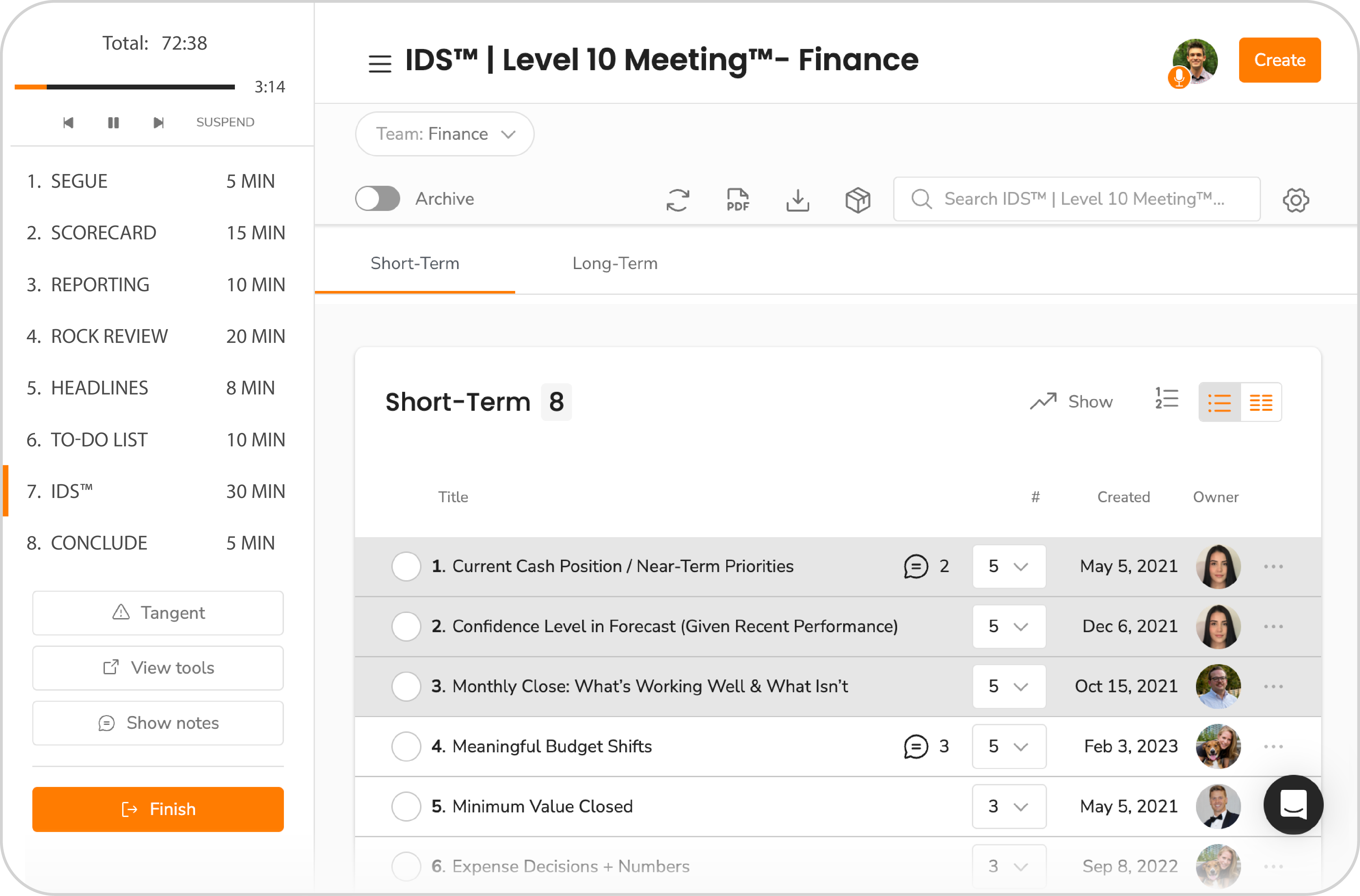
Use Ninety to prioritize your most urgent issues. When you rate each issue 1–5, it helps your team quickly see what deserves the most time and attention. You're not just picking what's easy. Focus on what your team should truly put their time and energy toward solving this week.
If it's not an issue you need to solve this quarter, make use of the Long-Term Issues List on your V/TO®. Anything that doesn't need to be addressed this quarter should not be on your L10™ Issues List. This will help keep you focused on the right issues.
You can't solve everything. That's why you need to put things in the right compartment, and prioritize the important issues to focus on this week.
Bringing It All Together
Solving 15 issues in 60 minutes isn't about moving faster. It's about getting clearer. When teams learn to define issues well, ensure the right person owns them, stay focused on one issue at a time, and agree on what "solved" means, everything starts to change.
It might feel uncomfortable at first. It requires discipline, patience, and a willingness to challenge how things have always been done. But when you do it right, instead of revisiting the same problems week after week, your team will create real momentum. You'll solve more, move more work forward, and finally gain Traction.
If your team feels stuck in the cycle of talking about issues without truly resolving them, you're not alone. Please reach out. I'd be happy to talk with you more about how, with the right structure and a bit of practice, solving issues at the root becomes not just
possible, but expected.



.jpg?width=500&name=large_Stuck_During_IDS_EOS_Blog_Header_1920_x_1080%20(1).jpg)
.jpg?width=500&name=large_Issues_Gym_1_Blog_Header_1920_x_1080%20(1).jpg)