
.jpg)

“Our group is too big.”
That’s what one CEO I spoke with recently said about the leadership teams across his two companies inside a family-owned enterprise. He was working with co-owner siblings, long-tenured employees, and decades of shared history.
That kind of long-standing business comes with layers of trust, loyalty, and deep relationships. It also comes with a reality most founders, CEOs, and Visionaries eventually face: The people who have earned influence over the years may not all belong on the leadership team.
He was the one who finally said it out loud: “We have 2 companies, 11 people on the leadership team at one and 8 at the other, even though the staff is under 30 people.”
The fact is when a leadership team gets too big, decisions slow down, the same conversations keep repeating, accountability gets harder to track, and meetings feel busy but not useful. The hardest part is nobody wants to make it personal. No one wants to break it to a trusted employee, family member, co-owner, or long-time leader that they no longer belong on the leadership team.
Your EOS® leadership team shouldn’t be built around tenure, ownership, loyalty, or who’s always been invited. Your company deserves better than that. It should be built around the major functions required to move the business forward. That’s one of the reasons why The Accountability Chart® is so important. It gives you a way to talk about structure before talking about individual people.
Let’s break down how to decide who belongs on your EOS leadership team, why oversized teams struggle to gain Traction®, and how to make the change in a way that protects relationships and strengthens accountability.
Why Do Leadership Teams Get Too Big?
Most oversized leadership teams start with good intentions. A founder wants certain people who were there from the start to feel included. A family business wants co-owners represented. A long-time employee has earned respect. A department head wants visibility. Someone has been part of leadership meetings for years, so removing them feels like a demotion.
When any of these happen, the leadership team stops actually leading and starts operating like a committee. Everyone has context, opinions, and a reason to be heard, but fewer people are clearly accountable for the final call. The team gets bigger in the name of visibility, but accountability ends up getting weaker.
A leadership team should be responsible for working on the business, solving enterprise-level issues, setting Rocks, strengthening the Six Key Components®, and driving the company toward the vision.
A committee is usually trying to make sure every voice, department, family branch, or trusted person has access to the same conversations. That kind of representation has value, but it’s not the same as leadership accountability.
This is where self-implementing EOS companies often get stuck. They can improve their Level 10 Meetings, build a Scorecard, create Rocks, and get better at To-Dos. But then they hit The Accountability Chart, and that’s where tension builds. No one is going to volunteer to leave the leadership team.
EOS Implementer® Andrew Turner described the challenge by borrowing a line from Al Moscardelli: Trying to self-facilitate this conversation can feel “like doing brain surgery on yourself.” You’re trying to be objective, but you’re also carrying history, relationships, ownership dynamics, and your own Seat on the chart.
That’s why founders need a tool that lets them stop asking, “Who deserves to be here?” and start asking, “What Seats does the business really need on the leadership team?”
How to Decide Who Belongs on Your Leadership Team
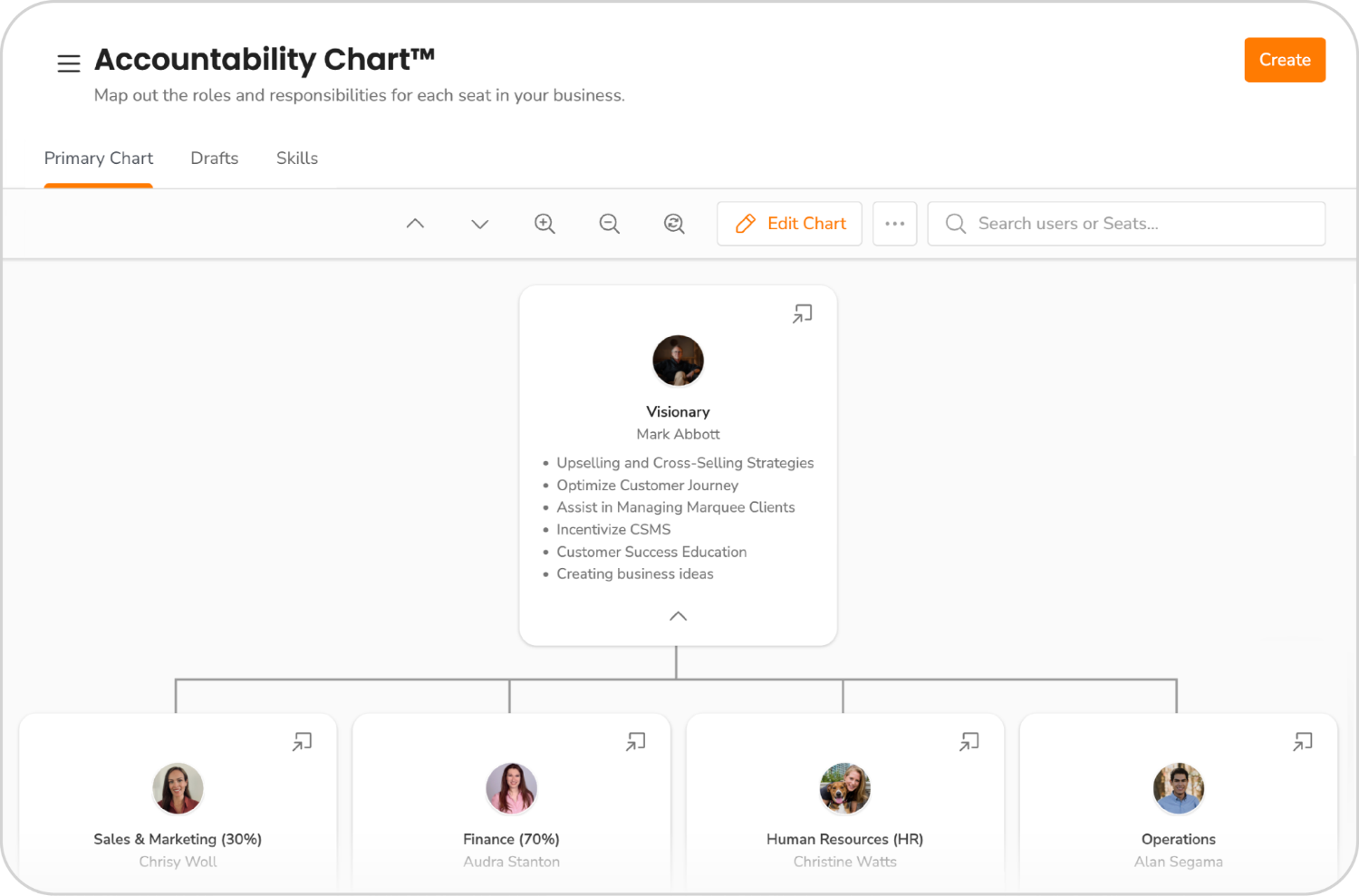
Your Accountability Chart should determine the structure of your leadership team before names are even added. And yes, that sounds simple, but it’s usually one of the hardest EOS disciplines to practice well.
You have to look forward 6–12 months and ask what structure the company needs to achieve the vision. Not what structure exists today. Not what structure protects feelings. Not what structure preserves old habits.
In a lot of EOS companies, the leadership team includes the people accountable for the major functions of the business. That usually includes Seats like Visionary, Integrator, Sales and Marketing, Operations, Finance, and any other major functions needed for the next Stage of Development. The exact structure depends on the business, but the standard stays the same: Every Seat needs clear accountability.
This is where right person, right seat matters. A person can be a great culture fit and still not belong on the leadership team. Another person may be highly skilled but not have the GWC® to be there.
Here are a few questions to test each Seat on your Accountability Chart:
-
Does this person own a major function of the business? Leadership team Seats should connect to company-level accountability, not just activity updates.
-
Does this person need to help make enterprise-level decisions? Some leaders need visibility into decisions. Fewer leaders need to help make every decision.
-
Does this person GWC the seat? They need to Get it, Want it, and have the Capacity to do the work required by that Seat.
-
Would the business design this Seat if it were starting fresh today? This question helps separate future structure from legacy structure.
-
Can this person lead for the whole business, not just their function? Leadership team members need to solve for the company first and their function second.
The goal isn’t to make the leadership team smaller just because smaller feels simpler. The goal is to make the leadership team more effective, efficient, and accountable.
How Do You Restructure the Leadership Team Without Breaking Trust?
This is where founders, CEOs, and Visionaries have to lead. When someone hears they’re no longer on the leadership team, they may assume the message is, “You’re less valuable.” That can’t be the message.
The real message you need to send is, “We’re clarifying how the business needs to be led. This isn’t personal.” There’s a big difference.
A person can be respected, trusted, essential, and deeply valued without holding a leadership team Seat. Some of the most important people in a company don’t sit on the leadership team. They lead departments, manage teams, own critical processes, serve customers, develop people, and carry culture every day. As you revisit your leadership team structure, your goal should be to separate value from Seat.
Here’s a practical way to do that:
-
Start with The Accountability Chart before names are discussed: Remember, structure first, people second. Build the structure the company needs for the next 6 to 12 months. Keep the first conversation focused on functions, Seats, and accountabilities, not people.
-
Define the purpose of the leadership team: Make it clear that this team exists to solve company-level issues, own the vision, set priorities, and drive accountability across the business.
-
Create the right next-level meetings: Some people may move from the leadership team into departmental Level 10 Meetings, manager meetings, or project leadership roles.
-
Tell people what’s not changing: Be direct about their value, their role, and where their leadership still matters. Ambiguity creates more pain than clarity.
-
Explain the reason: This change is about speed, clarity, accountability, and Traction®. It’s not about status.
When your Accountability Chart, Rocks, Scorecard, Issues, and Level 10 Meetings live in Ninety, your team has one shared place to see who owns what. During a restructure, that shared visibility helps keep the conversation focused on Seats, accountabilities, priorities, and outcomes instead of status, history, or tenure.
What Gets Better When the Right People Are Leading?
When your leadership team is the right size, the business is easier to lead. Accountability is clearer because every Seat has a defined owner, clear outcomes, and fewer places for responsibility to hide. Decisions move faster because fewer people are weighing in on issues they don’t own. Level 10 Meetings get stronger because the team spends more time solving the most important issues and less time keeping track of everyone’s opinions. And Company Rocks become more impactful because the people setting them are accountable for company-level priorities.
When too many people sit on your leadership team, you may think you’re doing the work of developing leaders for your scaling company. But in reality, you’re confusing access with growth. Leadership doesn’t have to happen in a leadership meeting. Leadership development happens when people are given clear ownership, coaching, feedback, and accountability. That can happen in departmental L10s, Quarterly Conversations, and direct LMA® work.
A smaller leadership team can actually create more leadership opportunities throughout the company because the right people are leading at the right level.
Where Should You Start?
When that CEO I mentioned earlier called out that his leadership teams were too big, he didn’t blame the people in those Seats. He identified the structure issue, and that’s where we all need to start.
It’s not about asking who should be removed from the leadership team. It’s about asking what Seats the business needs to achieve the vision. Then letting The Accountability Chart do its job.
The right EOS leadership team isn’t the biggest group of trusted people. It’s the smallest group of accountable leaders needed to run the business, strengthen the Six Key Components, and gain Traction®.
A smaller leadership team isn’t a smaller commitment to your people. It’s a stronger commitment to clarity.




.jpg?width=500&name=large_Lead_World-Class_EOS_Blog_Header_1920_x_1080%20(1).jpg)