
.jpg)

The Quarterly Planning Session started the way they usually do. We opened with a review of the past 90 days, including a walk-through of the Scorecard and Rock execution. We talked about what was on track and what wasn't. And throughout the conversation, Sales kept coming up again and again.
Off track. Off track. Off track.
"From everything we've looked at this morning, it seems like sales is a limiting factor for the business. Is that the number one issue affecting us today?" I asked.
The CFO didn't hesitate. "If we don't get our arms around sales, nothing else matters. The Rocks we set today, the priorities we walk out with, all of it depends on this."
"Would it be a terrible idea to pause and IDS® this right now, before we set a single Rock?"
The entire team agreed. We needed to talk about this now. Something about this issue was bigger than even the numbers showed. It was causing tension with the team and getting in the way of the rest of the day.
What Is IDS®?
IDS® is a core methodology in EOS® that stands for Identify, Discuss, Solve. Identify means digging past the symptom to get to the root cause of the issue. Discuss means exploring solution options. Solve means defining a solve for now. Using the IDS tool effectively is one of the most deceptively powerful skills a leadership team can build.
In every weekly Level 10 Meeting®, teams spend 60 minutes identifying, discussing, and solving their top priority issues that are getting in the way of progress. In Quarterly Planning Sessions, we allocate additional time to IDS the pressing issues the team couldn't resolve over the course of the quarter.
It could be a big idea that goes on the long-term issues list and will become a Rock in a future quarter. It could be something the team resolves right there in the room. Or, it could be a To-Do, something someone acts on over the next week to advance or resolve the issue.
IDS is a discipline that helps teams stay ahead of their biggest, most important issues and put the right, proportional effort against an issue at any point in time.
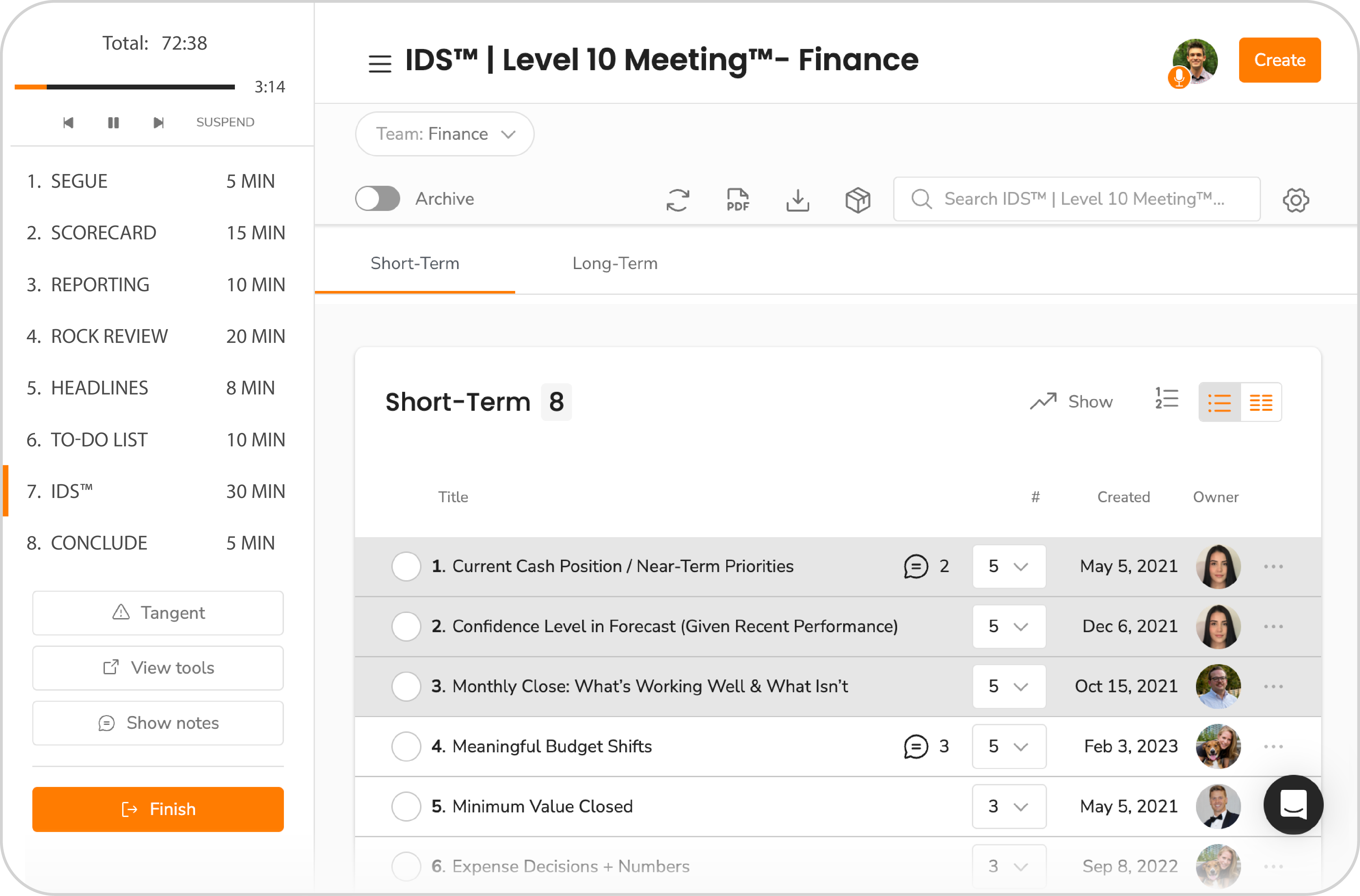
Want a cleaner way to capture, prioritize, and solve issues in your Level 10 Meetings? See how Ninety’s Issues tool helps teams stay focused, IDS the right things, and leave with clear next steps. Explore Ninety’s Issues tool.
Identifying the Real Issue
In this particular quarterly session, we needed to go off script and IDS this issue right now. This team had been running on EOS for over a year. On the surface, they looked like they had it down. But for the past 90 days, the Scorecard had been red in the places that count: not enough sales calls, conversions were soft, two Rocks were still lagging, a CRM update hadn't moved, and a sales initiative was way off track.
Each week the Head of Sales skated past the issues, blaming it on things like seasonality, a tough market, or a random slowdown nobody could quite name. And every week, the conversation moved past the sales numbers. There was always something else on the list.
Everyone on the team had a sense of the root cause, but nobody said it out loud. I should mention that the Head of Sales was also the founder of the company.
We put lagging sales on the board. Before we started digging, I asked one question to the team: "What's the real problem here?"
The way you define the problem shapes the entire conversation. So we named it plainly. Sales had been lagging for an entire quarter. The team wasn't digging into the sales measurables or Rocks that were off track each week. They were making excuses for them.
That problem statement "The sales function isn't operating as it should" put the real issues on the table.
Finding the Real Constraint
The discussion surfaced quickly that this wasn't just one issue. It was several layered around each other: Sales team performance, the founder's time capacity, the missing process. Each layer exposed another one underneath it.
Sometimes the team would surface a tangential issue. We call that issue stacking. It happens when a team starts naming tangential issues instead of going deeper on the core issue. I asked, "Are these the same issue or different issues? If they're different, let's add them to the issues list separately and stay focused on what's underneath the core issue."
As we continued, we kept asking "Why is that?" until we felt we were circling the root cause.
The founder had built this company himself. He was the Visionary and he was still running sales. For years that had worked. He was magnetic with clients. He personally owned 60% of revenue. But the company had grown past the version of itself he had built. The sales function needed structure. The team needed managing. He was stretched across too many Seats to go deep in any of them. The hunger was still there somewhere. It just wasn't showing up in the numbers.
His team could see it. They just respected him too much to say it out loud. Finally, the Chief Operating Officer looked at the founder and said what everyone was thinking, "I think the root cause is you. You're stretched. I'm not sure you really want this Seat. It requires developing the Sales team, transferring your knowledge, holding them accountable instead of just being frustrated with them. And until we solve that, I don't think any of the rest of this moves."
That was the "I": Identify. The team had gotten to the root cause. They were open and honest enough to name the real thing.
The founder went into defensive mode. That's human. When the issue has your name on it and your team is watching, the first response may not be graceful.
Finding the Right Next Step
Now they needed to discuss solution options, the "D" in IDS.
The team took a step back. The defensiveness had passed. Now they could explore together by asking some simple questions:
-
What did the founder actually want?
-
What was he good at?
-
What was he avoiding?
It came out quickly. He wanted to elevate. To get his ideas out of his head and transfer them to the team. To be in front of major clients, not managing reps. He knew the sales process lived in his gut. He knew it wasn't scaleable. He didn't want to codify it, train others, or do the rote work that building a Sales team requires. He got impatient with it. That wasn't a character flaw. It was a Seat problem.
That's when the real conversation opened up. The team didn't need the founder to become someone he wasn't. They needed a true sales leader. Someone who could build the process, manage the team, and hold them accountable. Someone the founder could actually report into on the sales function. And ultimately, a team that could deliver 80% of revenue without him involved in every deal.
The solve wasn't a To-Do. They zoomed out and updated their annual goal. The new goal wasn't to hit a number. It was to redesign the sales function entirely. And ultimately move the founder into the Visionary Seat. The Seat he had always wanted, which would also free him up to do what he did best.
Two Rocks came out of that session.
-
Engage a sales consultant who could help them understand what a routinized sales process looks like at their Stage of Development.
-
Research how best-in-class companies of a similar size structure the sales function, including roles, org design, accountability, compensation, training, and management.
The goal by end of quarter: A plan that included a new organizational structure, an Accountability Chart, and a clear picture of the gap between where they were and where they needed to be.
They didn't completely solve sales that day. They solved for now. And solved for now was the commitment they needed to understand the problem fully before redesigning around it. At the end of the meeting, the founder was energized in a way he hadn't been in years.
What Should You Take Into Your Next IDS Session?
When a team commits to the IDS discipline every week and every quarter, they keep their numbers on track, gain Traction® on the big things they want to achieve, and address immediate burning issues before they become bigger problems.
If you want to gain that kind of Traction in your own company, here are four practices to take into your next IDS session:
-
Define the problem before you start digging: You should be able to sum it up in one clear sentence. Remember, the way you frame the issue shapes the entire conversation.
-
Keep asking "Why is that?": The first answer is usually a symptom. Keep going until you get to what you truly believe is the root cause. Be honest, even when it's hard.
-
Watch for issue stacking: When the team starts raising new problems instead of going deeper on the one you're focused on, it's time to stop and evaluate. Are these the same issue or different issues? If they're different, add them to the issues list separately, one issue at a time.
-
Always leave with a solve for now: It could be adding it to the long-term issues list or a clear To-Do assigned to one owner. But don't leave without a solve.
Think about your own team:
-
What issue has been surfacing again and again in your Level 10 Meetings over the last 90 days?
-
When you prioritize your top three issues, does the real issue make the list?
-
What would it take to build a team where the hardest thing to say is also the safest thing to say?
IDS works best when the team is willing to be open and honest. That culture of accountability and trust is what accelerates decision-making. It's what gets a team to the heart of things. And it's what moves the business forward.
Ready to run better meetings, solve the real issues holding your team back, and gain Traction® every week? Ninety gives your team one place to focus, align, and thrive. Try Ninety free now.