
.jpg)

I use the same road-trip metaphor with teams all the time because it strips an issue down to its bones faster than anything else I've got. Picture it: I'm driving us to a meeting, we've got an hour, the music's on, we're having a great time. And then the car ends up in a ditch. What's the issue?
When I tell this story to a team and ask that question, most people don't answer it. They answer a different one: "What happened?” And then they're off. "We swerved to miss a deer. The road was slick. I looked down for a second. Someone cut us off." All of it could be true, all of it’s interesting, and none of it is the issue.
Ten minutes in, we know exactly how the car got there, but the car is still stuck.
Here's the issue: The car is in the ditch. That's it. It's not about how it got there or whose fault it was. The car isn't where it should be, and nothing else matters until it is. The moment you say that out loud, the thing you actually want becomes obvious too: I want the car out of the ditch.
Issue named, outcome named, in one short sentence.
That's the difference between discussing symptoms and solving the real issues. Asking "What happened?" will just give you a pile of symptoms. A team can circle those symptoms comfortably for an entire meeting because none of them require anyone to do anything hard.
That changes when the actual problem becomes clear: “The car’s in the ditch, and I want it out.” Now the team has something concrete to solve. Once the issue is that clear, they can stop circling and start moving.
Short-Term Solve vs. Long-Term Solve
Let's stay in the ditch a minute because this is where teams can really go wrong. Say we get out of the car and discover we've got a flat. What are our options? Call for a tow. Put on the spare. Push it out. Walk. Call for a ride. Any of these can be right, depending on how much time we've got.
So, we decide our best option with the time we have is to put on the spare and drive to the next town. Did we solve the issue? Short-term, yes. That's a real solve for our issue. But a spare tire only gets you 30 miles. The longer solve is finding the shop and buying a new tire.
Your issues work exactly the same way. There's the version that gets you moving today, and the version that means you don’t deal with this again, and they're rarely the same fix.
The trouble is that a spare tire feels like the right solution. It's satisfying and it's fast. The car's moving, everyone relaxes, so nobody goes and buys the new tire. Then the spare wears out on the highway and everyone, understandably, gets frustrated. When an issue comes back, all it's telling you is that you put the car back on the road when it was still riding on the spare.
Why Capable Teams Still Reach for the Spare
It doesn't come down to competence. The teams I watch get stuck here are usually the sharp ones, and their skill is part of the trap. A capable team is very good at generating quick, plausible fixes, so when an issue gets uncomfortable, that same skill gets aimed at the comfortable version of the problem.
It looks like work. It sounds like work. Everyone leaves the meeting feeling like they solved something. But a long-term solve always has a person's name attached, and naming that person often means having the hard conversation the team's been avoiding.
The tell is recurrence. A healthy team can have a long Issues List and still be moving because it's naming new things constantly. A stuck team has a long list made of the same thing over and over, described five different ways.
77 issues, 1 cause
I sat down with an engineering team at their Annual once. They were thoughtful people, and that may have been the reason their Issues List had ballooned to 77 items.
Before day two, I did the same thing I do with every team I work with: I sat with the list and looked for common themes. Did anything merge? Did anything point to one area of the company or one person?
I didn't know the first thing about their industry, but I didn't need to. When I stepped back and read all 77 issues, 70 pointed to Operations. So, I asked the leadership team the most basic question I could: "What's going on in Operations?" And then I didn't say another word.
The Ops leader just looked at me. Then I asked, "Are you doing okay?"
That kicked off one of the most meaningful 90-minute conversations I've been part of in 15 years of this work. Why? Because the person was right there, and it got real. And by the end of our conversation, he was no longer on the leadership team. Roughly 70 of their 77 issues traced back to him being in the wrong Seat.
It turned out that he didn't want to manage people. He wanted to do the work. Once we got him into the right Seat, the issues were resolved and the company grew. It was the only time in that company's history we finished early.
There were 77 spare tires, and only one set of real ones. All it took to decide which one the team needed was a single question that hadn't been asked until that day.
Spotting the Patterns
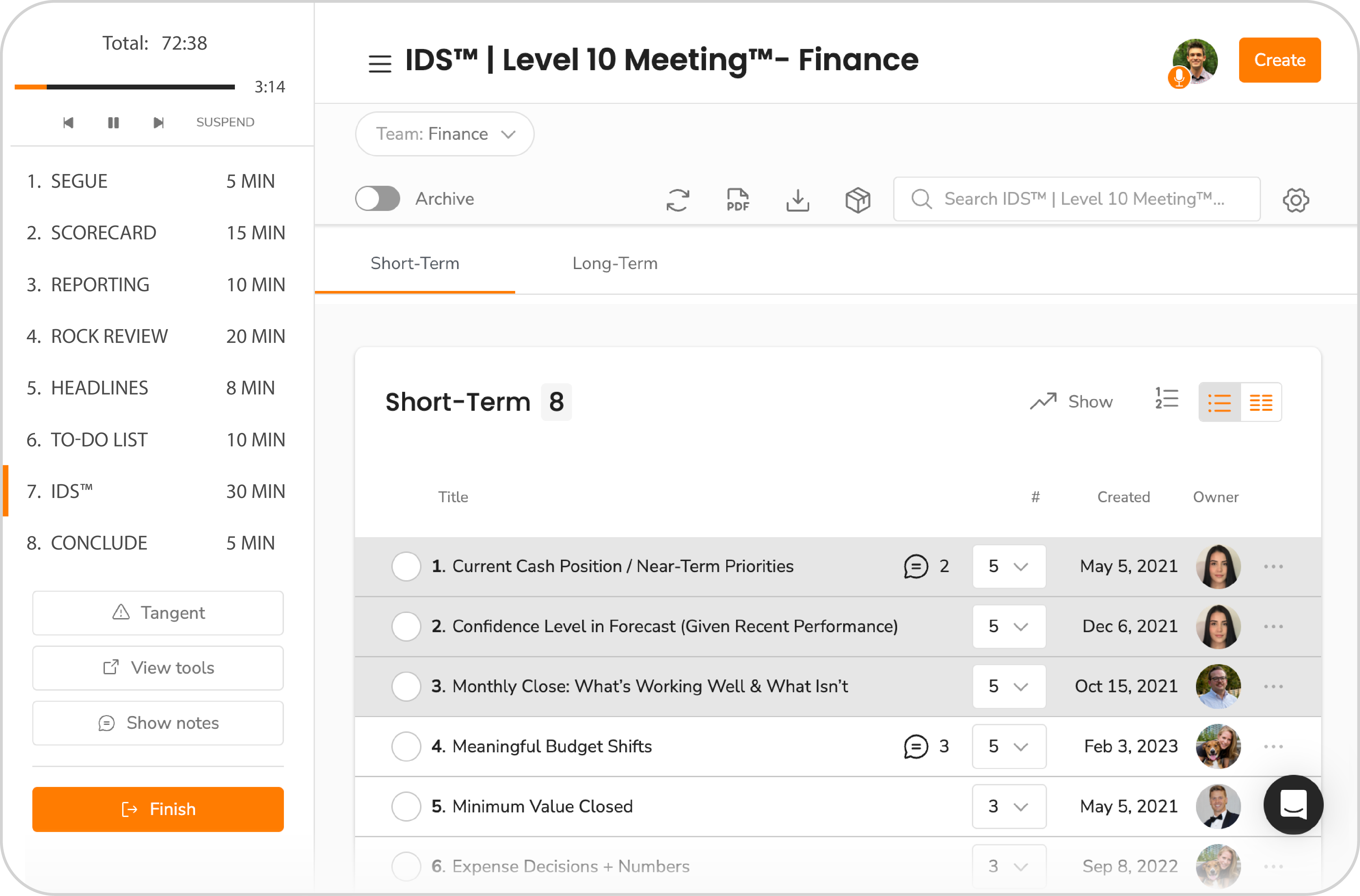
This is where a tool like Ninety does something your memory can't. On its own, a team will swear they’re dealing with brand-new issues every week. But the Issues List tells the truth. When you can look back over a quarter and see the same issue resurfacing under six different headings, the pattern is undeniable.
But seeing the pattern is only the first step. Ninety helps by tracking recurring issues and letting you merge the ones that are just the same problem showing up in different forms. That's the same exercise I ran with those 77.
From there, the work becomes human. The system can show you that something keeps resurfacing, but it can’t walk into the room and ask the Ops leader if he’s doing okay. That part is still yours. The value is that you’re no longer guessing at the pattern. You can see it clearly enough to deal with what’s actually underneath it.
Before Your Next L10™, Try This
If you suspect your team is riding on spare tires, do these four things before your next Level 10 Meeting®:
-
Pull your last quarter of issues from Ninety and read them in one sitting. Don't try to solve anything. Just look for the same issue showing up in different forms.
-
For every issue, name it in one sentence and state the outcome you want. If you can't, you probably haven't identified the real issue yet.
-
For each recurring issue, ask whether it points to a common person or process. Around 8 out of every 10 issues is a people or process problem. By merging recurring issues in Ninety, you can solve it one time instead of addressing the same symptoms over and over.
-
Before you close anything, ask: Is this the spare tire or the new set? Be honest about which one you're choosing rather than letting the spare pass for a long-term solution.
Solving the Right Issues
That engineering team didn't need a better process. They already had a great one. What they needed was someone who was willing to ask the honest question and then sit in the silence long enough for the answer to surface.
Identifying issues is a skill, and like any skill, it gets better with reps. The more often your team slows down, names the issue clearly, and separates the short-term solve from the long-term solve, the easier it becomes to recognize the pattern before another spare tire gets mistaken for the fix.
That’s the goal: not to have fewer issues, but to get better at solving the right ones.



.jpg?width=500&name=large_Stuck_During_IDS_EOS_Blog_Header_1920_x_1080%20(1).jpg)
.jpg?width=500&name=large_Glenn_Goldney_EOS_Blog_Header_1920_x_1080%20(1).jpg)