


I was facilitating a Level 10 Meeting® with a client when we got to a customer issue on our Issues List. A sales problem had gotten serious enough that one customer had already told them they were leaving. The team needed to decide what to do next, who would own the follow-up, and how they were going to try to save the relationship.
Then the Visionary jumped in because he saw a bigger pattern. He started talking about things like product improvements, customer success strategy, and a better onboarding experience so this kind of issue wouldn’t happen again. And to his credit, all of those were good ideas, but they weren’t the right solve for that meeting.
I share this story in my book Meetings Kinda Suck because it shows how easily a weekly L10™ can get pulled away from execution. In this case, the team needed to deal with the customer in front of them, while the bigger ideas needed to be captured on the Long-Term Issues List and addressed in Quarterly or Annual Planning.
Over the years, I’ve seen a lot of leadership teams face some version of this same situation. Both the short-term issue and the long-term issue are valid, but when they get mixed together in the same conversation, neither one gets solved.
Every issue needs a home, and the right home depends on whether you’re trying to win the week, the quarter, or the year. Let’s talk about how to use Short-Term and Long-Term Issues Lists to keep your meetings focused on solving the right things at the right time.
I wrote Meetings Kinda Suck because too many good teams are losing hours to meetings that don’t solve anything. Check out the book if you want a practical guide to making meetings fewer, better, and more worthy of your time.
.png?width=1000&height=620&name=MKS_Mid_Blog%20(1).png)
What You’ll Learn
-
How to decide whether an issue belongs in a Level 10 Meeting or Quarterly or Annual Planning
-
How to separate short-term issues from long-term issues without dismissing either one
-
How IDS® keeps teams focused on solving issues instead of circling the same topic
-
How to redirect mistimed issues without shutting people down
-
How Ninety can help teams capture, sort, archive, and solve issues with more discipline
What’s the Difference Between Short-Term and Long-Term Issues?
Short-term issues are about what needs attention now: a Scorecard number is off track, a Rock is blocked, a customer needs an answer, a broken process is slowing the team down. Think about it this way: If the issue could keep the team from winning the week, it probably belongs on the Short-Term Issues List.
Long-term issues work differently. These are the bigger questions about where the business is headed, how the team is structured, whether there’s enough capacity, or what needs to change before the next quarter or year. These issues matter, and sometimes they matter a lot. They just need a different kind of conversation than the weekly Level 10 Meeting can provide.
The mistake is treating every issue like it has the same clock attached to it. A topic can be important and still not belong in this week’s meeting. A Visionary’s idea can be valuable and still need to live on the Long-Term Issues List until Quarterly or Annual Planning.
That distinction protects the team. It keeps the weekly meeting focused on execution without losing the bigger ideas that could shape the future of the business.
What Belongs in a Level 10 Meeting?
The purpose of the Level 10 Meeting is to help the team win the week so they can win the quarter. The Short-Term Issues List should support that purpose.
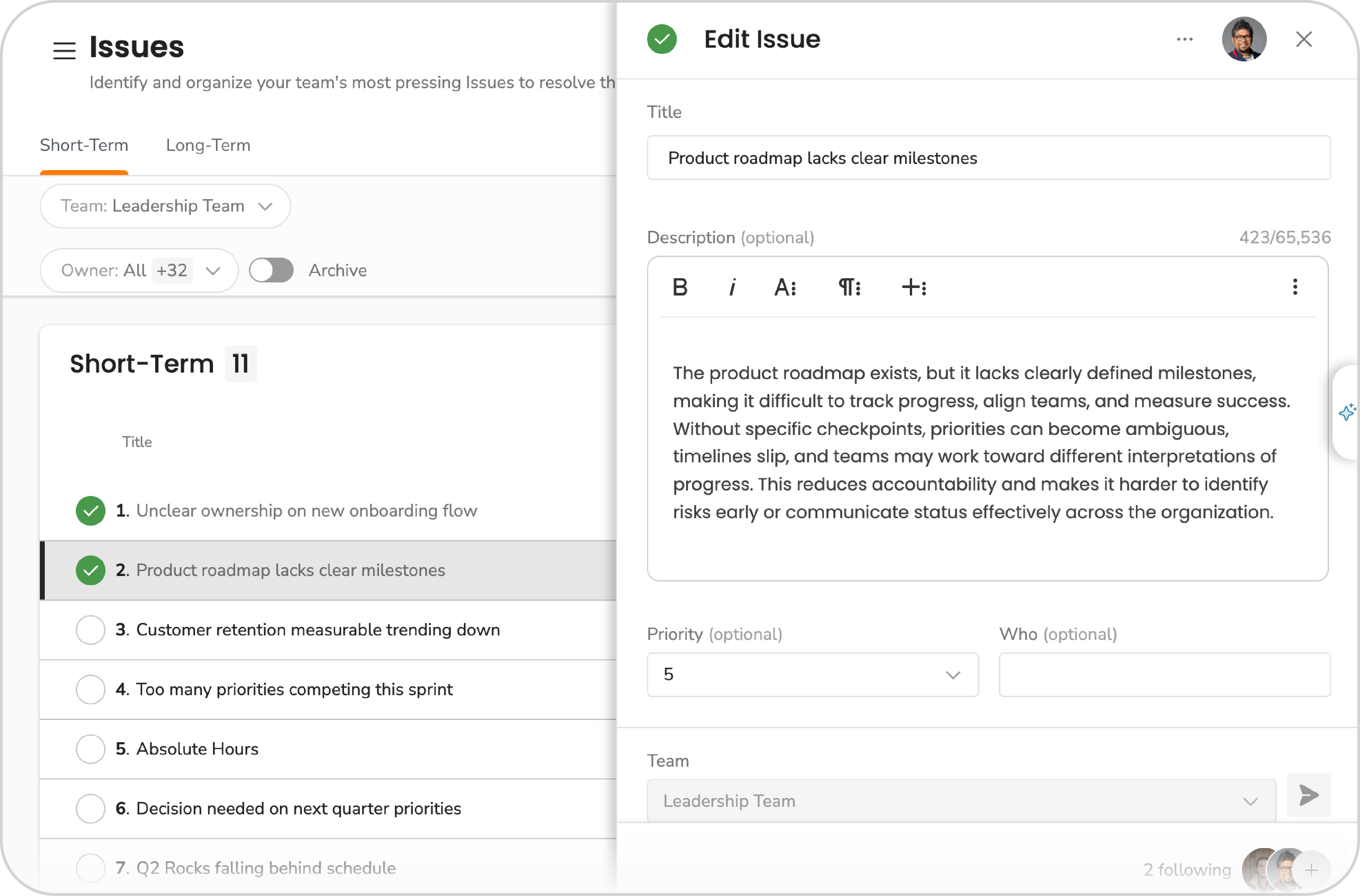
The issues you should focus on in your L10 should cover what is urgent or important for current execution. The team should prioritize the top issues (in Ninety, we rate these on a scale of 1–5 so the team knows right away what issues on the list are highest priority), IDS the ones that matter most, and create To-Dos so next steps are documented and followed through on.
Use these filters before adding or selecting an issue for the Level 10 Meeting:
-
Does this affect this week or this quarter? If the answer is yes, it belongs in the Level 10 Meeting.
-
Is it connected to a current Rock, Scorecard number, To-Do, or customer concern? If the answer is yes, keep it close to weekly execution.
-
Can we make progress with the people in this meeting? If the right people aren’t involved, create a To-Do to get them in a meeting together where you can address it.
-
Do we need a decision, owner, or next step soon? If the answer is yes, it’s probably a short-term issue.
-
Would solving this help us win the week? If the answer is no, it may belong on the Long-Term Issues List.
This discipline keeps the Level 10 Meeting from becoming a catchall. The goal isn’t to discuss everything on the list, and it isn’t to reward whoever brought the loudest topic. The goal is to solve the most important issues that are affecting execution right now.
What Belongs in Quarterly or Annual Planning?
Quarterly and Annual Planning are where teams step back and work on the business at a higher level. These meetings are built for long-term issues because they give the leadership team enough time to think, debate, decide, and align.
Long-term issues usually show up as bigger business questions, not quick weekly solves. They might tackle questions like:
-
Should we restructure the Sales team?
-
Do we have enough leadership capacity for next year?
-
Should we enter a new market?
-
Is our pricing model still right?
-
Do we need to revisit our 3-Year Picture?
-
Are we building the right leadership bench?
-
Should this become a Company Rock next quarter?
In many cases, they are the most important conversations the business needs to have. They just don’t belong in the middle of the weekly Level 10 Meeting.
Long-term issues can be exciting, and the team may want to jump in right away, but discipline protects execution. The team needs a way to capture the idea without letting it take over the meeting.
That helps everyone. The idea isn’t lost, the person who raised the issue knows it will be addressed, and the team can stay focused on the issues affecting this week’s execution.
How Does IDS® Keep Issues from Taking Over the Meeting?
IDS® stands for Identify, Discuss, and Solve. It’s a three-step process, and it’s one of the simplest and most powerful disciplines in EOS because it gives the team a clear path from issue to decision:
-
Identify comes first: The team needs to get clear on what’s actually going on. “Sales are down” may be the symptom, but the real issue could be lead quality, pricing, sales process, team capacity, or follow-up discipline.
-
Discuss comes second: This is where healthy conflict belongs, but the conversation needs boundaries. The team should be testing ideas, adding perspective, and working toward a decision instead of repeating the same comments.
-
Solve comes third: The solve may be a decision, a To-Do, a clear owner, or a commitment to bring back better information next week. The key is progress, not another round of thinking without any ownership.
A simple way to sharpen IDS is to clarify four things before the team starts talking:
-
Who owns the issue? Every issue needs an owner who cares enough to bring it forward and help move it toward resolution.
-
Who needs to be involved? If the right person isn’t part of the meeting, assign a To-Do for the right people to talk first.
-
What are we actually solving? The team should be able to state the issue clearly enough that everyone understands what’s being solved.
-
What outcome do we need from this meeting? The team should know whether the goal is to make a decision, assign research, create a To-Do, or move the issue to another meeting.
This is where teams build the decision-making muscle. They slow down long enough to get clear on the real issue, then use that clarity to drive a better conversation and a better solve.
How Do You Keep the Right Issues in the Right Meeting?
The facilitator’s job is to protect the purpose of the meeting without making people feel dismissed. That takes courage, especially when the person pulling the meeting off course is a founder, Visionary, or senior leader. A good redirect is practical, not personal. That sounds like:
-
“That’s worth capturing, and I think it belongs on the Long-Term Issues List.”
-
“Are we still solving the original issue, or did we move to a new one?”
-
“Let’s capture that as a separate issue and finish the one we selected.”
-
“This sounds bigger than today’s meeting, so let’s put it on our Long-Term Issues List to tackle in Quarterly Planning.”
-
“What decision do we need before we leave this conversation?”
Ninety helps teams keep the Issues List from turning into a memory test. When an issue comes up, the team can capture it, decide which meeting it belongs in, and use IDS to move it toward a real solve. If the same topic keeps coming back, the archive gives the team a way to see the pattern and decide whether it belongs in a bigger planning conversation.
Ninety’s Tangent button can also help teams redirect more easily. It gives people a low-risk way to flag that the conversation may be off track. Then the facilitator can check in and decide whether to continue, redirect, or capture the new issue for later.
It doesn’t replace discipline, but it does make the redirect easier, clearer, and less dependent on one person having to call it out.
How Do You Put This Into Practice Before Your Next Meeting?
Before your next Level 10 Meeting, spend a few minutes cleaning up the Issues List. Don’t wait until the meeting has already started to decide what belongs where.
Ask these questions:
-
What needs to be solved this week? Keep these issues on the Short-Term Issues List for the Level 10 Meeting.
-
What affects current Rocks or Scorecard numbers? Keep these issues close to weekly execution unless they require deeper planning.
-
What belongs in Quarterly or Annual Planning? Move strategic, structural, capacity, and future-focused issues to the Long-Term Issues List.
-
What keeps coming back without getting solved? Review the archive, identify the patterns, and decide whether the team is dealing with a bigger issue.
-
What can be deleted because it’s no longer relevant? A clean Issues List creates better focus and better conversations.
Short-term issues and long-term issues both matter. The discipline is putting each issue where it can actually be solved, then using IDS® to move the team forward.
When every issue has a home, the Level 10 Meeting can do its real job. Good ideas get captured, bigger questions get saved for the right planning session, and the team stays focused on solving what matters now. That’s how the business builds the discipline to win the week, the quarter, and the year.




.jpg?width=500&name=large-Solve_the_Issue_Afraid_EOS_Blog_Header_1920_x_1080%20(1).jpg)