
.jpg)

The same name kept appearing on the Issues List. Quarter after quarter, my client's leadership team would surface this employee, acknowledge the performance gap, offer reasons why now wasn't the right time to act, and table it for another day.
After watching this cycle repeat for the third consecutive quarter, I finally asked a question they'd all been avoiding: "What do you owe them?"
The team looked at me blankly. I pressed, "This person keeps coming up, but you won't make a change. I suspect you feel you owe them something. Until we understand what you think you owe them, we can't have an honest conversation about what that obligation is actually costing the greater good of this company."
And for the first time in three quarters, they started talking about it.
Why Avoiding People Issues Hurts Your Team
This same pattern plays out in leadership teams everywhere. Everyone knows who the problems are. But when tenure, personal history, or a vague sense of loyalty enters the room, logic tends to exit.
When you protect a chronic underperformer, you aren't being kind. You're asking your best people to subsidize mediocrity. Every deliverable that falls to a colleague, every cultural compromise made to keep the peace, that's the "tax" your high performers pay so you can avoid a difficult conversation. What a lot of leaders don't realize is that your tolerance is a decision, and it's one that actively punishes your best people, including yourself.
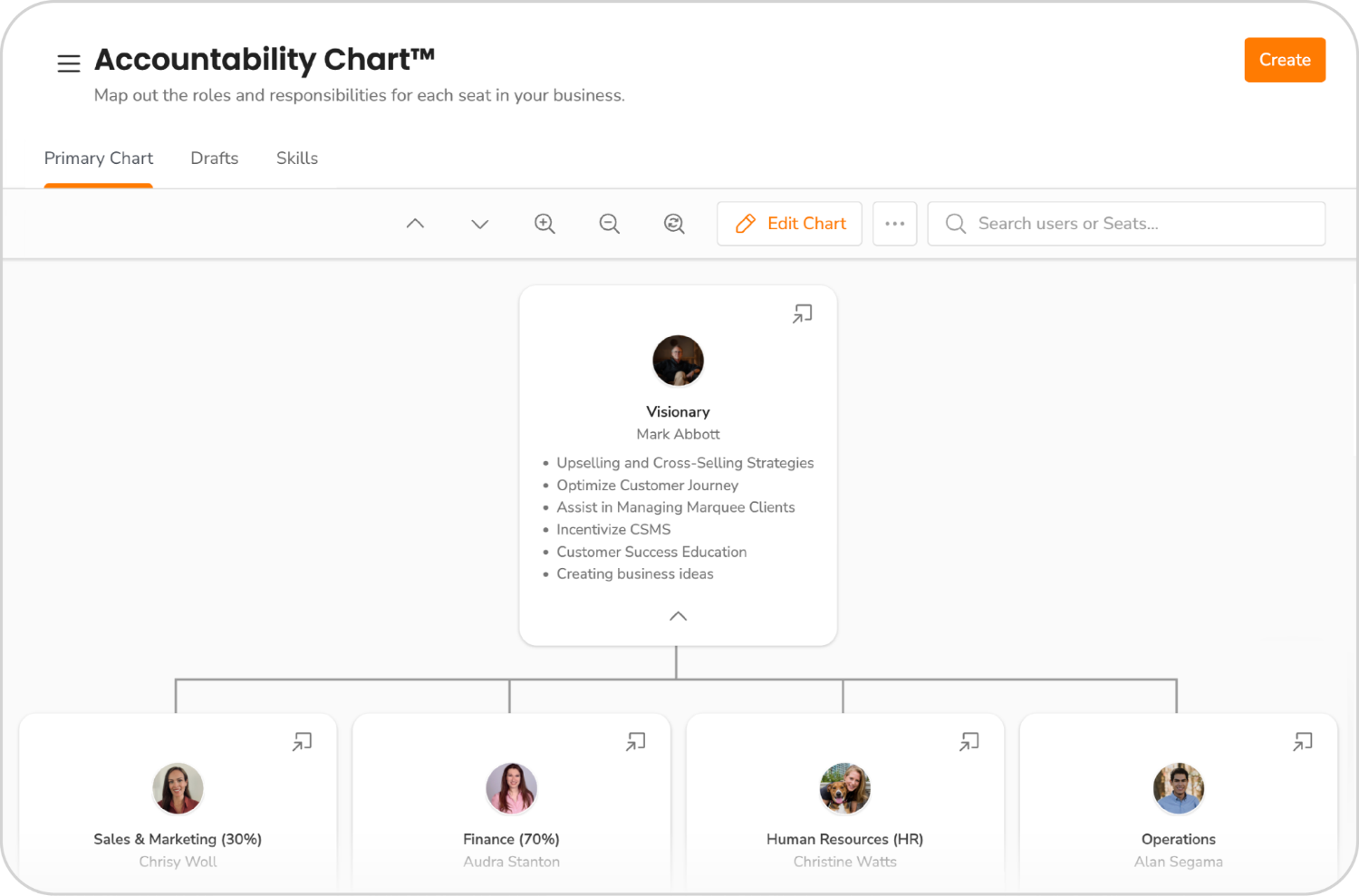
The fix starts with clarity, not emotion. In EOS®, we use The Accountability Chart® to establish exactly who owns what. It's not an Org Chart. It's an ownership map. Every Seat must have five clear roles and exactly one owner, because two owners means zero owners. The goal is to build the structure the business needs first, and then look at the people you have to fill those Seats.
Many self-implementing teams stumble here. They design around personalities and settle for comfort, then wonder why execution suffers. Ninety makes this dynamic. It connects those five roles directly to Rocks and Scorecards so "doing your job" is a matter of objective data, not subjective interpretation.
See how Ninety turns accountability into clarity. Ninety’s Accountability Chart tool helps teams define Seats, clarify ownership, connect roles to Rocks and Scorecards, and see where accountability is working or breaking down.
Using GWC® to Solve People Issues
Once the structure is right, it's time to use The People Analyzer® to strip away the noise of tenure and loyalty. We look for a Core Values fit, then we ask three binary questions:
-
Do they Get it?
-
Do they Want it?
-
Do they have the Capacity to do it?
In EOS, we call this GWC®. And for all three of the questions, the answer is plain and simple: Yes or no. If the answer to any of those is "No," a change needs to happen. Either the person rises up, or they move out. The goal is to provide an objective view that lets you act on what you already know for the greater good of the business.
My client finally made the hard call. There was no drama and no hostile exit. They sat down, had an honest conversation grounded in The Accountability Chart, and parted ways amicably. Afterward, the leader told me: "I don't know why I waited so long." But I know why: They were waiting for permission to prioritize the organization over their own discomfort.
Now it's your turn. Pull up your Accountability Chart in Ninety and run the GWC test on any names that you see on your Issues List. Because the people who genuinely want to do their jobs aren't afraid of accountability. They're waiting for you to provide it. Getting the right people in the right seats is your job.
Next Steps for Your Team
- Audit your company's structure: Is your Accountability Chart built around what the business needs, or around the people you currently have? Define the five roles each Seat must own, then confirm that every Seat has exactly one name on it. Two owners means zero owners.
- Run The People Analyzer: Look at anyone who has appeared on your Issues List more than once. Score them against your Core Values, then run GWC: Do they Get the role? Do they Want it? Do they have the Capacity to do it? Cultural fit plus role fit gives you the full picture. Log it in Ninety so the decision is driven by data, not discomfort.
-
Make a decision, not a discussion: If the same name has been on your Issues List for two consecutive quarters, stop tabling it. Bring The People Analyzer scores to your next Quarterly and commit to a path, whether that's a coaching plan, Seat change, or parting ways. The right people in the right seats aren't afraid of this conversation. They're waiting for you to have it.



.jpg?width=500&name=large_Team_Health_EOS_Blog_Header_1920_x_1080%20(1).jpg)