


I walked out of one of my own team's meetings once. Just the one time, and I never had to do it again.
It was our Marketing meeting. Everybody seemed relaxed and ready to roll. I sat down, took one look at the Issues List they'd brought, and said, more or less, "Is that it? I've got more important things I could be doing. That isn't a list you need me for. If this is how we're preparing, I don't need to be here. Good luck to you." And I left.
I only ever had to do it once because they got the point right away: If that's the deepest level of thinking we're going to bring, we probably don't need that meeting at all. It never happened again.
I tell that story because it gets at something I believe about the weekly Level 10 Meeting®: the most important part isn't the Scorecard, and it isn't the Rock review. It's IDS®. IDS is also the part most teams get wrong, and it starts with what they bring into the meeting.
IDS Is About Behavior
IDS seems simple enough. Identify the issue, discuss it, solve it, then move on to the next one. That simplicity is part of what makes the tool so effective, but it can also give teams a false sense of confidence. Knowing the steps doesn’t mean a team is doing the work well.
The harder part is what happens inside each step. Are people willing to say what they believe the issue really is? Are they willing to talk about the behavior connected to it? And once the team reaches a decision, is everyone prepared to commit to what comes next?
That’s why IDS is more than a process to follow. It tests whether your team will tell the truth under pressure. Every one of those three letters gives a team the chance to choose comfort over honesty, and when IDS starts breaking down, it usually happens well before anyone gets to “Solve.”
Identify: Naming the Wrong Issues
Most teams think they're good at the Identify step because they can fill a list with issues. But describing what happened isn’t the same as figuring out why it keeps happening. “The report was late again” tells you what happened. The issue is whatever behavior keeps producing the late report, and that usually has a person’s name attached to it.
A team that gets stuck in Identify will generate a long, busy list and never once put a behavior on it. Everything stays at the level of tasks and processes because tasks and processes are safe to discuss. The moment you have to say "this is about how someone on this team is showing up," the identifying stops.
Discuss: Agreement Isn't Commitment
The Discuss step is where I see the most damage, and it's the most convincing kind of damage because it can look like success.
A team talks through an issue, heads nod, and everyone agrees on a path. It feels resolved, but agreement is easy to get when everyone's in the same meeting. Commitment is what's left three weeks later when nobody's watching and the work gets hard. Plenty of teams mistake the warm feeling of agreement in the moment for the harder thing, which is a real commitment that survives contact with a busy week.
If the same issue comes back after everyone "agreed," the discussion didn't fail because people were confused. It failed because agreement was the most anyone was willing to give.
Solve: The Step That Exposes Everything
By the time you reach Solve, the quality of your outcome is usually already decided. If Identify was weak, you’re solving the wrong issue. If Discuss didn’t get the team to clarity, Solve won’t save you. This is the point where you find out how well you actually did the work.
A good Solve creates a clear decision, action, or change that makes the issue go away. A weak Solve gives someone a To-Do, creates a little sense of progress, and gets everyone on to the next issue. Then, a couple of weeks later, it’s back.
That’s why I say the recurring issue is the most honest metric in your meeting. It's telling you, week after week, exactly where your IDS is breaking down. You just have to be honest enough to recognize it and disciplined enough to do something about it.
How Ninety Can Help
Even a team that runs a genuinely honest IDS can fall off track once the meeting ends. Commitments get made, and as the week gets busy, follow-through gets pushed aside. It's not because people don’t care. It's because the day-to-day takes over.
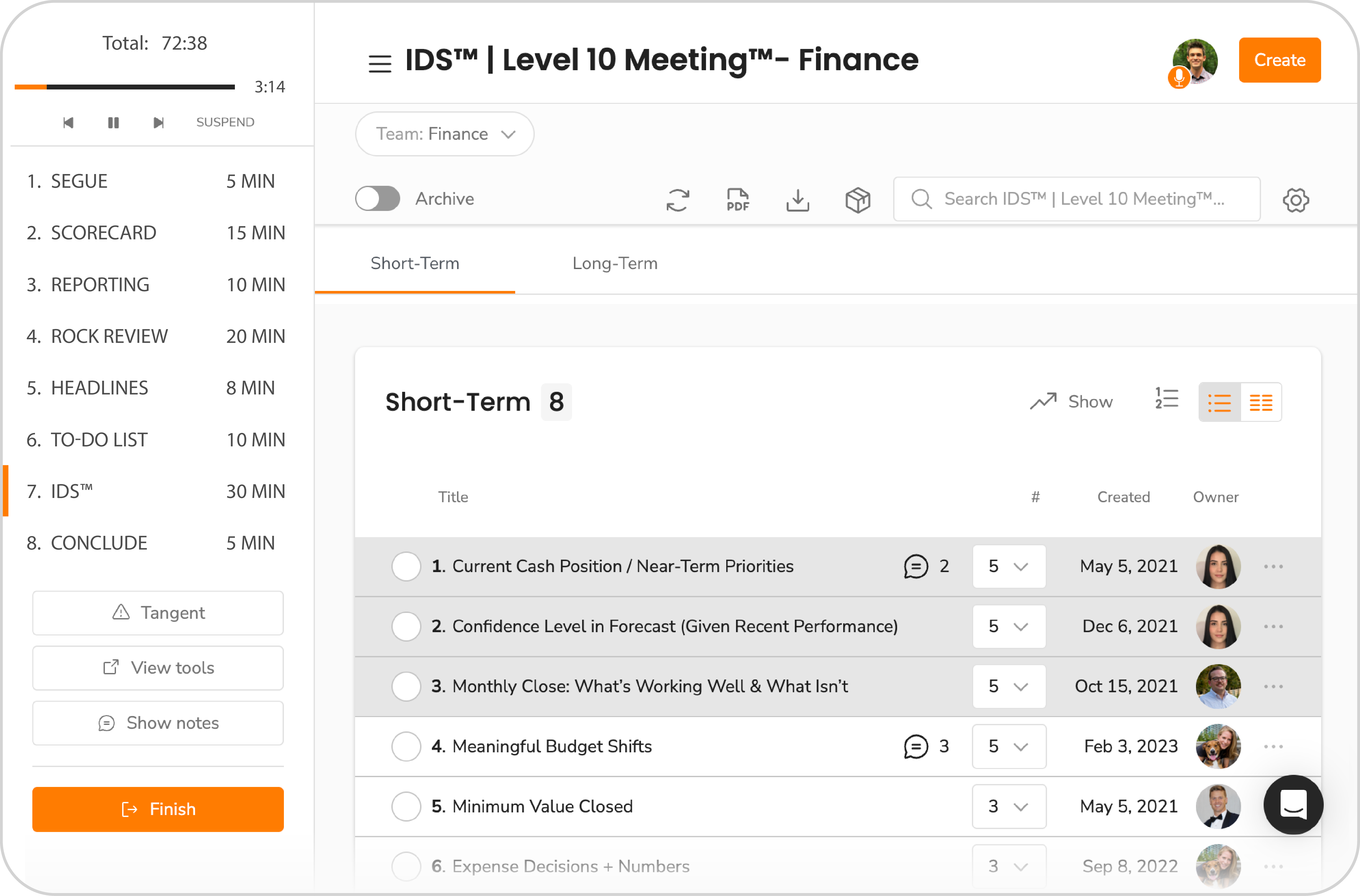
This is the part I lean on Ninety for. When you solve an issue and it produces a To-Do, that To-Do has an owner and a due date, instead of living in someone's memory. When an issue comes back again, the Issues List shows you that, which means you can't just pretend the last solve worked. Ninety won't have the hard conversation for you, and it shouldn't. But it does remove every excuse for letting a commitment disappear. It keeps your team honest between meetings, which is exactly where honesty usually goes to die.
How to Run an IDS That Keeps Issues Solved
If your IDS keeps producing repeat issues, spend more time looking at the behavior that keeps creating them:
-
At Identify, keep digging until you get past the task and into what’s really causing the issue. If someone’s behavior is part of it, put that person on the Issues List. A list that never includes people may be avoiding some of the harder issues.
- At Discuss, be clear about whether the team is agreeing or committing. Ask directly: “Are we agreeing, or are we committing?” Those are different outcomes, and teams usually know when they’ve stopped short of commitment.
-
Before moving on to new issues, look back at what was solved the week before. Use Ninety’s Issues List to see what was closed and whether the same issue is showing up again. If it is, the team may have solved the immediate problem without addressing what keeps causing it.
Why IDS Needs to be Protected
I walked out of my own meeting that day because I'd rather have no IDS than a meeting that could have been an email. A meeting full of safe issues isn't neutral. It teaches your team that the harder things stay off the list, and before long, that becomes the way the meeting works.
The opposite can be learned too. When a team sees one important issue get raised, discussed honestly, and solved, confidence starts to build. People become more willing to bring forward the issue they were holding back. The meetings get better because the team has proof that IDS can lead somewhere.
That’s the standard to protect. IDS should help a team get to what's getting in the way, make a decision, and leave with clarity about what happens next. When teams do that consistently, issues stop piling up and your weekly meeting becomes a place where true progress gets made.
Hear more from Sue Hawkes and Spencer Williams on why teams hold back during IDS® and what leaders can do to get the real issues out in the open. The webinar is available inside Ninety, and you can access it with a free trial if you don’t already have an account. Listen Now


