
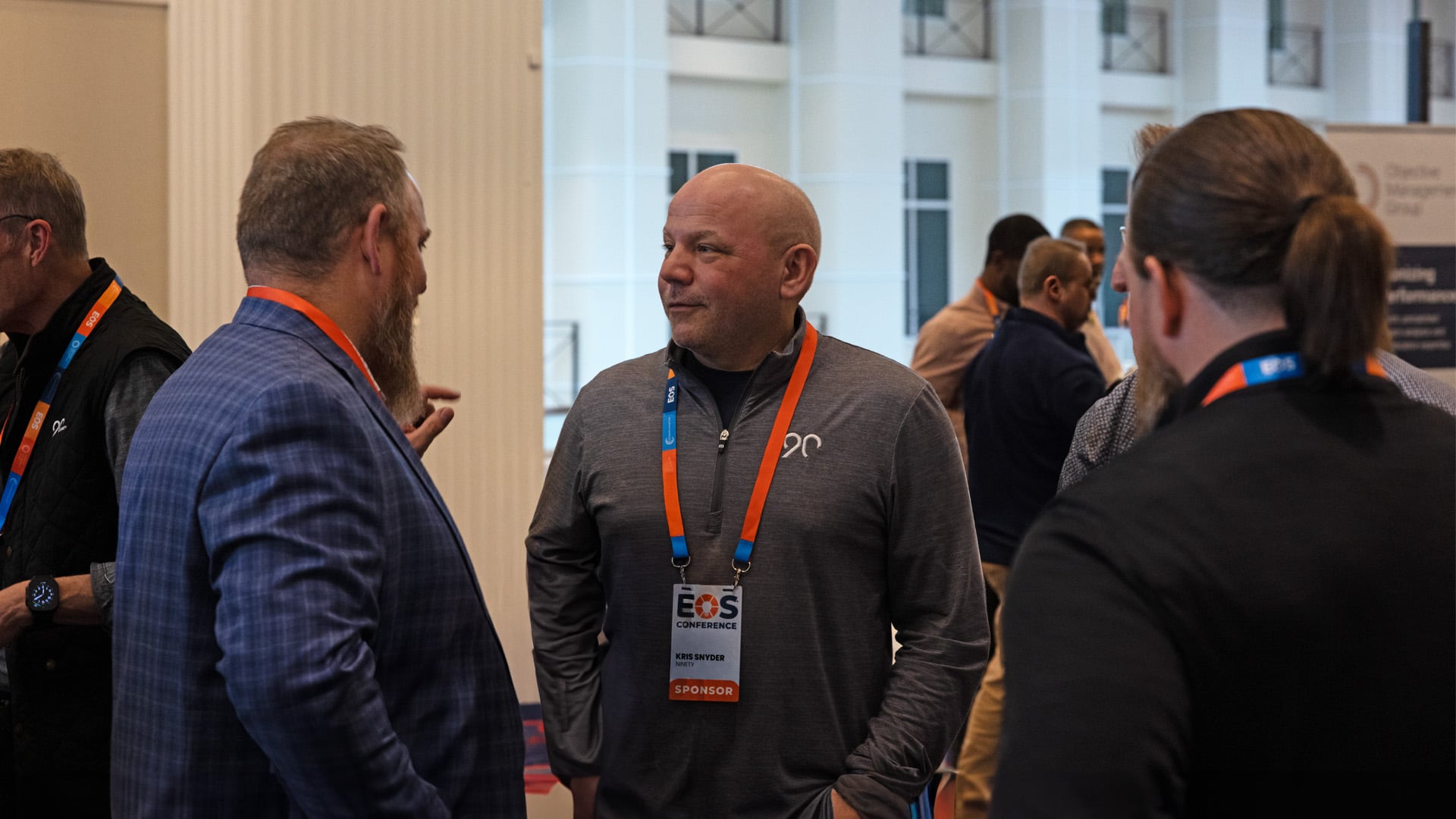

EOSCon is an annual conference for entrepreneurial leaders and teams running on EOS®. At this year’s event, Mark Abbott, founder of Ninety, and I asked over 160 business leaders, Visionaries, and Integrators a simple question:
What’s the biggest issue with your meetings?
The answers were honest: communication, accountability, hiring, role clarity, lack of processes, Visionary bottlenecks, taking on too much at once, and more.
That honesty points to something most leadership teams already know but don’t always say out loud: Your meetings expose the bigger issues your company is facing.
When a team walks into a Level 10 Meeting®, every issue shows up with them, whether it’s unclear ownership, tension with other team members, or weak execution. But when an L10™ is run the right way, it gives that same team a disciplined place to create clarity, solve issues that are holding them back, and ultimately move the business forward.
That’s one of the reasons why I wrote Meetings Kinda Suck. I don’t believe meetings are the enemy. Bad meeting habits are the enemy. When teams use meetings for updates instead of decision-making, when they avoid solving the real issues, or when they leave without knowing who owns what, the meeting starts to feel like the problem. But most of the time, the meeting is just revealing the problem.
That’s what showed up in their responses. They weren’t just naming annoying meeting habits. They were identifying the deeper breakdowns that make their meetings feel wasteful.
The good news is that broken meetings are fixable. It all comes down to more discipline. When you have a strong operating rhythm, clear ownership, and a team willing to solve what’s really getting in the way, meetings finally become useful again.
Let’s walk through five reasons your meetings aren’t creating Traction® and how you can get on the right track so your meetings don’t feel like a waste of time.
.png?width=1585&height=769&name=EOS_Word_Jumble%20(1).png)
1. Decisions Aren’t Communicated Across Teams
This is one of the most common meeting issues teams face because we often confuse discussion with communication.
A decision gets made, but no one clearly owns sharing that decision with everyone it affects. The team assumes everyone who needs to know will hear about it somehow. Then a few days later, another department is working from old information, a team member is surprised by a change, or the same issue shows up again because the message never made it beyond the meeting.
The fix needs to start in the meeting. Before leaders move on, they need to decide who will communicate the message, who needs to hear it, and what needs to be said.
Before your next meeting ends, slow down and ask three simple questions:
-
What decisions did we make?
-
Who needs to know?
-
Who is responsible for communicating them?
This is where Ninety helps take your meetings to the next level. You can turn next steps into To-Dos with one owner and a clear due date. You can also use Cascading Messages to share key decisions with the right teams. That way, decisions don’t get lost after the meeting ends. They get communicated, tracked, and followed through on.
Good meetings don’t just help teams make decisions. They make sure those decisions turn into clear communication so the right people know what changed, why it changed, and what they need to do next.
2. Accountability Isn’t Clear
Most teams say they want stronger accountability across their teams, but far fewer make it part of their weekly rhythm.
Here’s what usually happens: Someone misses a deadline, a Rock is off track, or a To-Do doesn’t get done. Everyone knows it, but nobody wants to make it a big deal, so the team moves on and hopes it gets handled later.
That feels polite in the short term, but it creates a bigger problem over time. People start wondering whether commitments actually matter. Strong performers get frustrated, and low performers take advantage of knowing the team will keep accepting excuses instead of expecting follow-through.
The fix starts with cleaner ownership and clear due dates. Every To-Do needs one owner and one due date. Every Rock needs one owner and a clear deadline. Every measurable needs one owner who is accountable for knowing the number. Not a department, not a group, and not “we.” One person.
Then the team has to review commitments every week. That doesn’t mean shaming people. It means telling the truth about what’s done, what’s not done, what’s on track, and what needs to be solved.
Accountability should feel clean, not personal. If the owner is clear and the commitment is clear, the conversation gets easier. You’re not attacking a person. You’re looking at a commitment someone already agreed to own.
3. Wrong People, Wrong Seats
A meeting can’t outperform the people who are there. That can be hard for leaders to admit, especially when there’s history with the team. Some people helped build the company, took risks, wore every hat, answered calls at night, and made it possible for the business to get where it is now. That loyalty is real. But loyalty can’t replace fit.
Across more than 150 EOSCon responses, the pattern was clear: teams are wrestling with hiring, people, right people in the right Seats, and Seats outgrowing leaders.
The truth is the person who was perfect for one stage of the business may not be right for the next stage. That’s a normal challenge growing companies face. That doesn’t make them bad. It just means the Seat changed, the business changed, or the capacity the Seat requires is now different.
When a wrong person or wrong Seat issue isn’t addressed, the meeting absorbs the tension it creates. Issues don’t get solved, decisions get revisited, other leaders compensate, and the founder gets pulled back into the details.
So when you suspect a wrong person and/or wrong Seat issue, it’s time to revisit GWC®. Here are the questions I’d ask:
-
Does this person live our Core Values?
-
Do they Get the role?
-
Do they Want the role?
-
Do they have the Capacity to do the role well?
-
Would we enthusiastically rehire them for this Seat today?
The last question is the one leaders try hardest to avoid. If the answer is no, don’t build a workaround and call it leadership. Use The People Analyzer® and revisit The Accountability Chart® so you can have the conversation with both clarity and care.
4. The Founder Becomes the Bottleneck
The EOSCon responses called this out in a few different ways, including, “Founder won’t let go of the vine” and “Founder is the bottleneck.”
A lot of meeting breakdowns start with the founder. I say that with respect because founders are the reason the company exists in the first place. They see opportunities and possibilities early, carry the business through messy seasons, and make decisions before anyone else has enough context.
That ability is a gift, but at some point, it can also become a constraint. Because if every meaningful decision has to run through the founder, the team slows down. Leaders stop fully owning their Seats, people have to wait longer for approval, and the founder gets frustrated that everything keeps coming back to them.
The fix is clarity around both role responsibilities and decision-making. The Accountability Chart should make it clear who owns what. (Note: As your company grows, it’s important to revisit the chart because structure has to change as the business evolves.) Once the owner is clear, the founder has to step back and let that owner lead.
A simple meeting rule helps: The Seat owner speaks first.
Let them define the issue, explain what they recommend, and let the team pressure-test the path forward. Founders scale by building leaders who can think, decide, and execute without waiting for permission on every move. And if the founder can’t trust those leaders to own the work, that’s a different issue to solve.
5. Lack of Discipline
The EOSCon responses around focus and follow-through pointed to a clear discipline issue. Leaders named problems like “pivoting too quickly,” “taking on too much at once,” and chasing “shiny things.”
This pattern is the simplest and maybe the most common. The meeting has no discipline so the team keeps mistaking activity for progress.
I’ve seen it all over the years: People show up late. The agenda changes every week. Scorecard numbers aren’t updated. Rocks aren’t reviewed with honesty. Issues get discussed in circles.
Then people say the meeting is a waste of time. I’d challenge that because it’s the lack of discipline that’s the problem, not the meeting itself.
When a Level 10 Meeting is run the way it was designed, it gives the team a rhythm: Every week, same day, same time, same agenda, same expectations. That structure creates efficiency and effectiveness because the team doesn’t have to invent how it meets every week.
To run a better weekly meeting, start with the basics:
-
Start on time, even when someone is missing.
-
Update and review the Scorecard every single week.
-
Mark Rocks on track or off track without over-explaining.
-
Keep updates short enough to leave time for IDS®.
-
End with clear To-Dos, owners, and dates.
-
Rate the meeting before everyone leaves.
This is another place Ninety helps teams stay on track. When you run your Level 10 Meeting® in Ninety, the agenda includes built-in timers for each section so the team can see where they’re falling off track. If you burn too much time on updates, there’s not enough time left to solve the issues that actually need attention. Ninety helps protect that time by keeping the agenda visible, the sections timed, and the team focused on running the meeting the way it was designed.
More discipline doesn’t make meetings rigid. It makes them more useful. When the rhythm is clear, the agenda is consistent, and the team respects the time, the weekly meeting becomes a tool for Traction® instead of another calendar obligation.
Better Meetings Start With Better Habits
What stood out at EOSCon was how quickly leaders could connect their meeting frustrations to deeper issues. They weren’t just complaining about bad meetings. They were naming the places where clarity, ownership, and discipline had broken down.
If you resonated with any (or all) of the issues on this list, it doesn’t mean your team is broken. It just means you need a stronger way to work together, especially as the business gets more complex and the old habits stop serving the next Stage of Development.
The goal isn’t to get rid of meetings. It’s to stop tolerating meetings that don’t create clarity, accountability, and progress. Start with one common breakdown from this list. Name it with your team, adopt one new habit to help fix it, and keep practicing until it becomes part of how you operate.
Effective meetings don’t happen just because the team blocks off 90 minutes. They happen because the team uses those 90 minutes to tell the truth, make decisions, and follow through. Do that consistently, and your meetings become one of the strongest tools you have for building Traction®.
If this topic is hitting home, stay connected with us. We regularly share practical guidance for teams running on EOS® through our newsletter, YouTube channel, LinkedIn, and Instagram.


.jpg?width=500&name=large_Lead_World-Class_EOS_Blog_Header_1920_x_1080%20(1).jpg)