
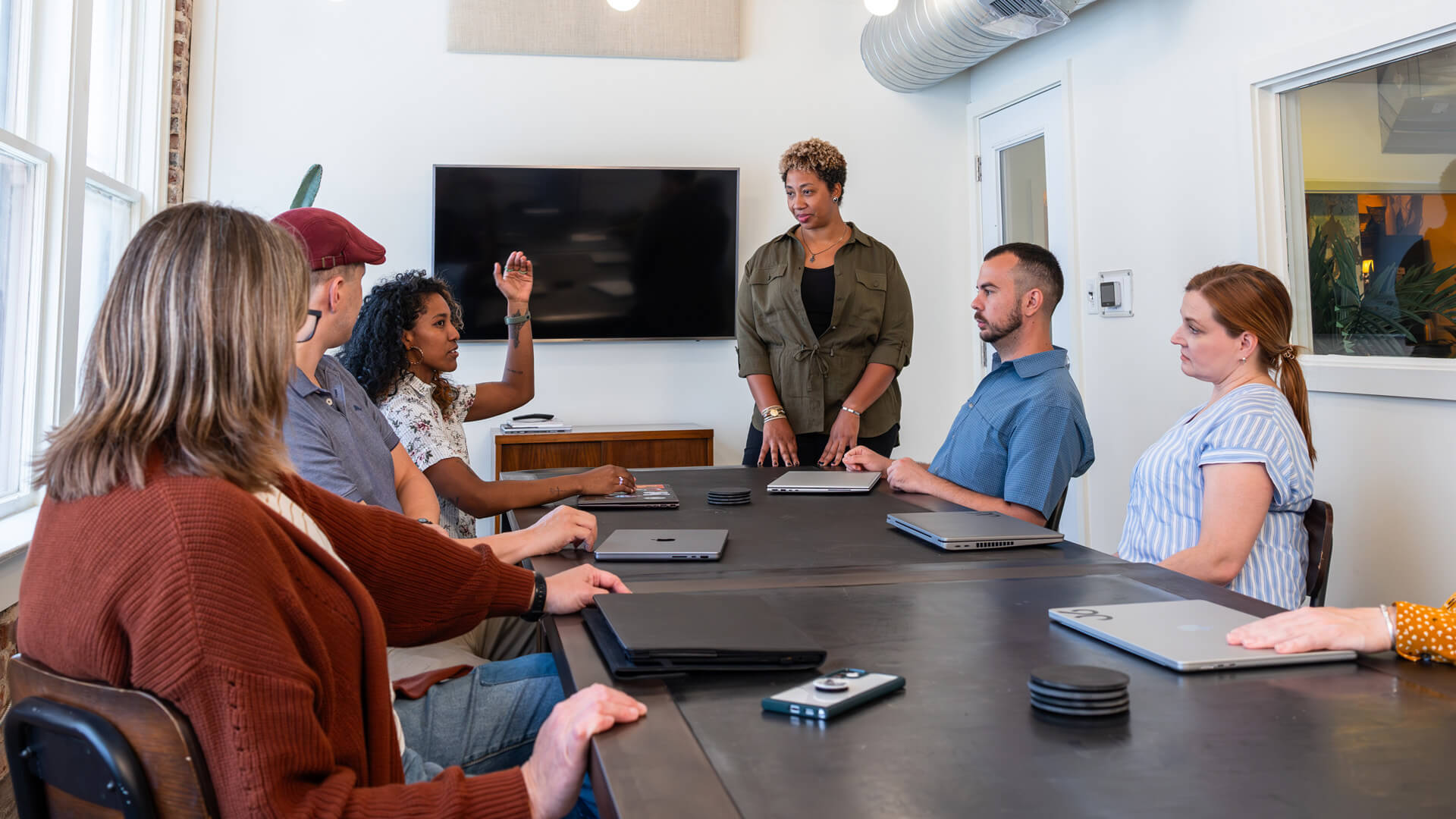

Before I worked on a team that ran on EOS®, weekly team meetings felt like a formality. We showed up, we talked about the work, and then went back to our own agendas.
The conversations were fine and people genuinely cared, but the pattern rarely shifted. We would share updates, vent about our frustrations, and then return to our desks to face the same unresolved problems. And the truth is, those meetings didn’t really do anything to help move our week forward. They were more like a casual check-in with one another midweek and a chance for the extroverts in the group to socialize.
When I joined a team that started running Level 10 Meetings in Ninety, I saw the true purpose of a standing weekly meeting and how powerful it could be. Instead of being a place where we caught each other up on things that had already happened, it became the one place where we looked at the truth, made decisions together, and adjusted priorities as a department.
Before joining a team that ran L10s, I never knew how productive and helpful meetings could actually be. But now I know that when you run your weekly team meetings the way EOS® is designed, they stop feeling like a formality and become the one time each week where your team connects to make decisions, solve real issues, and move the right work forward.
How Level 10 Meetings Are Different
The first time I sat in a Level 10 Meeting® at Ninety, I could tell right away this was not another “go around the room and share updates” kind of meeting. The format looked simple, but it was far more intentional than anything I had experienced at previous companies.
We followed the same agenda every week inside Ninety. There was a set time for each part: a quick Segue, a look at the Scorecard, a fast Rock review, any important Headlines, and then the Issues list. I could see the entire agenda on my screen, along with our Scorecard, Rocks, Issues, and To-Dos, all documented in one place. Instead of everyone showing up with their own idea of what the meeting was for, the agenda and layout in Ninety made it clear why we were there and what we were trying to accomplish together.
The biggest difference is what happens after the updates. In my past weekly meetings, once everyone had shared their status, the conversation usually wandered. We might talk about a few pain points or brainstorm ideas, but it often turned into venting or tangents that took up more time than they needed to.
In a Level 10 Meeting, the updates are just the starting point. The real work happens when we move into the Issues list and start to identify, discuss, and solve the issues that are holding us back (we call this IDS®). We rank the issues to make sure we get to the most pressing ones first, talk them through, and then decide what we’re actually going to do about them. There’s no hypotheticals or venting. Just real talk and real solutions. We make decisions together about how to move forward, turn them into clear To-Dos for people on the team, and capture it all in Ninety where everyone can see them and be held accountable.
That’s what makes these meetings feel so different to me. They aren’t just a pause in the week to talk about how things are going. They’re real working sessions that help my team sort through what’s in the way and take action. We’re actually getting things done, and it feels good to leave and know we're taking steps in the right direction.
Adjusting Our Week Inside the Level 10 Meeting
One of the biggest shifts I noticed once I started sitting in Level 10 Meetings was how much easier it became to adjust what my team was working on during the week. Instead of waiting for the end of the month or quarter to realize something was off, we had dedicated time to catch it sooner.
The Scorecard plays a huge role in that. At the start of every Level 10 Meeting, we walk through our weekly measurables. Each one has an owner and a target. It doesn’t take long at all, and it gives us a really honest view of how things are actually going. When a number is off, we see it right away and know that’s going to be a priority for this week.
For example, I work in marketing, and if we notice our traffic or lead numbers are off for a couple of weeks, we don’t just hope they recover on their own. We talk about what changed, adjust the plan for upcoming campaigns or content, and make sure someone on the team owns the next step.
Our quick Rock review adds another layer. We each give a quick “on track” or “off track” update for our Rocks. There’s no long story or excuses in that moment, just a clear status. If one of our Rocks is off track, we drop it to the Issues list so we can talk about what needs to change for that Rock to move again.
That simple routine forces us to look at what’s working, what’s not, and what needs to be reset every single week. It helps us shift timelines and priorities. Sometimes it leads to adding or changing milestones for a Rock so they reflect what we now know. Other times, we’re reassigning ownership, resetting agreements, or deciding that a project needs to move out of this quarter altogether so we can stay focused on what matters most right now.
Instead of carrying a vague sense that something is off, I know there’s a specific time where we’ll look at the numbers, talk honestly about progress, and adjust together. It keeps us aligned and makes it so much easier to course-correct before small problems have the chance to grow.
.png?width=3000&height=1919&name=Rocks_EOS_Screens%20(1).png)
Advancing the Work Through the Level 10 Meeting
Having the ability to adjust our plans as a team is important, but the purpose of our L10s isn’t just to fix what’s off or react to problems. There’s also real value in moving work forward and continuing to set new goals and achieve them. It’s about creating steady momentum so we keep building on what we’ve already accomplished.
A big part of this comes from how we follow through in the Level 10 Meeting. When we review To-Dos in Ninety at the start or mark a Rock as complete, it’s not just to check a box. It’s a simple way to remind ourselves of the work we’ve done so we can think about what’s next. It gives us a real sense of progress and naturally leads to, “Okay, what’s the next step now that this is finished?”
Sometimes finishing a To-Do around a process change means we’re ready to roll it out to another team. Other times, wrapping up a Rock prompts us to talk about what that completed work makes possible. If we launch a new initiative, we ask what it allows us to improve next. If we build a new system, we talk about the next piece we want to strengthen. Those conversations inside the Level 10 Meeting help us see our work as a series of connected steps rather than a collection of one-off projects.
Over time, this naturally changes the way you think about progress. Instead of treating each week as a standalone sprint, our weekly meetings together help us connect the dots between what we just finished, what we’re doing now, and what we’re aiming for next. We’re not just keeping things from getting stuck. We’re also using that time to keep advancing the work, set new goals, and move forward together in a way that feels both sustainable and impactful.
How You Can Use Your Level 10 Meeting® to Adjust and Advance Each Week
If your Level 10 Meetings still feel more like update sessions than working sessions, you don’t need to rebuild everything. Small tweaks in how you prepare, what you bring into the meeting, and how you follow through can make the L10 a much stronger tool for helping your team adjust and advance each week.
Here are some actionable steps you can start using right away:
-
Drop real issues into Ninety during the week, not just during the meeting: Any time something feels stuck, confusing, or off track, add it to your team’s Issues list in Ninety right away. By the time you get to your L10, you’ll have a real list of what’s in the way instead of trying to remember everything in the moment.
-
Prep your Scorecard and Rocks before you walk in: Take a few minutes before the meeting to update your measurables and review your Rock progress from that week. Decide where you need help or input. Come ready to say, “This is off, here’s what I’m seeing, and here’s what I think we should talk about.” That alone makes the Scorecard and Rock review more useful and keeps the conversation honest.
-
Help the team prioritize the right issues: When you rank issues, push the team to focus on the ones that will unblock Rocks or impact key measurables. Ask, “If we only have time to solve one or two issues today, which ones will help us make the most progress?” That’s how you use the meeting to advance the work that actually matters.
-
Push IDS all the way to clear solutions: During IDS, notice when the conversation starts looping or drifting into side topics. Bring it back to, “What’s the real issue?” and “What are we actually deciding?” Make sure every solved issue ends with a concrete next step, an owner, and a due date captured as a To-Do in Ninety.
-
Use your To-Dos to shape your week, not just fill it: Treat the To-Do list in Ninety as your short-term execution plan, not just a recap. If To-Dos keep rolling from week to week, talk about why in the L10. Do they need to be broken down, delegated, or tied more clearly to a Rock or measurable? Fixing that pattern is one of the fastest ways to turn good discussion into real movement.
Take it slow. Even if you only lean into one or two of these each week, your Level 10 Meeting will start to feel less like a recurring calendar event and more like what it’s meant to be: the place where your team regularly adjusts together and keeps advancing the work that makes a difference.
.png?width=3000&height=1919&name=To-Dos_EOS_Screens%20(1).png)
Turning Your Level 10 Meeting® Into Real Progress
When I think about the meetings I used to sit in and the Level 10 Meetings I’m part of now, the biggest difference is this: We’re not just talking about the work anymore. Instead, we’re using that time to adjust and advance together. We have a set place and time every week to see what’s on track, what’s not, and what needs to change. And we walk away from every meeting knowing exactly what each of us is responsible for before we meet again.
Sure, we still have busy seasons and plenty of unexpected work, and that’s not going away. But a strong L10 keeps us from living in constant reaction mode. We’re making adjustments before issues get too big to solve, and we’re setting and achieving new goals on purpose. Ninety helps us keep everything visible so we’re always on the same page with each other.
If your team’s already running on EOS, I promise leaning fully into the Level 10 Meeting is one of the most practical ways you can break through the ceilings you’re hitting. When you use that time to tell the truth, solve real issues, and turn decisions into To-Dos in Ninety, you walk out knowing you did more than talk about the work. You set your team up to move the right things forward.
Try Ninety free now to run your Level 10 Meetings, Scorecard, Rocks, Issues, and To-Dos in one simple place. You’ll quickly see how much easier it is to adjust together and keep the right work moving forward.


.jpg?width=500&name=large_Employee_Performance_Goals_EOS_Blog_Header_1920_x_1080%20(1).jpg)