
.jpg)

"Select new project management software" sits on the Issues List, again, for the fourth consecutive week. The leadership team continues to discuss it during IDS® (Identify, Discuss, Solve) but somehow never reaches resolution. The conversation covers the same ground—budget concerns, integration challenges, and team buy-in. The discussion runs long, eating into time for other issues, and ends with the familiar refrain: "Let's research some more and revisit next week."
Meanwhile, project managers drown in spreadsheets, deadlines pass, and the best PM just gave their two-weeks notice. This scenario haunts leadership teams running on EOS®. The very tool meant to drive accountability, the weekly Level 10 Meeting® (L10), has become an exercise in postponement.
When Your L10 Becomes a Groundhog Day Meeting
You've implemented the Level 10 Meeting agenda. You religiously work through your Issues List. You follow the IDS process. Yet somehow, the same issues keep appearing week after week.
The frustration is palpable — that sinking realization that you're not actually solving any issues, you're just discussing them. The Issues List keeps getting longer while your team's confidence in the process fades. The weekly L10, designed to create Traction®, starts feeling like a treadmill.
The problem isn't the EOS tools. It's that teams often jump to discussing solutions without first understanding what's really blocking progress. They're solving issues in a vacuum, disconnected from the actual work happening on the ground.
The Compound Cost of Unresolved Issues
When your Issues List becomes a parking lot for deferred decisions, the damage multiplies:
- The 90-Minute Meeting Myth crumbles: L10s stretch to two hours as unresolved issues pile up.
- Rocks get off track: Team members can't hit quarterly Rocks when blocked by delayed decisions.
- Accountability disappears: When To-Dos consistently roll over, the entire system breaks down.
- Meeting ratings plummet: Teams start scoring L10s as 5s and 6s, a clear signal the meeting isn't creating value.
And the most damaging part? Your team loses faith in EOS itself. They start skipping L10s or just going through the motions without expecting real progress.
The Pattern-Breaking Moment
The wake-up call often comes during a quarterly session when you realize half your Rocks are off track, all blocked by unresolved Issues. Or when a team member finally explodes mid-meeting, asking, "Why do we keep discussing the same things without deciding?"
For one leadership team, it came when their EOS Integrator™ calculated they'd spent 12 cumulative hours across four L10s discussing the same software issue, which is more time than implementing any solution would take.
That's when leadership teams realize they're using IDS to discuss issues, not solve them. What They need to surface real obstacles before they hit the Issues List.
The Three-Question Ritual That Transforms Your IDS
The solution isn't abandoning EOS. It's enhancing your IDS process with a simple check-in ritual. During the Issues Solving segment of your meeting, before diving into discussion, have each leadership team member answer these three questions:
- What are the three most important things you're working on this week?
- What obstacles are getting in your way?
- How can the leadership team help?
This 10-minute investment will transform your IDS from theoretical problem-solving to practical obstacle removal.
Why This Check-In Works
- It connects Issues to Rocks: When your VP of Sales says her top priority is hitting this quarter's revenue Rock and her obstacle is the delayed software decision affecting her team's efficiency, suddenly that lingering Issue has urgency and context.
- It surfaces root causes: Often what lands on your Issues List are symptoms. When you ask about obstacles, you discover what's really blocking progress. That "software selection" issue might actually be about unclear decision authority or budget constraints.
- It creates collective accountability: When someone asks "How can we help?" in front of the entire team, everyone becomes invested in removing that obstacle.
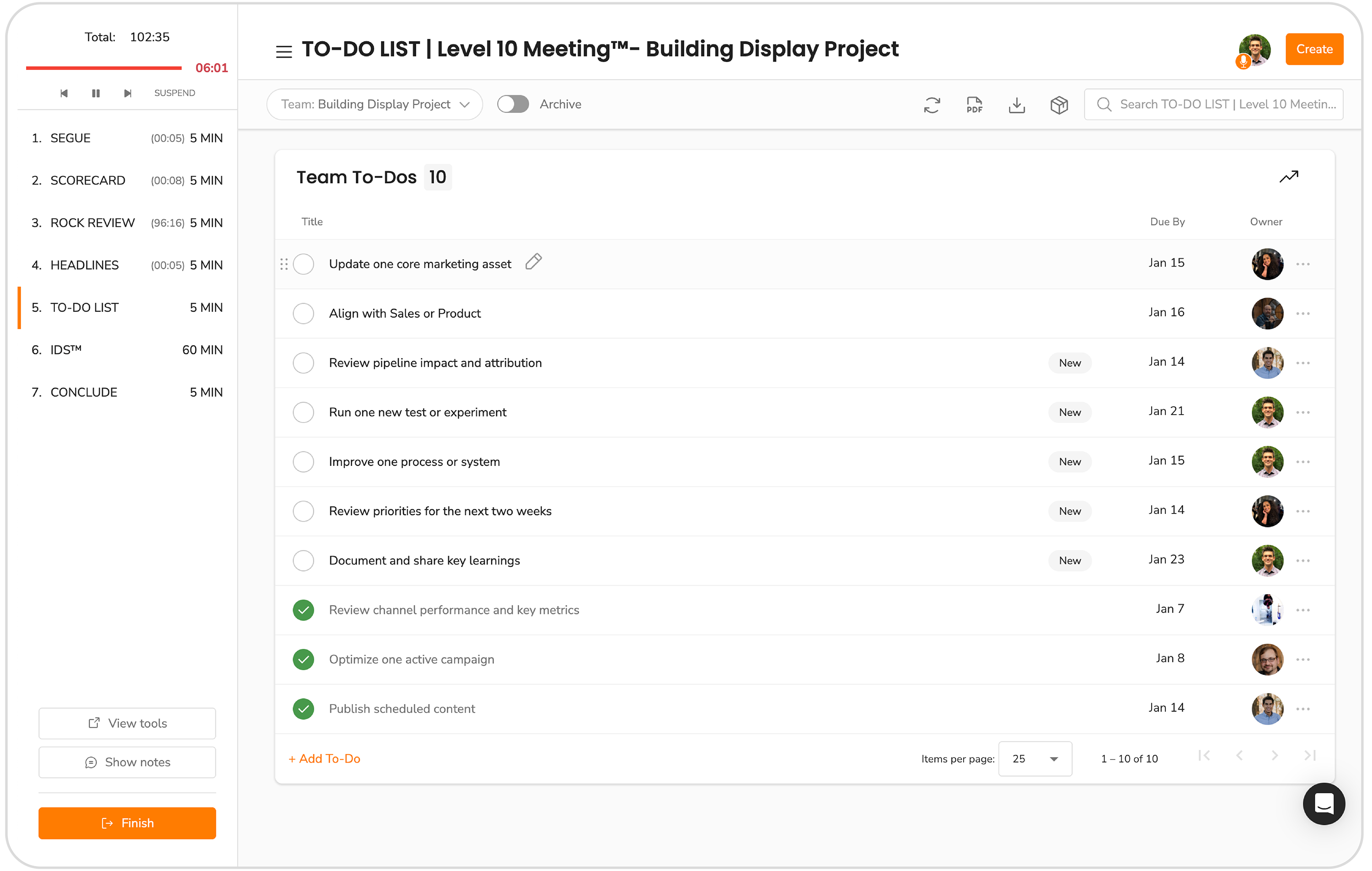
How to Implement This in Your Next L10
Here's are three simple steps to help you start the check-in ritual this week:
Step 1: Introduce the Ritual
At the beginning of your next Issues Solving segment, explain that you're testing a new approach. Before diving into the Issues List, spend 10 minutes on the three-question check-in.
Set clear expectations from the start. Keep answers brief (2 minutes per person, max). Focus on obstacles requiring leadership team help. This isn't just a status update. It's a way to identify obstacles.
Step 2: Capture Obstacles as Issues in Real-Time
As obstacles surface, add them directly to your Issues List if they're not already there. The difference is now they come with context. You know exactly how they're blocking this week's most important work.
This often reorganizes your priorities instantly. That software decision jumps to #1 when you realize it's blocking three team members' top priorities.
Step 3: Track Resolution Time
Start measuring how long obstacles remain unresolved once surfaced. In your meeting recap, note: "Software decision blocking Sales and Operations — must resolve by next L10."
This creates urgency. Next week, if that obstacle still exists, everyone knows you've failed to help with the most important work.
The Multiplier Effect
When leadership teams implement this ritual, the transformation is dramatic:
- Issues Lists shorten because they solve root causes, not symptoms.
- IDS time becomes more productive with clear context.
- L10 ratings jump from 6s to consistent 9s.
- Average issue resolution time drops from four weeks to one week.
That software decision lingering for over a month? It gets resolved in the very first enhanced L10. When the leadership team understands it's blocking three members' top priorities, the discussion shifts from "What are all our options?" to "What decision removes this obstacle fastest?"
This simple ritual doesn't replace EOS tools. It amplifies their effectiveness. Your L10 maintains its structure while gaining precision in obstacle removal. Teams develop "obstacle awareness," anticipating and raising blockers early. The Issues List becomes a dynamic tool for removing barriers rather than a static parking lot.
Your Next L10 Action Plan
Don't wait. In your very next L10:
- Reserve 10 minutes at the start of Issues Solving.
- Have each member share their three priorities, obstacles, and help needed.
- Add newly surfaced obstacles to your Issues List.
- IDS with new urgency, knowing exactly what's at stake.
Your team will immediately feel the difference. Issues become clear when tied to this week's real work. Decisions accelerate when everyone understands the cost of delay.
Remember: EOS gives you the framework, but you bring it to life. This simple check-in ritual could transform your L10 from a good meeting to a great one — and your leadership team from discussing issues to actually solving them.
Ninety helps leadership teams connect issues directly to the work that matters most so decisions don’t stall and Rocks stay on track. Try Ninety free now and experience L10s that create real momentum.


.jpg?width=500&name=large_To-Dos_Help_Teams_Build_EOS_Blog_Header_1920_x_1080%20(1).jpg)