
.jpg)

Most teams walk out of Annual or Quarterly Planning charged up. The plan makes sense, the priorities feel right, and the Rocks are achievable. There’s real alignment and optimism around what the next 90 days could deliver.
But for a lot of teams, those feelings change a few weeks later when they find that key Rocks are already behind, Scorecard numbers are starting to wobble, and conversations become reactive instead of intentional. Everyone’s constantly playing catchup, and instead of running the business, it feels like the business is running you.
That frustration is more common than most leaders want to admit, and when it shows up, it’s rarely from a lack of planning or effort. It’s from inconsistency.
Here’s the uncomfortable truth: Early-quarter chaos is almost never a planning problem. It’s a discipline problem. The leadership teams that launch each quarter strong protect one habit: a consistent meeting pulse, anchored by a weekly Level 10 Meeting®.
Let’s talk about why Traction® often breaks down early in the quarter and what disciplined leaders do differently to prevent it.
Why Does the Start of a Quarter Feel So Out of Control?
When it comes to strategic work during planning, a lot of leadership teams nail it. They come out with a solid plan and clear goals they believe will get them where they want to go. They have honest conversations around team health, strengths, weaknesses, opportunities, and threats. And when they leave, everything looks and feels good. Then the hard work of execution begins.
New information enters the equation. Customer issues arise that demand immediate attention. Hiring for key roles takes longer than expected. Operational challenges take more energy than planned. New opportunities appear that weren’t part of the original discussion. It’s only a matter of time before leaders start working around the plan instead of working through it.
That early-quarter loss of control isn’t random. Here’s what leadership teams have to accept: There will always be things that come up you didn’t expect. You can’t plan your way around reality, and you can’t see far enough ahead to prevent disruption.
This is exactly why EOS is designed as a complete operating system, not a planning exercise. The Six Key Components® exist to help leadership teams absorb disruption without losing focus. They create a way to process new information, surface problems early, and make decisions without abandoning the plan.
When those components are strong, unexpected issues get handled inside the system. But when they’re weak, execution becomes reactive and plans for the quarter start falling apart.
What Single Discipline Keeps the Quarter On Track?
There’s one clear separator between teams that maintain control through a quarter and teams that don’t. It isn’t the quality of the plan. It’s the consistency of the meeting pulse.
In a 90-Day World®, the most important leadership habit is the weekly Level 10 Meeting®. It’s a 90-minute meeting, held on the same day, at the same time every week, using the same agenda. Its job isn’t to create new strategies. It’s to protect execution.
When run as designed, the Level 10 Meeting anchors the entire quarter. Why? Because this single meeting ensures that Scorecard data is reviewed every week (not just when something feels off), that Rocks stay visible and actively discussed, and that To-Dos are clearly owned and followed through on. Most importantly, it gives the team time to Identify, Discuss, and Solve (IDS®) the most important issues instead of letting them linger until they become too big to resolve.
This is where a lot of leadership teams misjudge leverage. They assume the Annual Plan or Quarterly Plan will do the heavy lifting. But here’s the thing: Plans provide direction, but they don’t manage pressure. Habits do.
The L10 is where strategy becomes operational. It’s where accountability moves from an agreement to reality. And without this discipline in place, even strong plans struggle to hold together.
.png?width=7085&height=4500&name=Level_10_Meeting_Product_Shot%20(1).png)
How Do Leaders Turn the Level 10 Meeting into a Habit?
The Level 10 Meeting is simple by design, but it only works when leaders treat it as a nonnegotiable discipline. Like any habit that produces results, it requires clear decisions and consistent follow-through. Teams don’t “grow into” this habit by accident. Leaders build it on purpose.
To turn the Level 10 Meeting into a true habit, leadership teams must make three commitments:
- Lock the time and protect it: Schedule the Level 10 Meeting for the entire year on the same day and at the same time. Treat it with the same priority as a critical customer commitment. Travel doesn’t replace it. Competing priorities don’t override it. When leaders protect the meeting, the team learns that execution matters.
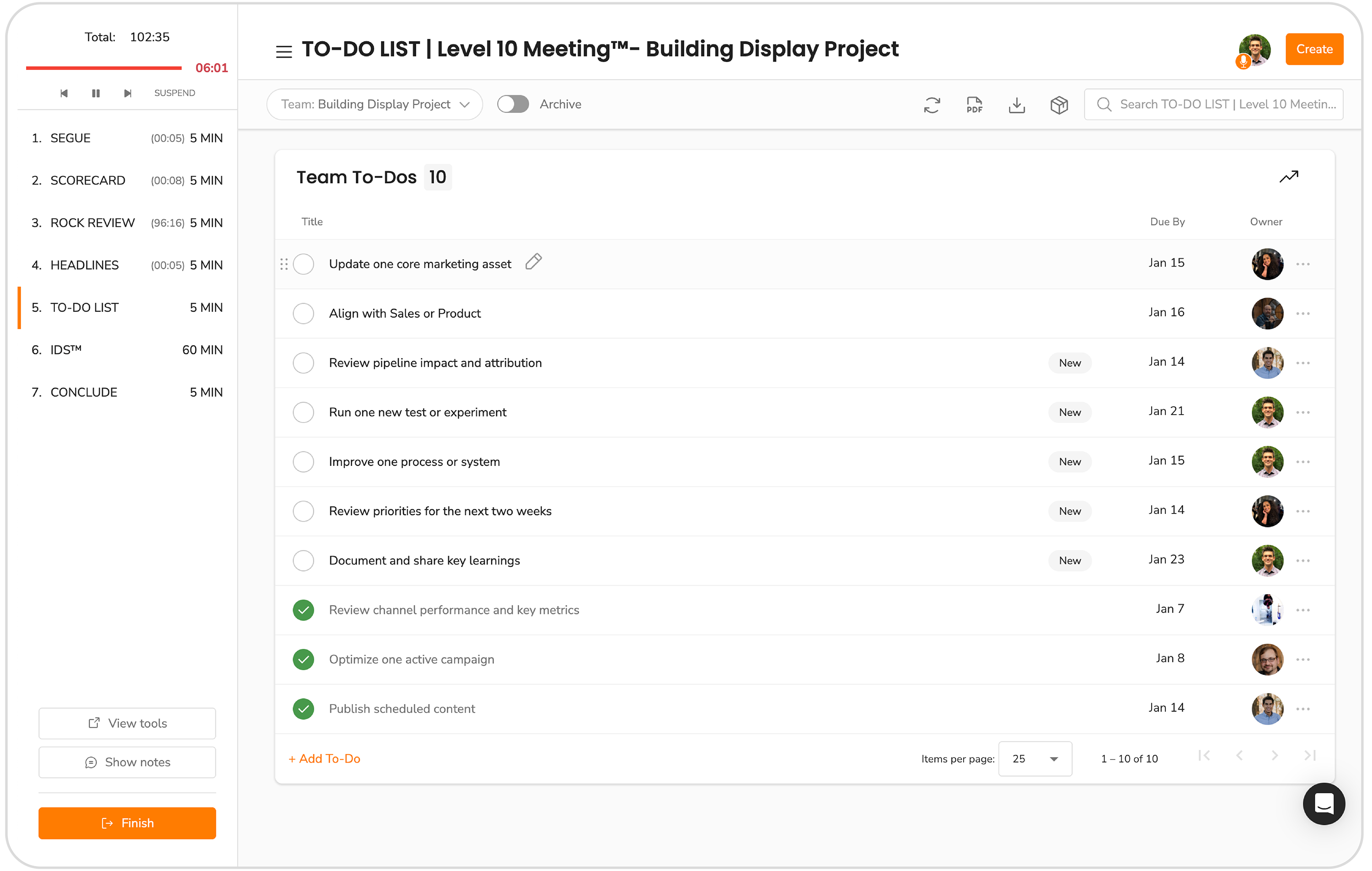
- Run the full agenda every week: The strength of the Level 10 Meeting comes from following the complete agenda: Segue, Scorecard, Rock Review, Headlines, To-Do Review, IDS®, and Conclude. Each section exists for a reason. Skipping steps weakens the discipline and teaches the team that structure is optional.
- Remove operational overhead: Leaders should spend their time making decisions, not managing tools. When teams run Level 10 Meetings in a platform like Ninety, Scorecards, Rocks, Issues, and To-Dos live in one place and move forward automatically. This keeps meetings focused on execution instead of administration.
When leaders hold these commitments, the Level 10 Meeting becomes part of how the business runs. Decisions get made where they belong. Issues get solved instead of left to linger. And most importantly, the quarter stays on track because leadership is applied consistently, every single week.
Restoring Control
When leaders fully commit to the weekly Level 10 Meeting, they see their business starts behaving differently. With dedicated time every week to ensure everything is on track, teams stop revisiting the same problems and start resolving root causes. Better decisions get made — faster. And the work keeps moving forward.
With a meeting pulse in place, leaders regain a real sense of control. They aren’t reacting to surprises or putting out fires as often. Instead, they’re guiding the business through a consistent operating cadence that supports focus, accountability, and follow-through. Over time, that discipline creates space for what EOS is ultimately about: doing meaningful work with people you trust, creating impact, and having time for life outside the business.
If you want every quarter to start strong, you need to make one clear decision: to run a true Level 10 Meeting® every week.
Choose the day and time. Put it on the calendar every week for the next 13 weeks. Align as a leadership team that it’s nonnegotiable. Commit to the full agenda. And set it up in Ninety so everything’s in one place. That’s how you’ll win this quarter and every one that follows.
Ready to commit to weekly Level 10 Meetings? Try Ninety to turn weekly discipline into consistent execution now.



.jpg?width=500&name=large_Accountability_Without_Micromanaging_EOS_Blog_Header_1920_x_1080%20(1).jpg)