
When Chris Finnecy, Founding Partner at TrellisPoint, first heard that his leadership team would spend 90 minutes in a meeting every week discussing issues, he thought the idea sounded crazy. They had a business to run. They had clients to serve. They had work to get done. How could carving out 90 uninterrupted minutes every week talking about the work instead of doing it possibly help?
Four years later, his view had completely shifted. In fact, his team became anxious when someone missed their weekly L10™ because the meeting had become one of the most valuable parts of their operating rhythm.
That’s what happens when a Level 10 Meeting® is run with discipline. It’s not there to fill the calendar or just share updates with the rest of the team. It’s there to help solve the issues that matter now and create accountability every single week.
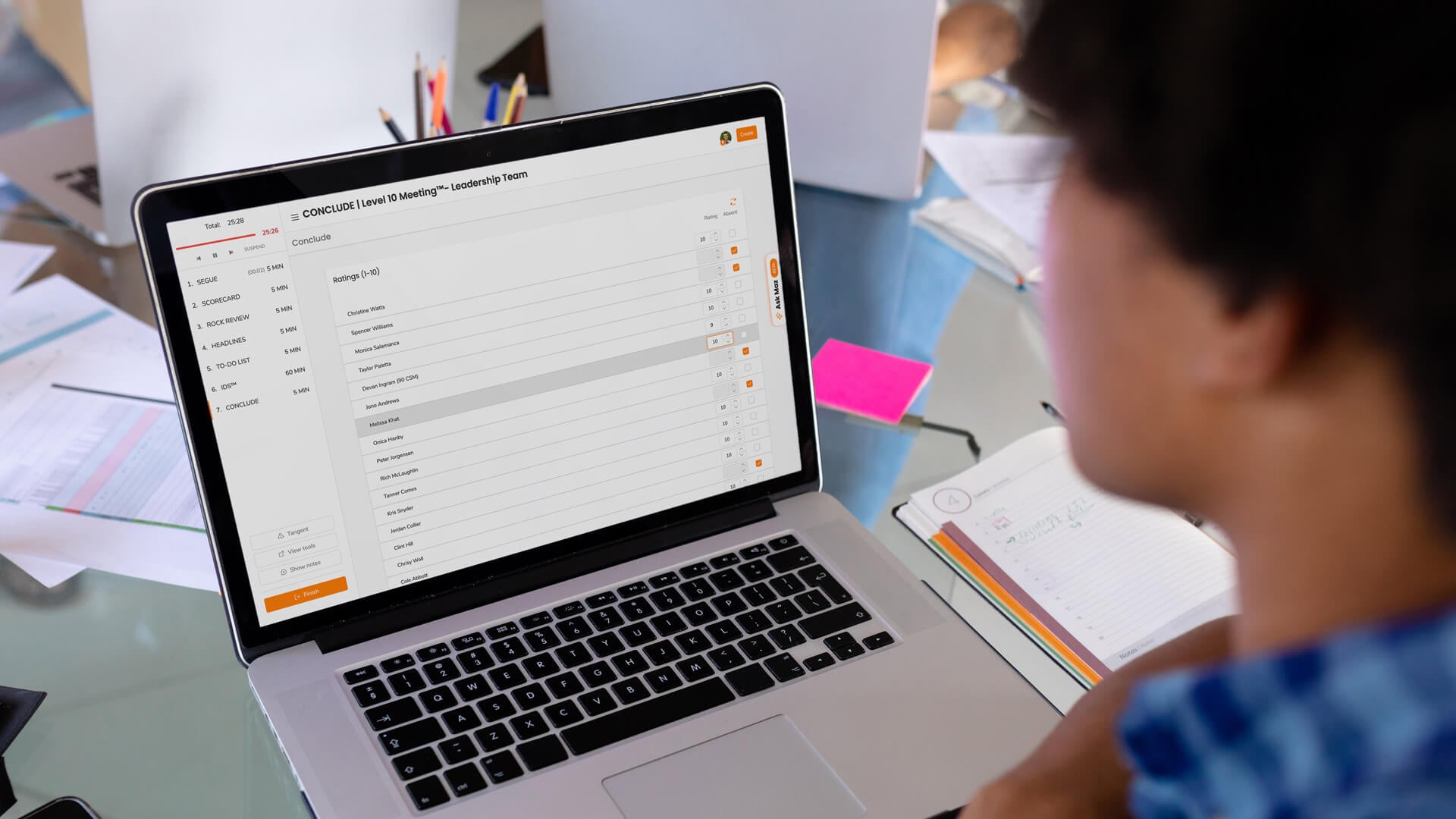
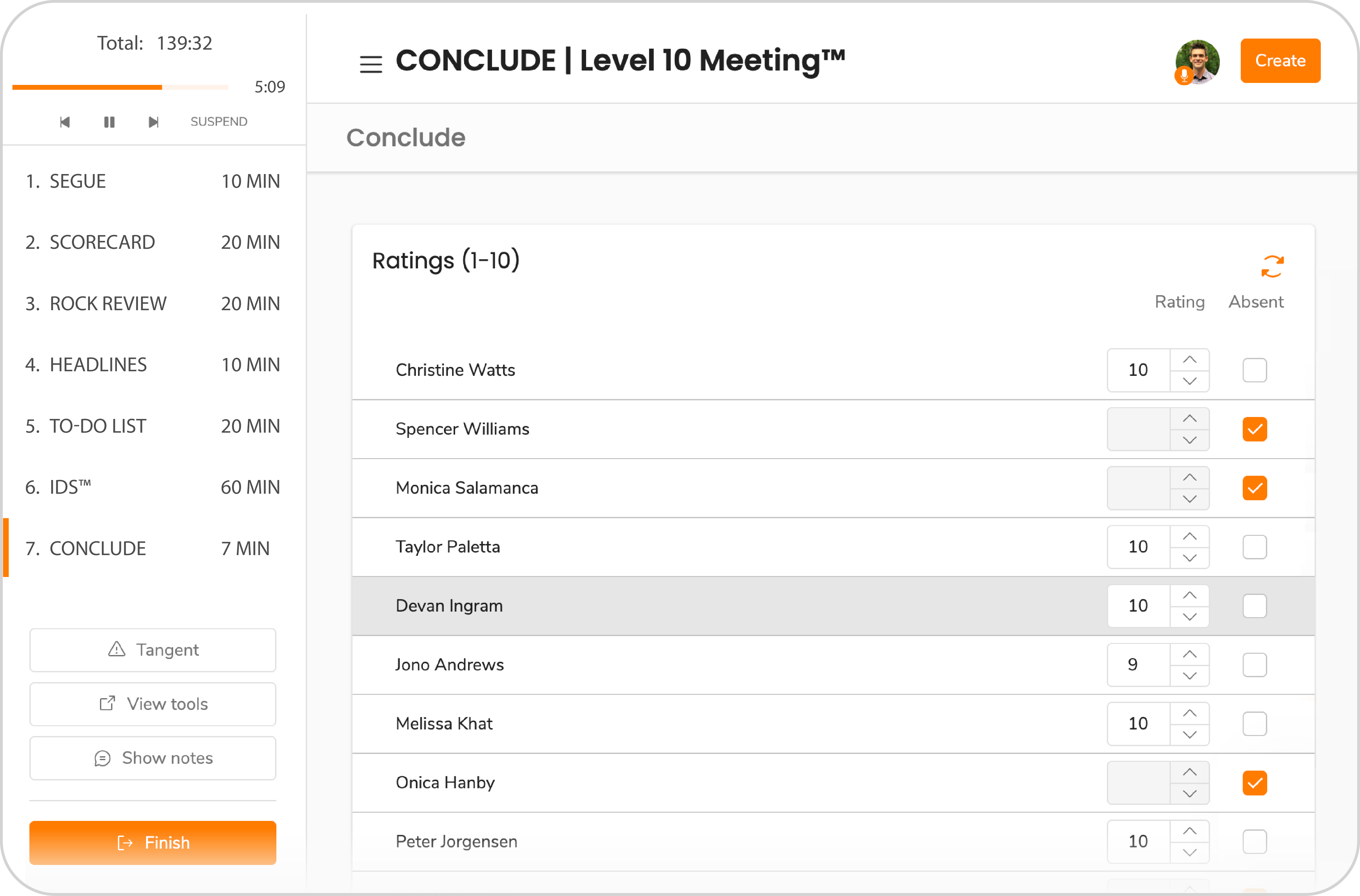
The rating at the end is a key part of that discipline. It isn’t a throwaway closing step that you can just skip if you run out of time. It’s there to help your team answer one very important question: Did this meeting work?
The meeting rating is so much more than a number. Let’s talk about why every Level 10 Meeting needs a rating and what those ratings can teach you about your team and the work they’re doing.
Why Does the Meeting Rating Matter?
Most teams continue to put up with bad meetings for two reasons:
-
They don’t know any different. (This is how all meetings are, right?)
-
They don’t have a clear way to measure whether the time was used well.
They just meet because it’s on the calendar. And once they’re there, they talk through updates, review projects, and leave when the time is up. But they rarely stop to ask whether the meeting actually created value.
Rating your Level 10 Meeting forces that question every week:
-
Did the team use the time well?
-
Did they stick to the agenda?
-
Did the most important issues for the week get solved?
-
Did people leave with clear ownership?
-
Did the meeting help the team gain Traction®?
Without a rating, the meeting ends on the assumption that the time was well spent. With a rating, the team actually gets a clear read on whether the meeting did what it was supposed to do: move the work forward.
The quality of the meeting shows up in the quality of execution. If the team talks around an issue, it comes back again next week. If next steps aren’t specific, the team leaves with intent instead of commitment. If ownership isn’t assigned, follow-through becomes optional.
A strong Level 10 Meeting® does the opposite. It turns conversations into decisions, decisions into next steps, and next steps into ownership the team can track.
How Do You Score a Meeting?
Before each person gives a score, the team should think through a few practical questions:
-
Did we start and end on time?
-
Did we follow the Level 10 Meeting® agenda?
-
Did we keep updates brief and preserve IDS® time?
-
Did we solve the most important and urgent issues?
-
Did we confirm To-Dos with owners and due dates?
-
Did we leave aligned on next steps?
These questions keep the rating grounded.
A pleasant meeting might still deserve a low score if the team avoided the real issues holding the work back. A hard meeting might deserve a high score if the team solved pressing issues, assigned ownership, and left aligned. The goal isn’t comfort. It's progress.
What Does a 10 Really Mean?
Scoring breaks down when teams confuse a 10 with perfection. Someone says, “I don’t give 10s because there’s always room to improve.” Another person scores every meeting an 8 because they believe a 10 should be reserved for something extraordinary.
But that misses the point of the rating. In a Level 10 Meeting, a 10 doesn’t mean perfect. It means the meeting performed. The team shouldn’t be asking, “Was this the best meeting we’ve ever had?” The better question is, “Did this meeting do what it was designed to do?”
A meeting can include a hard conversation, surface a major issue, or require a difficult decision and still deserve a 10. The score should reflect whether the team created clarity, solved what needed solving, and left with ownership, not whether the conversation felt easy.
A 10 means the meeting started on time, ended on time, followed the agenda, avoided unnecessary tangents, solved the right issues, and created clear To-Dos and accountability for next steps. That’s performance.
What Do Low Scores Mean?
Low scores shouldn’t be viewed as a problem. They should be viewed as information.
When someone gives the meeting a 7 or below, the facilitator shouldn’t try to defend the score or start a debate. Instead, they should ask one simple question: “What would’ve made this a 10 for you?”
The answer usually points to a fix. Maybe the team spent too much time reviewing updates. Maybe the Scorecard review turned into excuses. Maybe a Rock was off track, but no one dropped it into the Issues List. Maybe IDS® turned into discussion without a clear solve. Maybe the team ran out of time and rushed the Conclude section.
Whatever the reason, those are useful insights. You don’t need to solve every meeting issue at once. You need to identify the pattern, pick the next improvement, and bring more discipline to the next weekly meeting. That’s how your Level 10 Meeting® gets stronger.
How Does Rating the Meeting Build Accountability?
Rating your Weekly Level 10 Meeting makes the whole team responsible for the meeting.
Too often, people act as if the facilitator owns the meeting experience alone. That’s not how healthy teams work. The facilitator is responsible for moving through the agenda items, but everyone owns the quality of the meeting.
Every Seat at the table needs to prepare before the meeting, complete their assigned To-Dos, bring the right issues to the meeting, and participate in IDS® with honesty and discipline.
When everyone gives a score, everyone owns the standard. Accountability stops depending on one person pushing harder and starts living inside the meeting rhythm. The rating helps the entire team practice that ownership one weekly meeting at a time.
Running on Ninety Can Help
Ninety helps teams run Level 10 Meetings with the structure already built in.
The Scorecard, Rocks, To-Dos, Issues List, IDS®, Cascading Messages, and meeting rating can all live in one connected place. That makes the meeting easier to run and easier to improve over time.
Ninety doesn’t replace discipline. The team still has to prepare, tell the truth, solve issues, and follow through. But it does support the rhythm so your team can spend less time managing the meeting and more time doing the work the meeting was designed to support.
Run a Better Level 10 Meeting Today
The rating only helps if a team gives it enough room to work.
Don’t treat it like the last 30 seconds before everyone jumps to the next call. Protect the Conclude section of your Level 10 Meeting® by reviewing the To-Dos, making sure every owner knows what they’re taking out of the meeting, and then asking everyone for a 1 to 10 rating.
When someone gives a lower score, don’t try to defend the meeting. Ask that one question: “What would’ve made this a 10 for you?”
Then listen to the answer. That feedback is useful only when you turn it into action. If the answer points to a real issue, add it to the Issues List. If it points to a clear next step, make it a To-Do. If it points to a better meeting habit, name the adjustment and practice it next week.
That’s how the rating becomes more than a number. It becomes a weekly coaching tool for the team.
Use the scores. Learn from them. Bring the lessons into next week. That’s how your Level 10 Meeting® becomes one of the most valuable 90 minutes on your calendar each week.