


Most people don’t hate meetings because they don't like working with other people. They hate meetings because too many of them feel repetitive, unclear, and unnecessary.
We’ve all been there: You sit down with smart people, and everyone starts talking. A few people dominate the conversation, somebody repeats what was already said in different words, and the real issue never gets named (or solved for that matter). Then the meeting ends, and nobody’s fully clear on what got decided, who owns what, or what happens next.
That’s a big reason I wrote Meetings Kinda Suck.
I’ve spent years in session rooms with leadership teams, operators, managers, and founders trying to solve growth and execution problems. Again and again, the same issue shows up. Everyone says they want clarity, accountability, and Traction®, but the meeting rhythm says otherwise.
A lot of meetings feel harder than they need to because the basics aren’t in place. The purpose is vague, the structure is weak, and the time gets used without much progress to show for it. Let’s talk about why a strong meeting rhythm matters so much and what you can do to run better meetings starting now.
What Bad Meetings Are Really Costing You
Bad meetings usually aren’t ruined by one terrible agenda or one long-winded person. More often, they start to break down because the purpose is vague, the structure is weak, and too many people are in the room without a clear reason to be there. Then, when the time comes to make a hard call, nobody wants to own it, and the meeting ends without real accountability.
When that becomes the norm, people stop treating meetings like a place to solve problems and start treating them like something to survive. And that has a cost.
When a meeting goes nowhere, you lose more than the hour on the calendar. You start losing confidence that the time together is going to solve a real issue or move the work forward in a meaningful way. People become more guarded about what they bring into the room. They come with less energy, fewer ideas, and less honesty because experience has taught them that the meeting is more about talking than deciding. That’s when the problem gets bigger than scheduling. Bad meetings start showing up in execution, accountability, and culture long after the meeting ends.
How healthy are your meetings, really? Take the Rate Our Meetings Quiz to see where your team stands and get practical ideas to improve your meeting rhythm.
Why I Wrote Meetings Kinda Suck
.png?width=450&height=546&name=MKS_Book_Mock_v3%20(1).png) I didn’t write Meetings Kinda Suck because the world needed another book complaining about bad meetings.
I didn’t write Meetings Kinda Suck because the world needed another book complaining about bad meetings.
I wrote it because too many teams are living with a problem they’ve learned to normalize. They assume slow decisions are just part of growth, repeat issues are just part of leadership, and calendar overload is simply the price of doing business. After enough time working this way, people stop questioning it. They accept unclear agendas, unresolved issues, and meetings that create more conversation than progress because it starts to feel normal.
I don’t think it should feel normal.
I wrote this book because I’ve seen how much better work gets when teams stop winging their meetings and start treating them like a real operating discipline. Better meetings create better decisions, stronger accountability, and a healthier rhythm for the business as a whole. That’s the problem this book is built to solve.
Meetings don’t suck because meetings are inherently terrible. They suck because nobody taught us how to run them.
Meetings Kinda Suck
How To Fix Bad Meetings At Work
You don’t need to redesign your entire company this week. You need to fix the fundamentals one step at a time and do them consistently.
Start here:
-
Give every meeting a real purpose: “Weekly sync” isn’t a purpose. “Solve the top issues blocking this quarter’s priorities” is a purpose. If you can’t explain why the meeting exists in one sentence, don’t send the invite yet.
-
Separate updates from problem-solving: Meetings get bogged down when updates take over the hour. Put the numbers in a Scorecard, share headlines in advance when you can, and use the majority of the time for solving, deciding, and aligning.
-
Define who owns the meeting: Every meaningful meeting needs ownership. Someone should own the objective, someone should facilitate, and someone should capture decisions and To-Dos. You can combine roles in a small setting, but you can’t skip them.
-
Build an Issues List: Teams waste a lot of time discussing whatever feels loudest in the moment. A running Issues List helps you collect what matters, prioritize it, and solve the right thing instead of the newest thing.
-
Rate the meeting at the end: Ask everyone to rate it from 1 to 10. Then ask why. That one habit will tell you more about your meeting culture than most leaders want to admit.
If you want just one practical exercise to get started, do a calendar audit. Pull up every recurring meeting and ask these three questions:
-
What problem does this meeting solve?
-
Is that still a real problem?
-
Is this meeting solving it?
That exercise alone will show you where time is being wasted.
This is also where running on EOS® makes a difference. Tools like Level 10 Meetings, IDS®, Rocks, and Scorecards give teams a practical way to bring more structure, visibility, and accountability into their meeting rhythm. And if you’re trying to keep all of that moving across spreadsheets, notes, and scattered documents, Ninety simplifies the process by keeping your issues, priorities, and meetings in one place.
When you start running your meetings with more clarity and intent, they stop feeling like a recurring obligation and start becoming one of the most powerful parts of how your team works.
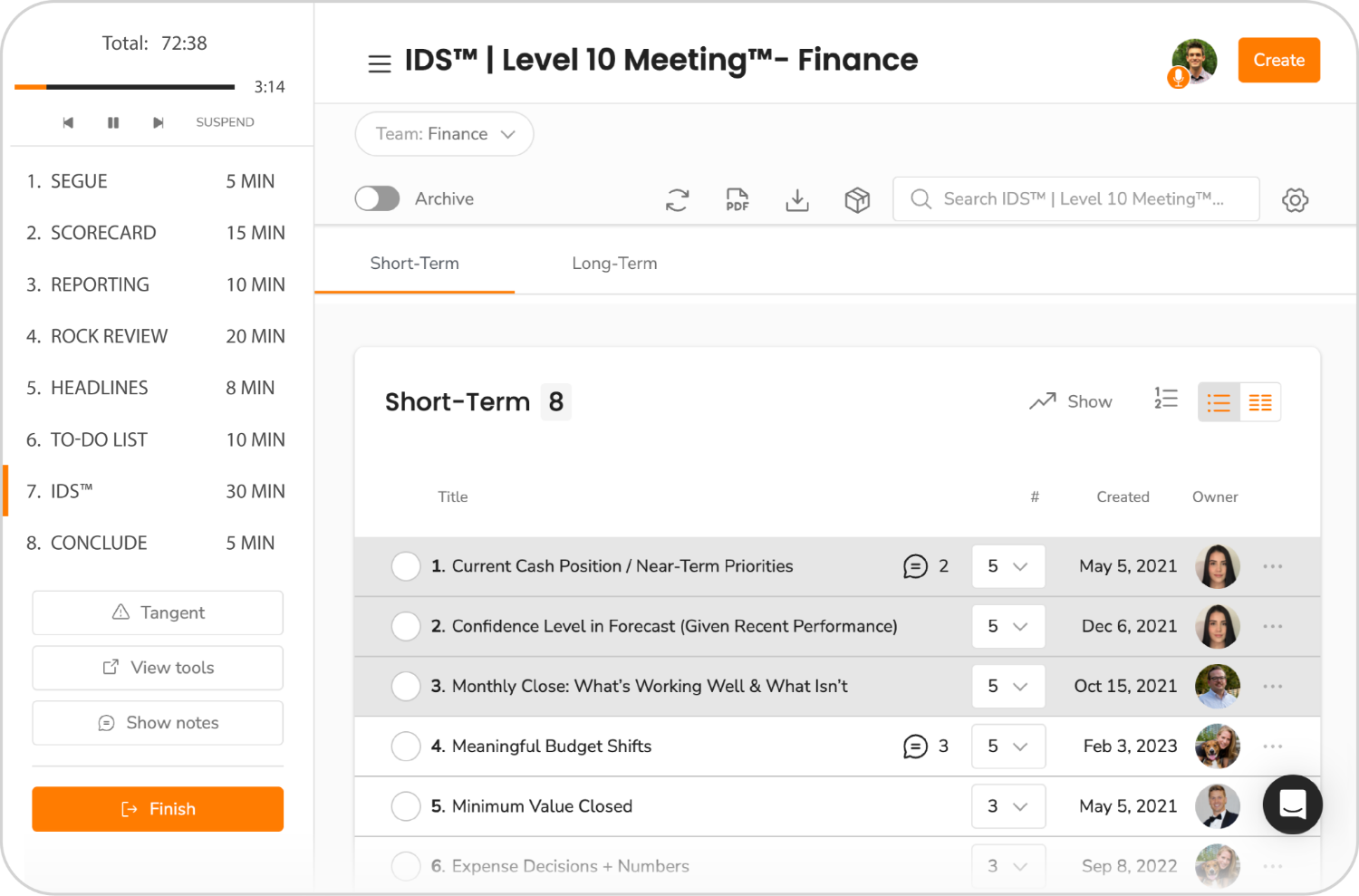
What Better Meetings Actually Give You
When meetings work, everything feels different. Decisions happen faster. Accountability gets clearer. Fewer issues come back week after week. Everyone leaves knowing what matters and who owns what. And when that happens, you spend less time cleaning up confusion after the meeting because the meeting itself did the work it was supposed to do.
That’s what a strong meeting rhythm creates.
A good weekly meeting should help you win the week. A good quarterly should help you step back, solve bigger issues, and set priorities you actually believe in. A good 1-on-1 should build trust and help people grow. A good annual should create alignment around where you’re going and what has to be true to get there.
None of that is complicated. It just requires consistency.
This is also where a lot of teams get stuck. They want meetings to feel useful, but they don’t want the structure that makes usefulness possible. They want clarity without prep, accountability without follow-through, and Traction® without hard conversations. That’s not how it works.
The teams that get real Traction® are the ones willing to do the simple things well, over and over again.
Run Better Meetings Starting This Week
Meetings don’t have to feel like something your team has to push through. When they’re built to create clarity, accountability, and forward progress, they become one of the most impactful parts of how the business runs.
That’s the case I make in Meetings Kinda Suck.
If your meetings are repetitive, unclear, or more tiring than productive, don’t assume that’s just how work feels. In most cases, the problem isn’t that your team is meeting too often. It’s that the meetings themselves aren’t being run with enough discipline, structure, or purpose.
So start with one. Fix the meeting everyone dreads most. Give it a real objective, capture the issues that matter, solve the top one, and rate the meeting at the end. Then show up next week and do it again.
That’s how better meetings get built. And once they do, they start giving your team something back: more clarity, more alignment, and more confidence that the time together is actually helping the business move forward.
If this hit a nerve, that’s exactly why I wrote Meetings Kinda Suck. Check out the book for a deeper look at how to run meetings that create clarity, accountability, and Traction® instead of wasting your team’s time.
Ready to run better meetings now? Ninety helps your team support that meeting rhythm with tools for tracking Rocks, Issues, Scorecards, and accountability in one place. Try it now.