


When a leadership team decides they want to run their company on EOS®, they have an important choice to make. They can self-implement, get support along the way, or work with a Professional EOS Implementer® from the start.
Alex Gertsburg, CEO of CoverMySix and managing partner of Gertsburg Licata law firm, chose to self-implement EOS® for a reason every entrepreneur understands: He wanted the benefits of the system without taking on the cost of a coach from the start. That doesn’t make self-implementation the easy path, but it does make it a practical one.
For some teams, self-implementation is the right place to start because it gives them access to the EOS tools, language, and cadence while they build discipline internally. It allows them to learn the system, apply it in real time, and decide where they need support along the way.
This article isn’t about whether self-implementation is possible. It is. The real questions to ask are: Is self-implementation right for my company? And, is my team equipped to do it well?
For the right team, self-implementation isn’t a compromise. It’s the right choice for creating more clarity, better execution, and stronger internal ownership. Let’s talk about how to determine if self-implementing EOS is best for you and your team.
Why Choose to Self-Implement EOS®?
Most companies don’t choose self-implementation for just one reason. Cost may be the most obvious factor, and Alex says it was one of the main drivers for him initially, but it usually isn’t the whole story.
Companies choose to self-implement EOS® for a handful of practical reasons:
-
Cost savings are real: For some companies, especially earlier-stage businesses, working with a Professional EOS Implementer® may not be an investment they’re ready to make. Self-implementation gives them a place to start.
-
They want to start now: Some teams don’t want to wait until they feel fully ready for outside support. They want a practical system they can begin using right away to create more clarity and improve execution, especially when they have access to tools that make the process easier to run.
-
They want to build internal ownership: Self-implementation requires the team to learn the language, use the tools, and maintain the cadence themselves. That creates a different level of buy-in than a system that feels externally driven.
-
They want to build discipline inside the business: EOS only works when the team owns it. Self-implementation forces leaders to teach the tools, run the meetings, and confront the issues instead of depending on outside facilitation to carry the system.
-
They want to learn where support is actually needed: Starting with self-implementation gives some teams a chance to use the system in real time and get clearer about where they need help along the way.
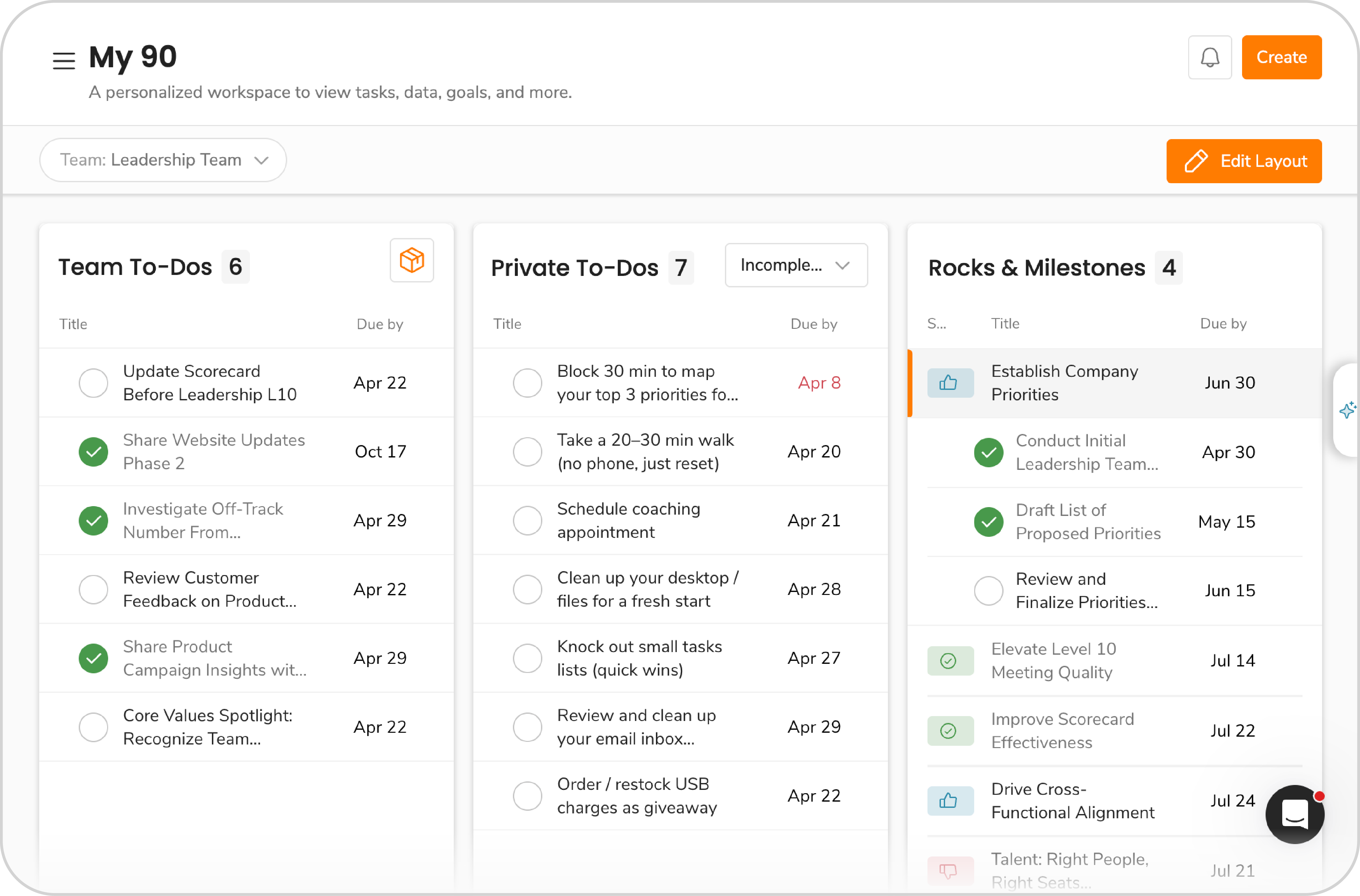
For teams who want to self-implement while still making the process easier on themselves, Ninety can help. It brings all the EOS tools into one system so your team can stay organized, aligned, and focused on execution instead of juggling disconnected tools.
What Does Self-Implementation Actually Require?
Self-implementation can be the right choice, but it only works when a team is honest about what the path demands. Here are three things every team who chooses to self-implement needs if they want to succeed:
-
A champion: Someone inside the company has to own the process in a real way. That person doesn’t need to know everything on day one, but they do need enough credibility with the team to teach the tools, facilitate the conversations, and hold the line when the group wants to fall back into old habits. This is a real commitment of time and to the process of mastery. These are often new skills and understanding that needs to be acquired. Without that internal champion, self-implementation usually turns into partial adoption. The team picks up some vocabulary, tries a few tools, and then falls back into familiar patterns the first time the work gets uncomfortable.
-
Commitment: EOS® is simple, but it isn’t casual. A team can’t decide it wants the benefits of EOS while treating the process like a flexible suggestion. Self-implementation asks leaders to use the tools as designed before they start customizing them. It asks them to keep showing up to the meetings, keep solving the same kinds of issues in the same disciplined way, and keep returning to the basics when they’re tempted to complicate things.
-
A willingness to face what the process reveals: Self-implementation sounds appealing when leaders picture better meetings, clearer priorities, and stronger accountability. It gets harder when EOS starts exposing people issues, structural gaps, and habits the team has tolerated for too long. That’s where the real test begins. Teams may like the idea of stronger accountability, clarity, and transparency, but those often come with tough decisions that have to be made in the best interest of the business.
That’s why self-implementation works best for teams that are willing to let the process challenge them. It’s about more than just running a better meeting. It’s about becoming the kind of team that can operate with more consistency, more honesty, and more follow-through than before.
Self-implementation works best when leaders don’t try to figure everything out in isolation. If you’re on this path, consider joining EOS Self Implementers Unite!, the Facebook group founded by Alex Gertsburg for leaders who are learning, practicing, and strengthening EOS® inside their own companies.
How Can You Tell Whether Self-Implementation Is Right for Your Team?
If you’re considering self-implementation, ask yourself and your team these questions and answer them honestly:
-
Do we have an internal champion who can really run this? That person doesn’t need to know everything on day one. But they do need the respect of the team, the ability to facilitate, and enough discipline to hold the line on the process.
-
Are we willing to start with the leadership team first? Teams get into trouble when they roll EOS® out too broadly before the leadership team has learned how to use it well. If the leadership team isn’t aligned, the rest of the organization won’t be either.
-
Will we follow the tools as designed before trying to customize them? There’s nothing wrong with adapting a system to work better for your company over time, but doing it too early usually creates confusion or unnecessary complexity. The simpler path is to use the tools as designed until the team has enough experience to know what actually needs to change.
-
Are we prepared for the people and structure decisions EOS will bring to the surface? That’s where self-implementation becomes real. EOS won’t just improve meetings and priorities. It will also expose Seats that aren’t clear, responsibilities that overlap, and people issues that have been sitting unresolved for too long.
-
Can we keep a weekly rhythm? Self-implementation breaks down if you let the meeting pulse become optional. If your team can’t commit to a consistent rhythm of meetings, priorities, follow-through, and issue solving, the process won’t stick.
-
Are we willing to get help if we stall? This is an important one. Some teams treat outside support as failure. It isn’t. Self-implementation can still be the right path even if the team needs guidance along the way. In fact, knowing when to ask for help is usually a sign of maturity, not weakness.
If your answers are mostly yes, there’s a solid chance your team can self-implement EOS successfully. If several answers are no, that isn’t a verdict against your company. It’s just clarity about which path will give you the best chance to gain Traction®.
Tip: Try exploring ENRG groups, where entrepreneurs connect with peers in a growing nationwide community. Ninety is proud to be a founding partner of ENRG, which now has 80 chapters across the country.
In this video, Alex Gertsburg shares how Ninety helped his team replace scattered spreadsheets, documents, and paper-based meeting tools with a simpler, more productive way to run L10 meetings, track Rocks, manage Issues, and stay aligned.
How Support Can Strengthen Self-Implementation
Self-implementation doesn’t mean doing everything alone, and Alex’s experience helps make that clear.
Before using Ninety, Alex described his team as trying to run EOS® with spreadsheets, Word docs, and paper across their Level 10 Meetings, quarterlies, and annuals. They also experimented with other tools, including Asana, but finally decided on Ninety because it fits the way EOS is meant to work. In his words, it was a “perfect match.” There’s a place for meetings, Rocks, issues, and To-Dos, and the structure makes it easier for his team to stay on track.
A lot of leadership teams think of this as a binary choice. Either they work with a Professional EOS Implementer® from the start, or they self-implement and figure it out as they go. In practice, there’s a lot more room in between. Teams can self-implement and still lean on technology like Ninety that makes the process easier to run. That doesn’t weaken the path. In fact, it usually makes it more sustainable.
It also doesn’t mean the decision is permanent. Some teams start by self-implementing because it’s the right fit for where they are, then decide to bring in a coach later as the business grows or the challenges become more complex. That doesn’t mean self-implementation was the wrong choice. It means the team is getting clearer about what kind of support will help them most in their current Stage of Development.
The point isn’t to prove you can do it all on your own. The point is to give your business the support it needs to run better.
You don’t have to choose between self-implementation and support. See how Ninety helps teams run EOS® with more clarity, consistency, and Traction®.
If your team is ready to start, try Ninety free now and build the rhythm that makes self-implementation work.


.jpg?width=500&name=large_Leadership_Habit_EOS_Blog_Header_1920_x_1080%20(1).jpg)

.jpg?width=500&name=large_Accountability_Without_Micromanaging_EOS_Blog_Header_1920_x_1080%20(1).jpg)