


Navigating the business landscape is challenging. Daily priorities often get lost in the hustle of running the business. The key is balancing the work you do in the business with the work you do on the business, giving attention to important but less urgent priorities.
That is where EOS® Rocks come in.
Rocks are the most critical priorities for a 90-day period inside the Entrepreneurial Operating System® (EOS®). They support your 1-Year Plan, strengthen processes, and help your organization gain traction toward its long-term vision.
In this guide, we will cover:
If you want to turn strategic goals into measurable progress, mastering the design and implementation of Rocks is essential.
What Are EOS Rocks?
Stephen Covey is widely credited for creating the concept of Rocks with this famous metaphor: Imagine you have an empty jar or bucket. Your goal is to fill it with water, sand, pebbles, and a handful of rocks. How would you go about filling the bucket so the biggest items, the rocks, all fit?
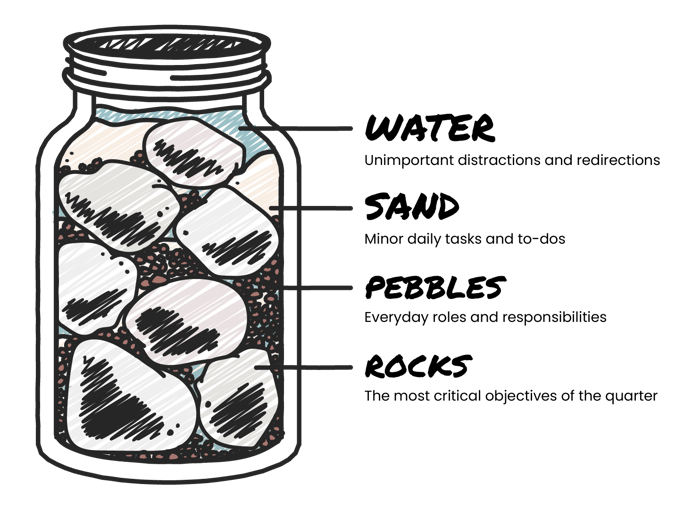
As illustrated, it’s imperative to get the rocks placed in the bucket first, followed by the pebbles, then the sand, and then the water, because the rocks are the most important items to solve for. Everything else — representing to-dos, emails, calls, and so on — can fill in around them.
Rocks are the most critical objectives of a quarter, with the vast majority in support of longer-term goals, and they’re made SMART — specific, measurable, achievable, relevant, and timely — to provide the needed clarity for completion.
Rocks help the Senior Leadership Team (SLT) focus on what’s most important to keep the business thriving and moving forward. When setting Rocks, the key is to create focus and alignment. They’re about quality, not quantity.
Why EOS Rocks Matter
Chunking out large goals into Rocks offers many advantages for businesses and organizations. To start with, day-to-day tasks and decisions are easier when they’re aligned with a compelling set of long-term goals.
Rocks are designed to be completed within a 90-day period. This creates an easily digestible scope, especially when those Rocks' progress is measured by Milestones, or steps. After all, it’s human nature to focus on a shorter time frame, which is why quarterly Rocks, when thoughtfully developed, are highly achievable. Otherwise, we might lose sight of an important annual goal when in the trenches, grinding through the daily work and unexpected challenges that tend to crop up. But Rocks and their Milestones help us stay on track and keep us accountable.
Because Rocks and Milestones are shared with the team, accountability increases and commitment strengthens. The goal is to make sure the team is making progress so that by the end of the quarter, we have given everyone the support they need to say “This Rock is done!”
At the very root of EOS Rocks is a discipline that is almost essential if we want to achieve our annual company goals. It all starts with the Senior Leadership Team. Each quarter, they should set aside at least one day for a quarterly or annual meeting. During this session, the SLT will look at the company's 3-Year Picture and 1-Year Plan and decide on Rock candidates that help ensure the company achieves goals supporting their vision.
Company Rocks are set by reviewing the Rock candidates that came out of the 1-year goals review and the major Issues (problems and opportunities) on the Long-Term Issues list. Company Rocks are commitments that are shared with everyone in the company. They help ensure that the entire organization is aware of the company’s 90-day priorities.
The Importance of EOS Rocks
If Rocks are critical quarterly objectives in an organization, everyone should be aware of not just the status of those Rocks but also who is accountable for bringing them to “Done!” to ensure accountability, each Rock has a specific owner who is accountable for the actions and decisions that drive the completion of the Rock.
Regular check-ins during the weekly Level 10 Meeting™ promote accountability and allow team members the chance to raise Issues or roadblocks. Open dialogue is the best way to keep those Rocks on track. Nobody should be surprised at the end of the quarter if the Rock was not completed.
That does not suggest, however, that all Rocks are completed. Completing 80% or more of your overall Rocks as a team is something that should be celebrated. And for all those Rocks we do complete, you’d better believe we’re celebrating them. These are significant steps we’ve accomplished, and they keep us on the path to major goals. Celebration is the kind of positive reinforcement that keeps everyone committed to doing all they can to get future Rocks done.
How to Build and Prioritize EOS Rocks
Use the following structured process to build effective Company Rocks:
Step 1: Add Rock candidates to your Long-Term Issues List before your quarterly planning session. Then, use this to build a list of 10–20 larger efforts that you’d like to see potentially accomplished in the next 90 days.
Step 2: Narrow the list to 3–7 Company Rocks. The probability of achieving at least 80% completion drops significantly when teams take on more than seven Rocks in a quarter.
Step 3: Make each Rock SMART by defining clear outcomes, due dates, and measurable success criteria
Step 4: Assign a single accountable owner for each Rock. Create a “Rocks Sheet” containing all Company Rocks and individual Rocks for each of your SLT members. Ninety’s platform makes it easy to add Rock candidates to your Long-Term Issues List and identify them with a priority indicator that simplifies the selection exercise.
Step 5: Share Company Rocks during your Quarterly State of the Company meeting to ensure alignment.
Step 6: Cascade Rocks to departments so each team sets supporting priorities aligned with Company Rocks.
When it comes to prioritizing your Rocks, the first thing to consider is how each Rock aligns with the long-term vision and objectives of the organization. This is what we’re supporting above and beyond anything else. If it doesn’t truly jive with the vision, it can be deprioritized or amended as appropriate. The key is to ask whether achieving the Rock supports or advances organizational goals.
Of course, there are other considerations, such as customer impact, urgency and timelines, risk, and more. These are valuable discussions to have when choosing which Rocks will have the greatest impact.
Now, the key to designing an attainable Rock is to make it SMART:
-
Specific — A one-sentence description of what success looks like. What precisely do we want to achieve? Who owns this Rock?
-
Measurable — The metrics used to determine success or failure. How and when will we monitor progress? Can the data retrieval be automated?
-
Achievable — An accounting of the existing capacity to achieve the Rock. What resources do we need to acquire? Given our current capacity, do we have at least an 80% chance to complete this Rock?
-
Relevant — The connection between this Rock and a longer-term goal. How will this Rock keep us on track for our 1-Year Plan and 3-Year Picture? What is the connection between this Rock and our Purpose/Passion/Just Cause?
-
Timely — A detailed description of the Rock’s due date. When will we stop collecting new data to determine success or failure? How do we achieve this goal through Milestones we’ll complete along the way?
Common EOS Rock Mistakes to Avoid
Rocks should be challenging but realistic. Overcommitting undermines execution and morale. We don’t want to design Rocks that we “hope to get done.” Hope is not a strategy. Discipline is.
Here are a few common mistakes to watch out for to ensure you aren’t overcommitting a team or person tasked with managing a Rock:
-
Don’t set too many Rocks. We recommend keeping it manageable (no more than three per person) to ensure the focus is sharp from beginning to end. As the saying goes, “If everything is important, nothing is important.”
-
Don’t allow vagueness to creep in. Make the Rock SMART, with clear objectives outlined.
-
Don’t ignore capacity constraints. Accounting for the available resources and capacity to complete the work is critical to avoid overextending oneself or a team… and potentially damaging morale.
-
Ignore dependencies and timelines at your own peril. Many times, Rocks dovetail with each other to help push toward longer-term goals. Understand any such dependencies or limitations to avoid getting bogged down in details and risk failure for the Rock(s).
-
Failure to adjust is not a good thing. Focus on the “what” and not the “how.” Adjustments may be needed to get the Rock done. It’s okay to have that discussion. (It really, really is.)
Manage EOS Rocks in Ninety
Ninety is software that supports EOS® frameworks and implementation, helping teams manage Rocks, Issues, Meetings, and Milestones in one place. Use Ninety’s tools to implement and manage your EOS Rocks and other elements of the EOS Toolbox™. If you are ready to gain traction and implement EOS Rocks effectively, start your free trial today.



.jpg?width=500&name=large_EOS_Strategy_Planning_EOS_Blog_Header_1920_x_1080%20(1).jpg)
.jpg?width=500&name=large_SWOT_Analysis_EOS_Blog_Header_1920_x_1080_v2%20(1).jpg)