


If you’ve ever sat around a table with your leadership team and realized that everyone has a slightly different version of where you're going and how you’ll get there, you’re not alone. In EOS®, that's what we call a Traction Gap. Without a shared vision, people start making decisions based on their own understanding of where the company is headed.
As a Professional EOS Implementer®, I’ve seen dozens of leadership teams get aligned by answering eight simple questions. We use a tool called the Vision/Traction Organizer® (V/TO®), a two-page tool that helps leadership teams clarify where the company is going and how they plan to get there. I can tell you with confidence that it works.
The V/TO gives leadership teams a shared view of the company’s direction and near-term priorities. When everyone agrees on the answers, the team has a common reference point for making decisions and setting priorities. When done right, it gets your entire team rowing in the same direction and working as one.
What You’ll Learn
In this article, you’ll learn:
- What an EOS V/TO is and why growing companies need one
- How the eight EOS Vision questions work together
- What each section of the V/TO is designed to clarify
- How to use the V/TO during Quarterly Meetings and Annual Planning
What is EOS Vision?
EOS Vision is the component of the Entrepreneurial Operating System® (EOS) focused on getting everyone aligned on where the business is going and how it will get there. Teams use the two-page Vision/Traction Organizer to answer eight questions about their Core Values, Core Focus, 10-Year Target, Marketing Strategy, 3-Year Picture, 1-Year Plan, quarterly Rocks, and issues.
The V/TO separates those answers into Vision and Traction® so the team can see both where the company is headed and what it needs to accomplish along the way.
Question 1: What Are Your Core Values?
Your Core Values define your company culture and the behaviors you want to see from your team. They answer the question, “Who are we?” These are more than just words for your website. They should shape how people make decisions, work together, and represent the company.
Core Values are discovered, not invented. They already exist. The work is getting clear enough about them that you can use them to hire, fire, review, and reward people.
I’ve worked with plenty of teams that tell me their Core Values are already defined. Then I ask how often those values come up in the business, and someone says, “Let’s pull up the website,” or “I’ll grab the brand book.” That tells us there’s still work to do.
When Core Values are truly part of the business, people know them and use them. They show up in hiring decisions, feedback, recognition, and the way the team works together.
Question 2: What Is Your Core Focus?
If Core Values are “Who We Are,” then Core Focus is “What We Are.” Core Focus combines your purpose, cause, or passion with your niche: why your organization exists and what it does especially well.
Start with your purpose, cause, or passion. I like to describe this as your “I have a dream” thinking, rather than your “I have a plan” thinking. This is why the organization exists beyond making money. In EOS, the strongest versions are concise, usually 3–7 words, and meaningful enough that the team can rally around them.
Next comes your niche, which is your “What.” This is where you get clear on what your company does best and where it should focus its energy.
Put the two together and you get the formula:
Purpose/Cause/Passion + Niche = Core Focus
A clear Core Focus helps the team stay centered on what the company is built to do and why it exists.
Question 3: What Is Your 10-Year Target?
Think of your 10-year Target as “Where We're Going.” This is your moment to think big and create your long-term goals. The purpose of the 10-Year Target is to stretch your thinking and unite your team around a bold destination. It creates alignment around what the company is striving for over the long haul.
For some teams, 10 years is the right horizon. For others, it may be harder to see that far ahead. I recently worked with a team in the real estate brokerage industry where AI is creating so much change that we chose to set a 5-year target instead.
Whatever timeframe you use, the target should be specific, measurable, and time-bound. Visionaries often enjoy thinking this far ahead, but the 10-Year Target has to work for the whole organization. People should be able to understand it and see where the company is headed.
Question 4: What Is Your Marketing Strategy?
In EOS, your Marketing Strategy defines your Ideal Customer and the message that helps them understand why they should choose you. It includes your Target Market, Three Uniques, Proven Process, and Guarantee.
All four parts are important, but the Three Uniques are my favorite because they force the team to get clear on what truly sets the company apart. That clarity helps with prospects and clients, and it also gives your own team a stronger understanding of how to talk about the business.
When you know who your Ideal Customer is and why they buy from you, your marketing becomes much more focused.
Question 5: What Is Your 3-Year Picture?
Your 3-Year Picture describes what your company will look like three years from now, including revenue, profit, team size, and culture. The key is that it’s a picture, not a detailed plan. You’re getting specific about where the business should be in three years without trying to map every step required to get there.
When the leadership team agrees on that picture, it gives everyone a clearer reference point for the decisions being made today.
Question 6: What Is Your 1-Year Plan?
Now it’s time for the “I have a plan” part. This is where the V/TO moves from Vision to Traction and the team gets clear on what needs to be accomplished over the next 12 months.
Your 1-Year Plan includes 3–7 Company Goals, along with the appropriate revenue and profit targets and leading measurables that help you track progress toward them. Each goal should support your 3-Year Picture and move the company closer to its 10-Year Target.
A strong 1-Year Plan gives the organization a clear set of priorities for the year and helps each department understand where its work fits.
Question 7: What Are Your Quarterly Rocks?
The 90-Day World® is central to EOS. The 90-day planning cycle helps teams stay focused on the priorities that need attention now.
Each quarter, your team sets Rocks, the 3–7 most important priorities the team needs to complete to keep the 1-Year Plan on track. This also includes lagging measurables, such as revenue and profit, along with leading indicators that help the team see whether it’s moving in the right direction.
The discipline is simple: decide what needs to get done this quarter, assign clear ownership, and follow through.
Question 8: What Are Your Issues?
Every long-term plan will run into problems, obstacles, and ideas that need to be addressed. The Issues List gives the team a place to capture them and work through them using IDS®, which stands for Identify, Discuss, and Solve.
Your long-term issues should also be shared across the company. That level of transparency can feel vulnerable, but your team already knows the business has challenges. What helps is knowing leadership sees them too and is working through them.
When teams consistently identify and solve issues, they build trust and keep problems from getting in the way of progress.
How the V/TO Drives Accountability, Alignment, and Action
Once you’ve answered the eight questions, the V/TO becomes a reference point for how the company operates. It gives the leadership team a shared direction and helps connect day-to-day decisions with the longer-term vision.
When the V/TO is Shared by All, people across the organization have a clearer understanding of where the company is going and how their work supports it. Review it quarterly and use it throughout the year when setting priorities and making decisions.
How Often Should You Review the 8 EOS Vision Questions?
Review your answers to the eight EOS Vision questions every quarter, with a deeper review during your Annual Planning Session. Quarterly Meetings help the leadership team reconnect with the vision and set priorities for the next 90 days. Annual Planning is where you take a broader look at the year ahead and update the V/TO where needed.
- Annual Planning Session: Review all eight questions and revise them when the business has changed enough to warrant it. This is also the time to establish the next 1-Year Plan and make sure the longer-term parts of the V/TO still fit where the company is headed.
- Quarterly Meeting: Review the V/TO to confirm the team is still aligned. Set the next quarter’s Rocks, update the Issues List, and check progress toward the 1-Year Plan and 3-Year Picture.
The true value comes from using the V/TO throughout the year, not just during planning sessions. It should help your team make decisions with the same understanding of where the company is going.
Bring Your EOS Vision to Life with Ninety
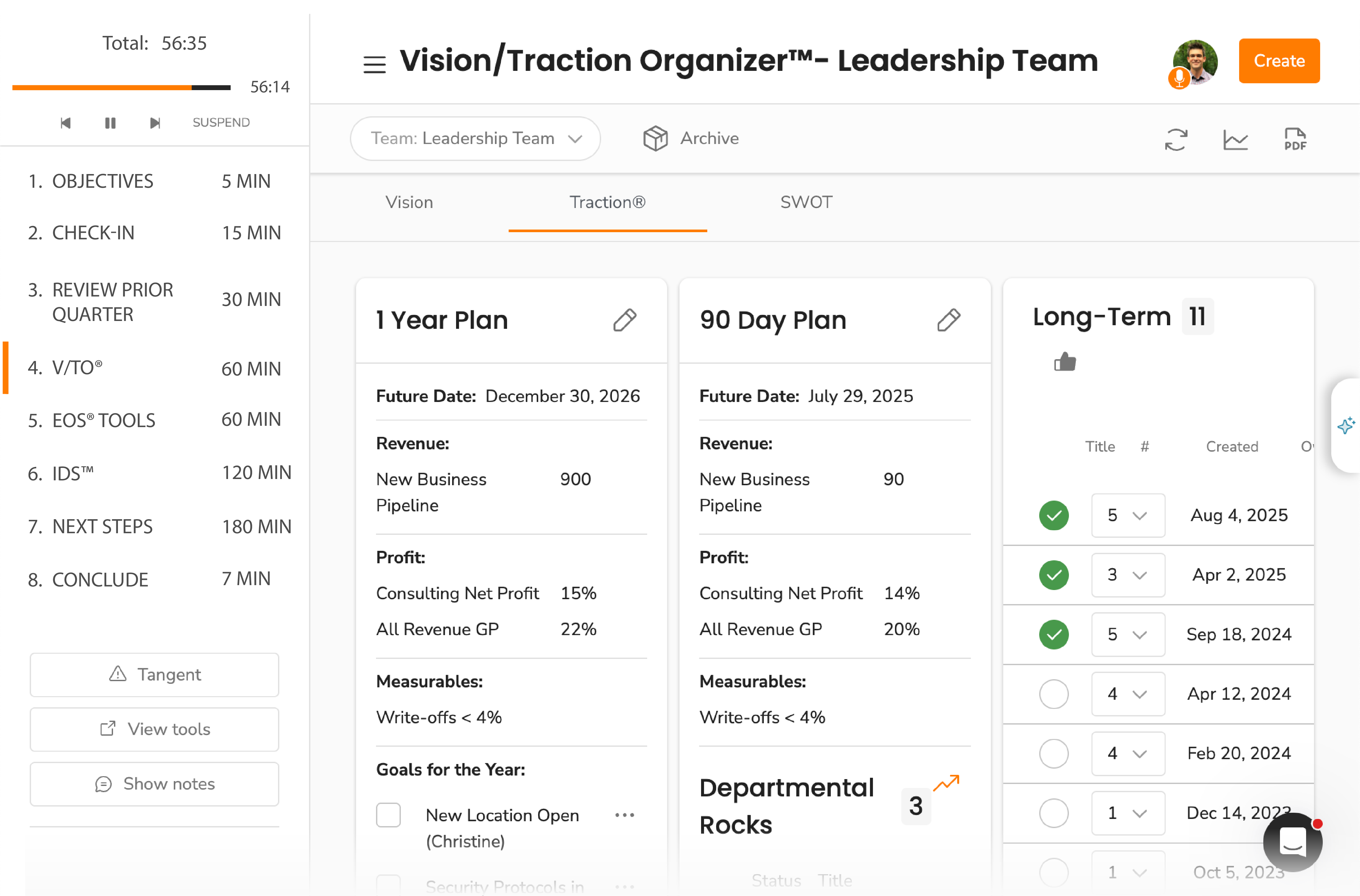
Building your Vision/Traction Organizer gives your leadership team clarity. Keeping that vision connected to the way your company operates is where Ninety comes in..png?width=450&height=410&name=Ask_Maz_Landing_Christine%20(1).png)
Ninety is the AI-powered business operating system for companies running on EOS®. In Ninety, your team can build and review the V/TO, connect it to quarterly Rocks, bring issues into your meetings, and give everyone in the organization better visibility into where the company is headed. Because all of the context of your business already lives in Ninety, its AI companion Maz can help you spot patterns, risks, and off-track data that your team needs to address before they become bigger problems.
Ninety helps you make your V/TO an ongoing part of how the business runs, rather than something the leadership team only looks at during planning sessions.
EOS Vision FAQs
-
What is the EOS Vision/Traction Organizer®? The Vision/Traction Organizer® (V/TO®) is a two-page EOS tool that helps leadership teams clarify where the company is going and how it plans to get there. It organizes the company’s vision and near-term priorities around eight key questions.
-
What are the eight questions in the EOS V/TO? The eight questions are:
-
- What are your Core Values?
- What is your Core Focus?
- What is your 10-Year Target?
- What is your Marketing Strategy?
- What is your 3-Year Picture?
- What is your 1-Year Plan?
- What are your quarterly Rocks?
- What are your issues?
-
What is the difference between Vision and Traction in the V/TO? The Vision side defines where the organization is going. It includes Core Values, Core Focus, the 10-Year Target, Marketing Strategy, and 3-Year Picture. The Traction side turns that direction into execution through the 1-Year Plan, quarterly Rocks, and issues.
-
How often should we review our V/TO? Leadership teams should review the V/TO every quarter and revisit it more deeply during Annual Planning. Quarterly reviews help the team reconnect with the vision, set the next round of Rocks, and update issues. Annual Planning is the time for a broader review of long-term direction and the next 1-Year Plan.
-
Is the V/TO the same as a strategic plan? The V/TO serves many of the same purposes as a traditional strategic plan, but it is intentionally simpler. Instead of creating a long document, the V/TO captures the company’s long-term direction, strategy, annual goals, quarterly priorities, and major issues in a concise format the team can actually use.
- How does Ninety support the EOS Vision Component? Ninety gives companies running on EOS® a shared system for managing the tools that connect vision with execution. Teams can document their V/TO, manage Rocks, track accountability, monitor data, run meetings, and capture issues in one place.



.jpg?width=500&name=large_EOS_Strategy_Planning_EOS_Blog_Header_1920_x_1080%20(1).jpg)