


For a long time, I thought good Quarterly Planning came down to building Rocks that are clear enough to execute. But I've learned that a Rock can be well-planned and achievable and still not be the right thing for my team to spend 90 days working on.
Before joining Ninety, I ran EOS® at another company, and every quarter my team worked through the process of creating Rocks. We took that work seriously, often spending close to a month turning an initial idea into a Rock we were ready to commit to.
At each Quarterly Planning Session, we would talk through the work, refine the scope, build out milestones, and make sure everyone understood what needed to happen. But even after all that preparation, we would still reach the end of the quarter and ask ourselves whether the Rock really helped the company or created more value for our customers.
That experience changed how I approach Quarterly Planning as a department leader at Ninety. My responsibility goes beyond just making sure my team has Rocks for the next 90 days. It’s my job to make sure we’re committing our time and energy to work that supports our company goals, produces a meaningful outcome, and can realistically be completed alongside everything else we own.
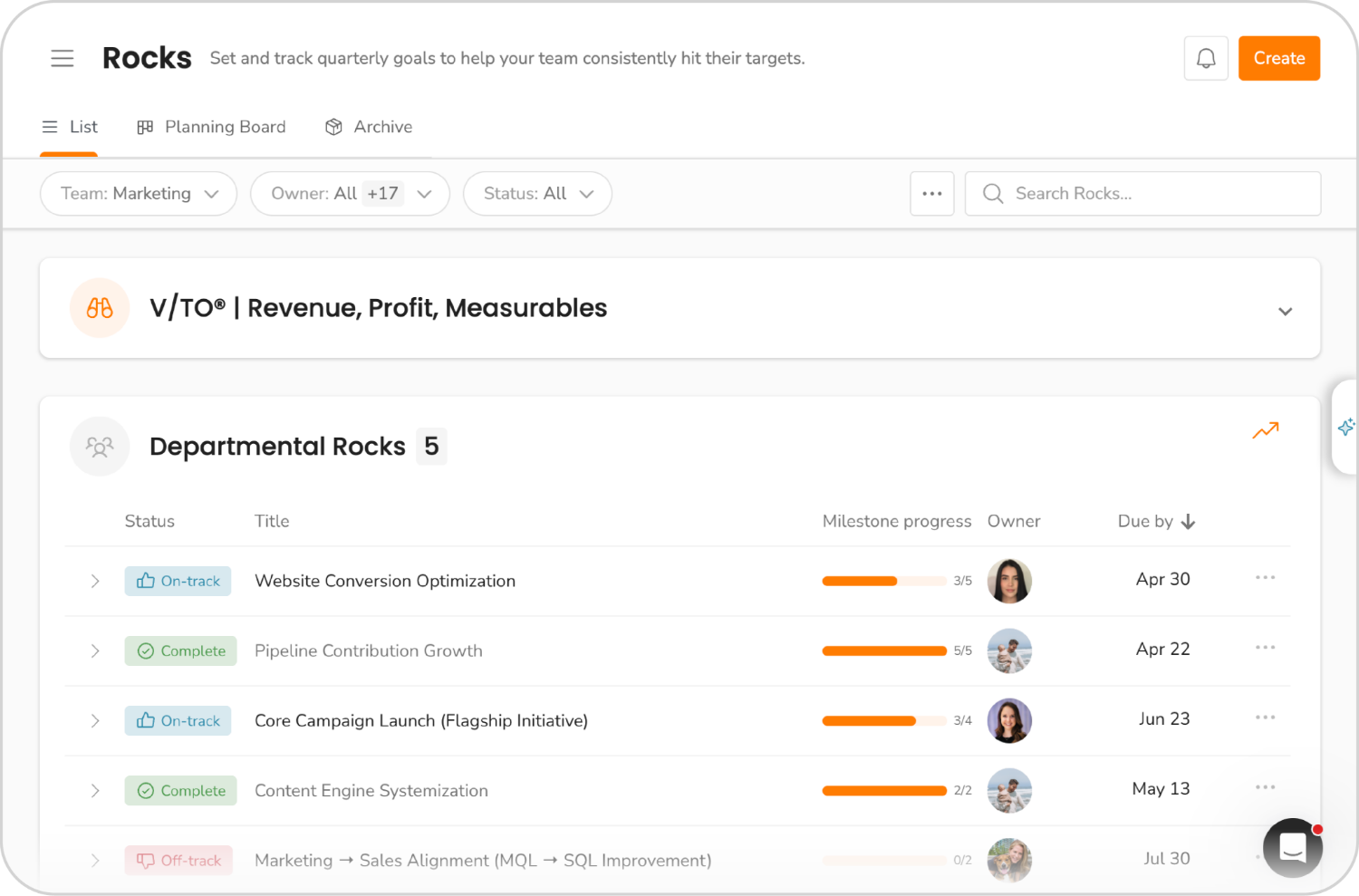
Now, when I prepare for Quarterly Planning, I use Ninety and Maz, Ninety's AI companion, to pressure-test those decisions before the quarter begins. It helps me think more clearly about what we’re committing to and whether it deserves 90 days of our focused attention.
How Do I Prepare My Team Before Quarterly Planning?
My team and I add Rock Candidates to our Long-Term Issues List throughout the quarter. Team members who have been with Ninety for a while are usually in the habit of doing this on their own, but I still remind everyone a couple of weeks before Quarterly Planning to add any candidates they’ve been thinking about.
I don’t ask them to fully build out the Rock at this point. A title, a description, and a few rough notes about what they want to accomplish is enough.
The goal is to come into Quarterly Planning with ideas we can actually discuss rather than trying to come up with ideas during the meeting. From there, we can look at each candidate together and decide which ones are worth committing to.
That also gives me a chance to see what the team is thinking about before we make final decisions. In the days leading up to the meeting, I go into the Long-Term Issues List and look at all of the potential Rocks. If I can see that several of them will be competing for the same people or resources, or if something doesn’t clearly connect to a department or company goal, I’ll make a note to discuss it in the meeting so we can work through that together.
What Should Team Leaders Focus on Before and During Quarterly Planning?
A team can leave Quarterly Planning with solid Rocks that have clear owners and detailed milestones but still be focused on the wrong things. I’ve seen it more than once, and as a department leader, I’m trying to make sure that doesn’t happen.
Before my team commits to a Rock, I want to know what it’s going to do for the business. I ask questions like:
-
What company or department goal does this support?
-
Can we realistically finish this in the quarter?
-
Can we do it without sacrificing the quality of the work we already own?
I also look at how our Rocks connect to one another. If they’re dependent on each other, I want to know that before the quarter starts. If another department is already working on something similar, I also want to figure that out before we commit.
For every Rock we take on, I want my team to be able to answer:
What will be different at the end of the quarter because we completed it?
When you choose the wrong Rocks, they keep your team busy without really moving anything important forward. You can complete every milestone and still realize the work didn’t have the impact you expected. That’s why I’d rather challenge the Rock during planning than question its value at the end of the quarter when we’ve already sacrificed the time and energy to complete it.
How Do I Make Sure Our Rocks Work Together?
One of the harder parts of Quarterly Planning is looking beyond each individual Rock and seeing whether the full set of commitments makes sense together.
For example, last quarter, I had three Rocks that overlapped in some capacity. There were good reasons to keep them separate, and each one made sense when I looked at it on its own. When I reviewed them together with Maz, it pointed out dependencies between the three and showed me where one delay could put other work at risk.
This is one place where AI can add another layer to the planning process. When you’re looking at several Rocks at once, a tool like Maz can help you see relationships between the work and call attention to patterns or overlap you might not have noticed on your own.
Some work needs to happen before other work can start, and several Rocks may depend on the same people, decisions, systems, or information. Reviewing them together gives me another chance to see those connections early enough to adjust the plan before they start causing problems during the quarter.
.png?width=700&height=638&name=Ask_Maz_Landing_Christine%20(1).png)
How Do I Look for Overlap Across Other Teams?
Different departments can end up working on similar or adjacent Rocks without realizing it. I've seen quarters where a team was working on similar projects to another and no one realized it until we were already deep into the work. Everyone was trying to move the company forward, but duplicating effort like that isn’t a good use of anyone’s time.
This is another place where AI can help, especially when it’s built into your business operating system like Ninety. You can ask it to look across Rocks from different departments and point out similar or related work. That gives leaders a chance to see where teams should collaborate, where ownership needs to be clearer, or where one team may be depending on another.
As Head of Demand Gen, I need to know what my own team is committing to, but I also need visibility into what’s happening across Product, Sales, Customer Success, and the rest of the company. Seeing those connections earlier helps my team make better decisions about our own priorities and avoid finding out later that two teams were solving the same problem separately.
How Do I Turn a Rock Candidate Into a Clear Commitment?
Once we’ve decided a Rock belongs in the quarter, there’s still work to do before it’s ready to execute.
One of my recent Rock candidates was focused on improving conversion rate optimization, or CRO. I had rough notes about what I wanted to test and how many tests I wanted to run, but I hadn’t worked out the full plan yet. When I went to convert it into a Rock, Maz asked whether I wanted it to draft the Rock or ask me more questions first. I chose the draft.
Within about a minute, it had organized the tests in a logical order and helped turn my notes into SMART descriptions and milestones. I still needed to confirm the timelines, but I had something much more complete to review and refine.
We had already decided the CRO work belonged in the quarter. Ask Maz helped me take that decision and turn it into a Rock that was much closer to being ready to execute, without spending another 30 or 45 minutes building the structure from scratch.
Ask Maz isn’t deciding what my team should work on. My team and I still make those decisions together. It helps us take the priorities we’ve chosen and get them into a form we can execute better.
How Can You Prepare Your Team Before Quarterly Planning?
If you lead a team, the work starts before you get into the Quarterly Planning Session. I want my team coming in with enough thought behind their Rock candidates that we can spend our time deciding what belongs in the quarter, not trying to come up with ideas from scratch.
A few things I ask my team to do ahead of time:
-
Add Rock candidates as they come up: When something feels like it could become a priority for the next quarter, add it to the Long-Term Issues List. I still remind the team a couple of weeks before Quarterly Planning to go back through their work and add anything they haven’t captured yet.
-
Add enough context to understand the idea: In the notes, explain what you’re proposing and what problem or opportunity is behind it. I review the Long-Term Issues List before the session, so this gives me enough context to understand the candidate before we’re all in the session room together.
-
Describe the impact you expect it to have: Add a few notes about what should be different if we complete the Rock. That could be an improvement for the department, the company, or our customers. I want us discussing the outcome, not just the work involved.
-
Explain why it belongs in this quarter: Add why this needs attention now and what company or department goal it supports. That helps us separate good ideas from the work that actually deserves 90 days of focus now.
That gives us better material to work with when we get into planning. Instead of starting from a blank page, we can spend our time comparing the candidates, asking questions, and deciding which ones are worth committing to.
What Does Better Quarterly Planning Look Like?
For me, better Quarterly Planning starts before the meeting even starts and continues after we’ve chosen our Rocks.
I want my team thinking about Rock candidates ahead of time. I want us to talk through what each priority is supposed to accomplish. I want to understand dependencies and overlap before they become problems. And once we choose our Rocks, I want them clear enough that people know what they’re committing to and the impact they’re going to have on the company as a whole.
By keeping track of it all in Ninety, we have one place to keep that work visible so none of our ideas get forgotten. We all use Maz to help us work through some of the details, make our Rocks SMART, and set and keep track of our milestones.
Using that technology to help us along the way doesn’t take the place of my leadership or my team’s judgment. We still have to decide what deserves our attention and what we can realistically commit to for the next 90 days. The difference is that I can go into the quarter with more confidence that we’ve thought through those decisions before we start executing.
That’s a much better place to be than getting to the end of the quarter and asking whether all that work was worth it. When we’ve done the planning well, my team doesn’t just leave with a list of Rocks. They leave knowing why those Rocks deserve their time and what we expect them to change.


.jpg?width=500&name=large_Kris_Quarterly_Planning_EOS_Blog_Header_1920_x_1080%20(1).jpg)
.jpg?width=500&name=large_Owner_Bottleneck_EOS_Blog_Header_1920_x_1080%20(1).jpg)
.jpg?width=500&name=large_Leadership_Habit_EOS_Blog_Header_1920_x_1080%20(1).jpg)