
.jpg)

I’m never short on ideas. Some come from conversations with teammates. Others come up while I’m reviewing Scorecard data, working on a campaign, scrolling through LinkedIn, or participating in a webinar.
Sometimes those ideas are ready for action right away, like an article tied to a feature we just launched or a social media trend I want to share with the rest of the Marketing team before it becomes irrelevant. But some of them aren’t meant for right now. They need more context, research, or input before we can act on them (or before we can decide whether they’re worth pursuing at all).
For a long time, keeping track of those ideas was harder than generating them. In previous roles, I stored them in my Notes app or jotted them down on sticky notes at my desk. I was sure I would remember the best ones when Quarterly Planning came around, but that wasn’t always the case.
By the time I needed them, I might remember the general concept but I couldn’t remember all of the details around why an idea felt important at the time or what result I hoped it would produce. And some of my ideas I forgot entirely.
Since joining Ninety’s Marketing team, I’ve always used Ninety to prepare for our Quarterly Planning. It gives me one place to keep track of my Rock candidates, review the work my team is already doing, and make sure my ideas are connected to our longer-term goals.
Now when I prepare for an upcoming planning meeting, I don’t have to track down all of my notes hidden in random places or search for information in old spreadsheets and docs. I can actually use the time to review the information living inside Ninety, from data trends to current Rocks to goals, and decide which ideas are worth bringing forward for the upcoming quarter.
Here’s how I use Ninety to organize those ideas and better prepare for EOS® Quarterly Planning so I can help my team start the new quarter focusing on the work that will make the biggest impact.
Tracking Future Rock Ideas
The first place I go when preparing for Quarterly Planning is my team’s Long-Term Issues List in Ninety.
Whenever I have an idea that could become a future Rock, I’ve made it a habit to add it to our Long-Term Issues List. I also include detailed notes about why I think it could be a Rock, what outcome it may support, and any context I’ll want to remember later. It gives me a place to capture the idea while it’s still fresh without treating it like something we need to act on right away.
As Quarterly Planning gets closer, I review those ideas alongside our current and previous Rocks. Looking back helps me see what we’ve already completed, what may still need attention, and whether a new idea builds on work we’ve already done.
For example, I might have a Rock candidate tied to creating a new content series around a specific topic. When I review it later, I may realize the idea is still useful but doesn’t require a full quarter of focused work. In that case, I can move it into our regular workflow, turn it into a smaller To-Do, or leave it on the Long-Term Issues List until the timing is better.
Another candidate may require more sustained effort and have a clear outcome that can be completed within 90 days. That idea stays on my list so I can discuss it with the rest of my team during our Quarterly Planning Session.
Having that information in Ninety means I don’t have to search through old spreadsheets or rely on my memory to keep track of where an idea came from and how it connects to work we’ve already completed. It also means none of my ideas are forgotten, which I love, because even though it may not be meant for right now, doesn’t mean it’s not important.
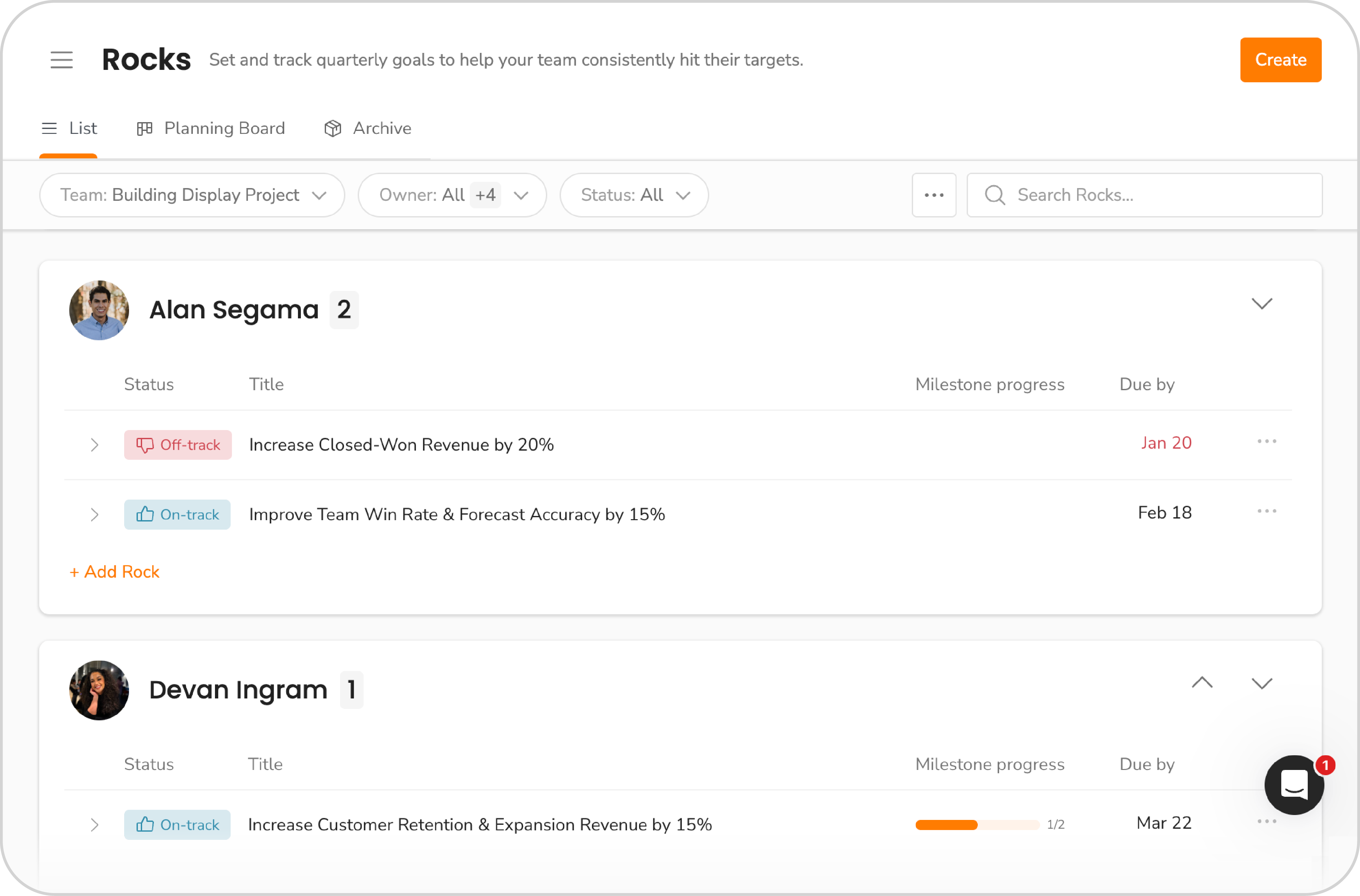
Narrowing Down My Rock Candidates
Once I have a working list of Rock candidates, I review our company vision and goals.
Looking at our 90-day goals, 1-Year Plan, and 3-Year Picture helps me see if there have been any changes to current priorities or where the company is headed in the longer term. It also helps me better evaluate how each idea supports what the business is trying to accomplish rather than choosing Rocks based only on what feels most interesting or timely to me.
By reviewing the V/TO®, I can easily see which candidates support our current goals and which ones should remain on the Long-Term Issues List to tackle in a future quarter.
From there, I ask a few questions to help me narrow down my list:
-
Does this idea support a broader company or team goal? I want to make sure the idea connects to work we’ve already agreed is important, instead of adding another priority that pulls our attention in a different direction.
-
Does it need the focus of a Rock? Some ideas are useful but don’t require 90 days of attention. They may be better handled as a To-Do, a smaller project, or part of our regular weekly work.
-
Can the outcome be completed within 90 days? If the idea is too broad, I may need to narrow the scope and define a more specific result that can realistically be completed within the quarter.
-
What will be different when the Rock is complete? I want to be clear about the result we’re working toward, not just the tasks involved. A strong Rock should have a finish line the team can clearly recognize.
-
Do I have the capacity to own it well? A Rock requires consistent attention throughout the quarter. I need to be realistic about whether I can give it that attention alongside my other responsibilities.
I don’t make the final decision on my own. But I use these questions to identify the Rock candidates I think are strongest, then I bring them into Quarterly Planning to discuss them with my team.
By preparing for the planning meeting, I’m able to explain why each idea deserves consideration, how it connects to our goals, and what outcome we could realistically achieve within the quarter. That gives the team a stronger starting point for our conversation on which Rocks should move forward.
Using Ask Maz to Prepare Better
Ask Maz is a newer part of how I prepare for EOS® Quarterly Planning. It’s Ninety’s AI companion, and it can answer questions using the business information our team already has inside Ninety. That means I can use it to brainstorm or pressure-test an idea without having to explain the company context first like I would with a generic AI platform. With Ask Maz, I spend less time explaining background information and more time working through the questions I have.
Instead of using it only to review possible Rocks, I can ask it to help me look across our V/TO®, Rocks, Scorecards, issues, and meeting history so I can spot patterns or potential overlap. I don’t have to dig through past meeting notes, review several tools one by one, or pull notes into another system. I can simply ask a direct question and start working through the answer right away.
Ask Maz improves the quality of my preparation because I can ask it to look at an idea from more than one angle or show me related information in Ninety that I may not have considered. That way, I can walk into Quarterly Planning with clearer questions and stronger context.
Here are a few questions I might start with:
-
What should I review before our next Quarterly Planning Session?
-
Which priorities may need more attention based on our recent activity?
-
What patterns are showing up across our Scorecard, Rocks, and issues?
-
Which issues have continued to come up in recent meetings?
-
How does this Rock candidate connect to our 1-Year Plan?
-
Is this outcome realistic to complete within one quarter?
-
What questions should I bring to my team about this idea?
If the first answer gives me something useful to explore further, I can keep going. I might ask Ask Maz to explain its reasoning, compare two ideas, or look at the question from another angle.
I don't let the tool make the final decision for me. It's still important that I use my judgment and work through the final decisions with my team. But it does give me a more efficient and effective way to prepare. I spend less time gathering information and more time understanding it, which lets me contribute at a higher level during our session.
How to Prepare for EOS® Quarterly Planning in Ninety
A strong Quarterly Planning Session starts with the work you do before the meeting. Ninety gives you one place to track your ideas, review current priorities, and prepare the questions you want to bring to your team.
Here are a few steps you can take so you feel better prepared for your next Quarterly Planning Session:
-
Add future Rock ideas to the Long-Term Issues List: Include enough detail to remember why the idea could be useful and what outcome it may support.
-
Review current and previous Rocks: Look at what's already been completed, what may still need attention, and whether a new idea builds on earlier work.
-
Check the V/TO to narrow down Rock candidates: Review the 90-day goals, 1-Year Plan, and 3-Year Picture so your ideas connect to where your company is going, not just your department.
-
Separate Rocks from weekly work: Decide whether an idea needs a full quarter of focused attention or whether it belongs in a To-Do or regular workflow.
-
Use Ask Maz to challenge your thinking: Ask questions about priorities, recurring issues, Scorecard trends, or possible Rock candidates before you bring them to your team.
-
Bring your strongest candidates into Quarterly Planning: You don’t need to come with every answer. You just need to come prepared to explain your ideas, the outcomes, and why they deserve discussion.
A little preparation before the meeting will make the planning conversation much more productive. You’ll spend less time trying to remember what happened and more time helping your team decide where to go next.
Prepare for the Next 90 Days With Ninety
I’m still going to be the person who has way more ideas than I can ever pursue, and that’s probably never going to change. But what has changed is how I manage them.
Ninety gives me a place to capture possible Rock candidates, connect them to our goals, and review them when Quarterly Planning approaches. Ask Maz gives me another way to work through the information so I can prepare both better and faster.
Now I show up to planning sessions with more than a list of vague possibilities. I come with ideas I’ve pressure-tested and a better understanding of how they support the company’s direction.
For me, that’s the biggest benefit of preparing for Quarterly Planning in Ninety. My team spends less time searching for information or trying to remember why an idea was worth considering. That gives us more time to focus on the priorities that will make the biggest impact over the next 90 days.