


You’re in the office at 5:00 a.m. on the first business day after New Year's. You’ve been anxious to get back to “normal” work since mid-December. You feel the weight of the year ahead and the pressure to start the first quarter strong, knowing it’s going to lay the foundation for the rest of the year.
By 8:30 a.m., the rest of the team is just starting to arrive. You get a call that your sales leader is out sick, an email from a client you were counting on saying they’re delaying due to budget concerns, and then you hop on to your weekly operations meeting where one person is late and another can’t get their video to work.
Ahhhh… What the &%*^ is wrong with these people?
You don’t say anything directly, but inside you are pissed (and a little scared?). You push through the day trying to get as much done as possible: returning emails, closing the loop on prospects, answering those nagging bookkeeping questions, and cramming in a quick lunch while you work.
It feels like you’re the only one who’s focused while everyone else is still strolling into the year. No one carries the same weight or responsibility you do as an owner or key leader, and that often shows up as frenetic energy.
The question is: How can you channel that energy into urgency, clarity, and focus that can be shared with your entire organization?
The Power of Focus
I first learned the exponential power of focus as an Army Drill Sergeant. In 2009 at Fort Knox, Kentucky, I received my first batch of new recruits and had 10 weeks to help turn them into elite soldiers. One of the key milestones in Army basic training is qualifying on the M16.
As I prepared to deliver the best instruction I could, I made a discovery that completely shifted the way I think about marksmanship and the power of focus. When aiming a weapon, most people focus on the target they're trying to hit, while the front sight of the weapon is out of focus. This is intuitive and the way most people aim. That’s the way I aimed while successfully navigating Army boot camp, drill sergeant school, and multiple promotions.
As I researched the best way to train my soldiers though, I discovered that I (and the vast majority of my fellow soldiers) had been aiming incorrectly all along.
The proper way to aim, and the way elite shooters aim, is counterintuitive. Instead of focusing on the target you're trying to hit, you should focus on the front sight of the weapon and let the target be blurry or out of focus. This engages an instinctual super power that we all share, one that creates perfect alignment.
When I trained my soldiers to focus on the front sight instead of the target, my platoon set all-time records for rifle marksmanship qualification at Fort Knox, Kentucky bootcamp, and I went from being an average shooter to an expert hitting 40 out of 40 targets.
The point? Shift where you focus and everything changes.
So how can we get both ourselves and our teams to focus on the right things and avoid the three common focus traps that slow us down? Let's dive in.
Focus Trap #1: Mistaking Activity for Effectiveness
You’re in the middle of Q1, and everyone seems to be working hard. There’s lots of activity, everyone is saying they are busy (and even overwhelmed), yet somehow, you still aren't hitting the early targets that will lead to a successful first quarter and year.
While you love to see your team working hard, you don’t feel in control or confident that you're going to produce the results you really need.
Most people are naturally inclined to stay busy and try to do a good job. The problem is, if that effort isn’t focused on activities that drive results, it’s wasted time and energy. And when that happens in the first quarter, it sets a precedent for the rest of the year and puts you at a major disadvantage in hitting your key goals.
So how do you keep your team focused on effectiveness over activity?
- Communicate: Communicate the 3–7 most important results for the first quarter and for the year. Coming out of the holidays, even if you’ve done great annual planning, most people have already forgotten what truly matters. Make sure you and your key leaders are consistently reminding the entire team of the results you must deliver.
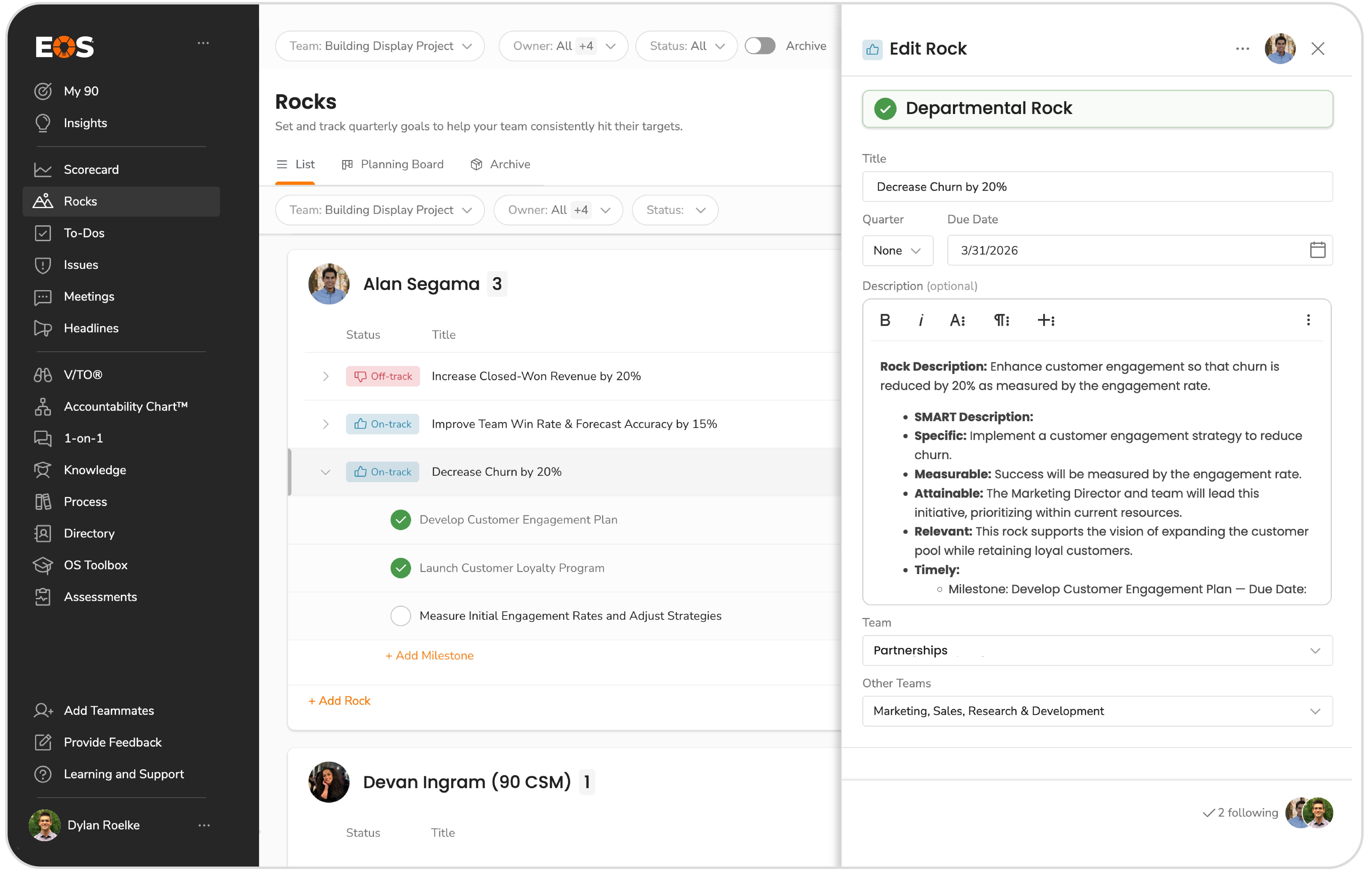
- Coach: To get all of that human energy moving in the same direction and avoid wasting time and money on “busyness,” each leader must make sure their direct reports have 3–7 priorities for the first 90 days that tie directly to the company’s top 3–7 goals. A great coach makes sure those priorities (or Rocks, as we call them in EOS®) are SMART: Specific, Measurable, Achievable, Relevant, and Time-Bound.
- Follow-Through: Establish a weekly rhythm where you revisit the 3–7 priorities for the quarter, keeping them in front of the team and proactively tackling any obstacles that could block results.
Focus Trap #2: Too Many Priorities
If you’re like many of the most talented and brilliant leaders I've worked with, you have incredible discipline, have an inner drive that runs circles around most people, and a to-do list a mile long that you faithfully tackle every day. You work as long and as hard as you can until you’re either out of energy or out of hours.
This may work for you as the owner or key leader of your organization because you’re wired differently than most. The problem is, if you give your team 20 priorities, most people will naturally gravitate toward the comfortable, easy tasks and avoid the truly challenging ones.
They may even work really hard, but that effort doesn’t translate into achieving the most important results, like improving operational efficiency, addressing people issues head-on, or getting the sales team performing at a high level and landing key contracts in the first quarter.
You’ve got to have the discipline to narrow down the top 3–7 goals for the year, break those into the top 3–7 for the first quarter, and then go one step further so each person is crystal clear on the 1–3 things they must get done in the first 90 days.
Here are three action items to help you do that:
- Consolidate: Take your long to-do list and consolidate it into 3–7 priorities for both the year and the quarter for the entire company.
- Prioritize: Work with department and team leaders to identify their 3–7 priorities for the year and quarter, and then narrow that down to 1–3 priorities for each individual team member.
- Clarify: Determine who is accountable for each of the goals and priorities. Many people might contribute, but only one person can fully own the result. As we often say in EOS®, “When two people are accountable, no one is accountable.”
Focus Trap #3: Avoiding Difficult Conversations and Decisions
Great leaders drive performance by addressing difficulty head-on. We often turn to military and sports examples in business because the cost of inaction and ineffectiveness is obvious. In the military, avoiding tough conversations or decisions can cost lives. In sports, the scoreboard tells the truth. There’s no hiding or pretending the team is performing well when it’s not.
Leaders who want to help their company and their people reach their full potential must be proactive and courageous in addressing uncomfortable conversations and making tough decisions.
When we avoid taking action or diving into discomfort in business, we put the quarter at risk, then the year, and ultimately the fate of the company.
Would a championship coach avoid a difficult conversation with their team when they're losing at halftime? Would a military leader on the battlefield tiptoe around poor performance on a critical mission objective? To put it simply, hell no. They can’t afford it and neither can you.
The advantage military and sports leaders have is that urgency is clear and obvious. As a business leader, you have to create your own scoreboard and lean into your intuition when you sense the company or a department is off track.
Here are some ways to do that:
- Create or update your scoreboard (in EOS®, we call this a Scorecard): It doesn’t have to be perfect, but you as a leader need 5–15 measurables that give you a clear view of how your company, department, or team is performing. This lets you predict whether you’re winning or losing during the quarter. If you don’t know the score, you’re stuck waiting until the end of the quarter or year to see how you did, and you miss the chance to deliver the half-time pep talk or solve key issues while there’s still time.
- Don’t procrastinate on addressing key issues: I see it in myself and in many leaders I work with: We love to give people the benefit of the doubt and wait until we’re at our absolute limit before doing what we already know needs to be done. Championship teams make adjustments and call out anything or anyone getting in the way of the shared goal. Ask yourself this: What’s the one decision or action I'm avoiding that I know is for the greater good of the business?
- Don’t beat around the bush: Imagine a military leader in the heat of battle who needs the Bravo Team to provide cover fire while the Alpha Team moves to a hill 100 meters to the east. Under enemy fire, with the whole platoon at risk, they’re not asking politely. They say, “Bravo Team, provide cover fire to the north. Alpha Team, move 100 meters to the east. Ready… execute.” No ambiguity. Just clear direction. Now, you may not be on a battlefield, but when your company’s priorities are at risk and you see underperformance, you have to communicate just as clearly about what’s not working, what needs to happen, and by when.
Turning Focus Into Real Results
When you strip it all down, focus is a leadership choice. You can let the year happen to you, lost in activity, too many priorities, and avoided conversations, or you can narrow the targets, give every person clear Rocks, and use your Scorecard and meetings to address issues head-on.
When you do, that restless energy you feel at the beginning of the quarter turns into alignment, accountability, and real progress that compounds quarter after quarter. The work is simple, not easy. But if you commit to these action items, your team will stop strolling into the year and start moving with intention.
If you’re ready to turn focus into real Traction®, start building your EOS® tools inside Ninety. Try Ninety free and experience how much easier it is to keep your team aligned, accountable, and moving in the same direction every week.


.jpg?width=500&name=large_Employee_Performance_Goals_EOS_Blog_Header_1920_x_1080%20(1).jpg)
.jpg?width=500&name=large_To-Dos_Help_Teams_Build_EOS_Blog_Header_1920_x_1080%20(1).jpg)
.jpg?width=500&name=large_EOS_Check-in_EOS_Blog_Header_1920_x_1080%20(1).jpg)