.jpg)

It seems everyone has something to say about meetings. Many say they’re unorganized, ineffective, and mostly a waste of time. Others say they lack clear decisions, there are too many, and they often don’t have the right people in the room to make things happen.
But if you ask the more than 50 clients I’ve coached who are Running On EOS® Powered by Ninety, they’ll tell you the Level 10 Meeting® changed the way they work.
Professional EOS Implementers like myself teach the weekly Level 10 Meeting as one of the 20 tools in the EOS Toolbox™. It’s a proven, world-class meeting format that’s currently being followed by tens of thousands of companies. Why? Because it keeps everything on track, keeps every team member aligned, establishes accountability, and helps solve the most urgent and important issues. It’s a core driver for gaining Traction®.
This article will explain what a Level 10 Meeting is and how it works. We'll dive into the agenda and talk about the ways we use it to stay informed, engaged, and aligned. When you see how effective this meeting agenda is for yourself, especially when automated in EOS Powered by Ninety, you’ll understand why it makes such a difference.
What we'll cover:
What Is a Level 10 Meeting?
A Level 10 Meeting is the weekly EOS meeting used by leadership teams to stay aligned, review priorities, solve issues, and create accountability.
The meeting runs for 90 minutes and follows the same agenda every week: Segue, Scorecard, Rock Review, Headlines, To-Do List, IDS®, and Conclude. The structure may be simple by design, but it's incredibly powerful. It keeps the team from spending entire meetings focused on status updates, side conversations, or problem-solving the wrong issues.
In 90 minutes, a team uses the same agenda every week to:
- Transition the team to working on instead of in the business
- Create consistent reporting on what matters
- Review prioritized commitments
- Establish weekly accountability
- Solve the most urgent challenges and opportunities
- Evaluate whether the meeting time was used well
The goal isn't to have another meeting. It's to create a weekly discipline where the team can step out of the day-to-day, look honestly at what’s working and what’s not, and solve the most important issues before they slow the business down.
At the end of each meeting, the team rates it from 1 to 10. That score helps the team improve the meeting over time, which is where the name Level 10 Meeting comes from.
Why Is It Called A Level 10 Meeting?
As part of the EOS Proven Process, when we first meet with leadership teams, we ask them to rate the quality of their meetings on a scale of 1 to 10. The prevailing view is people haven’t found meetings nearly as helpful as the amount of time invested in them, with many rating their meeting effectiveness at a 4 on a 1–10 scale, with 10 being the best.
That’s not healthy or productive.
When running on EOS, we’re aiming for a 10. We’re looking for honest assessments because we strive for improvement at any opportunity. So when our Level 10 Meeting is ending, the last item on the agenda is to rate the meeting on a 1–10 scale. However, a 10 is not about perfection. It's about performance.
So often, I hear from early clients statements like “Well, I’m a hard grader” or “I don’t give 10s because there’s always room for improvement.”
The reality is that the usefulness of the rating is to assess our performance and improve on a weekly basis. So when we rate the meeting, we ask:
- Did the Level 10 Meeting start and end on time?
- Did we follow our agenda? (No tangents.)
- Are we on the same page?
- Did more than 90% of our To-Dos get to done?
- Did we solve the most important and urgent issues?
With that context in hand, let’s now establish guiding principles and the agenda to see the power of the Level 10 Meeting. (Spoiler alert: Running a Level 10 Meeting in the Ninety software automates the structure and the flow so you can focus on execution.)
“When we began implementing EOS, I learned we would be carving out 90 minutes each week to discuss our issues openly and honestly and thought, ‘This guy is crazy. Does he not understand we have a business to run?’ Four years later, we get anxious when one of us is not in attendance for our weekly L10s.”
— Chris Finnecy, Managing Partner (Integrator™), TrellisPoint
What Makes a Level 10 Meeting Work?
A Level 10 Meeting works because the team commits to a consistent meeting pulse.
It’s not easy, but it is simple. Here are five points to establishing a strong rhythm:
- Meet on the same day
- Meet at the same time
- Use the same agenda
- Start on time
- End on time
By living these five principles, you create a routine, something to build upon week after week. Truth is, the first few meetings aren’t always smooth. It takes some getting used to before you find a rhythm and buy-in to the discipline of how much time should be allocated to each agenda item. But once you’ve got a level of comfort with it, you’ll see the benefits in team health and communication. You’ll see how these meetings support Traction and you start to actually look forward to the weekly focus time.
Ninety helps teams keep the Level 10 Meeting focused by guiding the agenda, timing, and flow. Watch this short overview to see how it works:
In this video, Christine Watts, Head of Professional Services at Ninety, shows you how Ninety supports the Level 10 Meeting structure, helping teams stay on track, review priorities, and move through the agenda with discipline.
The EOS Level 10 Meeting Agenda
Here, we’ll outline the Level 10 Meeting agenda and the duration for each component. Then we’ll go through each section in greater detail:
- Segue: 5 minutes
- Scorecard: 5 minutes
- Rock Review: 5 minutes
- Customer/Employee Headlines: 5 minutes
- To-Do List: 5 minutes
- IDS® (Identify, Discuss, Solve): 60 minutes
- Conclude: 5 minutes
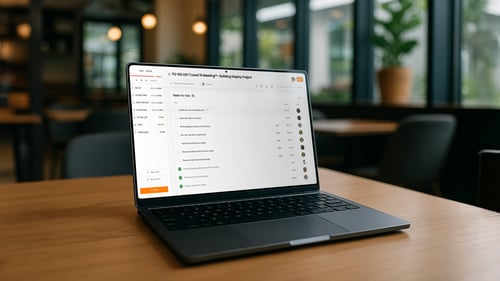
If you watched the video above, you noticed that having a Ninety software meeting manager removes the setting up and support aspects of running the meeting’s timing and flow. This is especially useful when you first begin the practice of the Level 10 Meeting. We recommend setting roles in the meeting: a facilitator who guides the team through the agenda and a scribe or a person to capture the information and next steps in the software.
I’ve also found it very helpful to rotate these roles in the leadership team as they work on mastery before deploying this meeting framework to their departments. Once the team has built the habit, the same meeting framework can be deployed to departments with more consistency. Now, let’s go deeper on each agenda item.
Segue
This is a time to share updates that represent our personal and professional “good news” of the past week. By sharing the news, we’re connecting on a human level and increasing team health through shared stories.
I like to think of it as getting our empathy triggers active so we’re ready to be open, honest, and vulnerable as we begin the hard work of running a meeting worthy of a 10 rating.
Scorecard
This is an opportunity for teams to examine the 5–15 most important activity-based numbers related to their work at a high level. It’s a quick report just to make sure things are on track for the week.
Anything that doesn’t look right will be discussed in the Issues portion of the meeting, so don’t dwell on it or burn time on it here. We like to say, “Drop it into the Issues List” if something needs more time to discuss.
Rock Review
This is where you review your 90-day priorities and simply say whether they are on or off track. Like the Scorecard review, this is just a quick thumbs up or down on the status of your Rocks. If it’s off track or someone wants to discuss the status in greater detail, you save that discussion for the IDS segment by dropping it onto your Issues List.
Headlines
Any updates (good or bad) related to customers, employees, or both? This is the time to share them. These are 1–2 sentences that could cover anything from good news received from an customer, an announcement about organizational new hires, or simply letting people know about upcoming out of office plans. However, if it takes more than 1 to 2 sentences to explain, then “drop it down” to the IDS section.
To-Do List
This is a list of those seven-day action items people have committed to. The facilitator leads the team through a review of all the To-Dos from the prior week’s meeting.
Here, it’s all about accountability and accomplishing more as a team. Together, you review each item on the To-Do list, note that it’s “done” or “not done.” If it’s done, check the box. If it’s not, either leave it on the list and get a commitment to get it done by next week or “drop it down” to the IDS section.
Rule of thumb: 90% of To-Dos should be “done” every week.
IDS (Identify, Discuss, Solve)
This is where the Level 10 Meeting shifts from reporting to solving. You’ve collected all the items “dropped down” earlier, plus any from previous weeks and any new ones added since the last meeting. Now's the time for working to solve them.
Start by reviewing the list of issues and asking if anyone has new issues to add. Then, if it’s a long list, I like to take a pass-through and get the team to keep, kill, combine, or move items.
- “Keep” means it’s still relevant for us to work on
- “Kill” means it’s no longer relevant
- “Combine” happens when two items are similar and we don’t need both
- “Move” happens if an issue in the leadership team can be moved to a department meeting
Once the Issues List is clear, the team selects the most important issues to solve this week. In Ninety, team members can rate issues on a 1–5 scale to help prioritize the list. From there, the facilitator guides the team to a starting point and moves the conversation into IDS®: Identify, Discuss, and Solve.
- Identify is simply getting to the core issue and not the symptom of the challenge/opportunity.
- Discuss is a chance for the team to give input. The goal is to stay grounded in facts and relevant experience so the conversation doesn't drift into assumptions or opinions.
- Then, it's time to Solve. The issue has an owner, and after some intense collaborative work, the solution should become apparent. It often results in a To-Do assigned to a team member who will take action on the decided solution.
Coach’s Note: Often, people show up to the Level 10 Meeting without preparation. The goal is to populate all items before the meeting starts, including the most recent Scorecard data and issues. Great leaders do the work. They come prepared to use meeting time wisely. Using Ninety to run your meetings helps the team come prepared by keeping all of that work in one place. When the meeting starts, the team isn't looking for updates or information. Everything is visible to the team so they can come ready to focus, prioritize, and solve.
Conclude
So, how did you do?
This is the time to rate the meeting and ensure it’s been effective, productive, and worth everyone’s time. As I mentioned earlier, we’re aiming for 10s here. Sure, a 9 or an 8 is fine, though it’s nice to have a little context added for where or how the meeting fell short. But if someone offers a rating below 8, you really want to understand the reason and see how the team can do better the next time around.
That’s why there are a few minutes allocated to this section. Giving the rating takes just seconds. But in the event a low rating is given, you'll want time to hear why so you can learn how to perform better next week.
.png?width=7085&height=4500&name=Level_10_Meeting_Product_Shot%20(1).png)
What Impact Do Level 10 Meetings Have?
After running a handful of Level 10 Meetings, you truly get a feel for how the work you do supports larger goals and the overall vision. Describing the impact of these meetings is probably best done by Gino Wickman and Mark Winters, co-authors of Rocket Fuel:
“By setting 90-Day Priorities and implementing the Weekly Level 10 Meeting, you create both a 90-Day World and a weekly focus. You keep the circles connected between the Visionary, the Integrator, and the Leadership Team. You gain tremendous traction toward your vision. You are now doing what the successful V/I duos do. Your past frustrations start to subside, and you make progress on your way to helping your company and relationship evolve from chaotic to a well-oiled machine.”
When Should You Start Running Level 10 Meetings?
Of the hundreds of companies I have interacted with running on EOS and powered by Ninety, no one has ever said, “I wish I would have waited longer.” Most of the time, they say, “I waited too long.”
So start today! Read my book Meetings Kinda Suck, check out this article on how to run a Level 10 Meeting in Ninety, and start a free trial of Ninety today.
Once you get started and are curious to learn more, then sign up for a 90-Minute Meeting with a Professional EOS Implementer®. You will leave that meeting with clarity about your next steps in implementing EOS.
Why Run Level 10 Meetings in Ninety?
The Level 10 Meeting works because it gives leadership teams a clear weekly structure for staying focused, solving issues, and following through on commitments. The agenda itself isn't complicated, and teams have run it for years using paper, spreadsheets, slide decks, and general project management tools.
The problem is that those tools weren't built around the way EOS® teams actually work. Your Rocks may live in one spreadsheet, your Scorecard in another, your Issues List in a shared document, and your To-Dos in a separate task app. That setup can work for a while, but over time it creates extra work for everyone (and so much easier for important things to get missed).
Ninety brings the core parts of the Level 10 Meeting into one place so your team can review the Scorecard, check Rock progress, confirm To-Dos, surface customer and employee Headlines, and move into IDS® without jumping between files or rebuilding the same agenda every week. The meeting stays focused because the work is already organized around the EOS rhythm.
Ninety doesn't replace the discipline of a strong Level 10 Meeting. It supports the discipline by making the tools easier to use, easier to see, and easier to keep current across teams.
When you run your Level 10 Meeting in Ninety, accountability becomes more visible. Each To-Do has an owner and a due date. Issues can be captured when they show up and prioritized when it is time to solve them. Rocks and measurables stay connected to the weekly conversation so your team isn't relying on memory or manual updates to know what needs attention.
The outcome is simple: a cleaner meeting, better follow-through, and a team that spends more time solving real issues.
Join the thousands of companies running Level 10 Meetings on Ninety. It's your turn to run the most productive meetings you’ve ever experienced. Start your 30-day free trial today.
Want help getting started? Our team can help get you up and running on Ninety in less than 30 minutes. Talk to our team.