
.jpg)

I was working with a sibling leadership team recently when an issue about purchasing authority took an unexpected trip back to childhood.
The business issue was straightforward: Branch managers were ordering stock outside the agreed limits, tying up cash, and creating headaches in the warehouse. The older brother wanted all significant purchases approved centrally. His younger sister said that would slow the branches down and just create another bottleneck.
He said, “This is what happens when nobody follows the rules.”
She replied, “No, this is what happens when you change the rules after we agree to them.”
Their father, the Founder, stepped in. “Right. That’s enough. We’re not doing this here.”
The non-family Finance Director looked down at his notes. The Operations leader stopped contributing. The person running the meeting tried to return everyone to the purchasing issue, but everyone had already moved somewhere else.
The siblings were no longer discussing stock. They were arguing about who gets heard, who gets to decide, and whose version of history wins. It was a 20-year-old argument wearing a business costume. Everyone knew it, but nobody said it out loud.
The issue was parked, which protected the family from an uncomfortable moment but did absolutely nothing for the cash tied up in the warehouse. Sunday lunch was probably a delight.
In most businesses, IDS® asks people to separate the issue from their ego.
In a family business, IDS asks them to separate the business role from the family relationship, the ownership position, and several decades of emotional evidence. That's why it's harder.
Running on EOS® gives the team a strong process. It doesn't erase family hierarchy at the door, but that's also why family businesses need more structure around the conversation, not less.
Nobody at the Table Is Wearing Just One Hat
A family business has three overlapping systems: the family, the ownership group, and the operating business.
That sounds simple until you look at the people around the table. One person may be Dad, the majority shareholder and the CEO. Another may be his daughter, a future owner and the Head of Marketing. A third may be a non-family Operations leader with significant business responsibility but no family status and no ownership voice.
All three can be discussing the same issue from completely different positions.
The Three-Circle Model, developed at Harvard Business School, makes those overlapping roles visible. It reminds us that a disagreement may be happening in the business circle, while the emotional reaction is coming from the family circle, and the power to decide sits in the ownership circle. That's a lot to fit into one agenda item.
A Founder may believe they're making a sensible commercial point. Their adult child may hear a parent saying, “I still don't trust your judgement.”
A sibling may believe they're challenging a poor decision. The other sibling may hear the same criticism they've heard since they were 14.
A non-family executive may have the clearest view of the issue, but also know that disagreeing with the CEO means disagreeing with Dad, the controlling shareholder, and the person hosting Christmas.
This isn't necessarily a sign that all family businesses are dysfunctional. It's a sign that roles matter.
The problem begins when nobody says which role they're speaking from. A shareholder concern gets presented as an operational instruction. A family grievance appears as a performance issue. A parent uses their Founder authority to end a business debate because the family tension feels unpleasant. When the circles blur, the team starts solving the wrong issue in the wrong room.
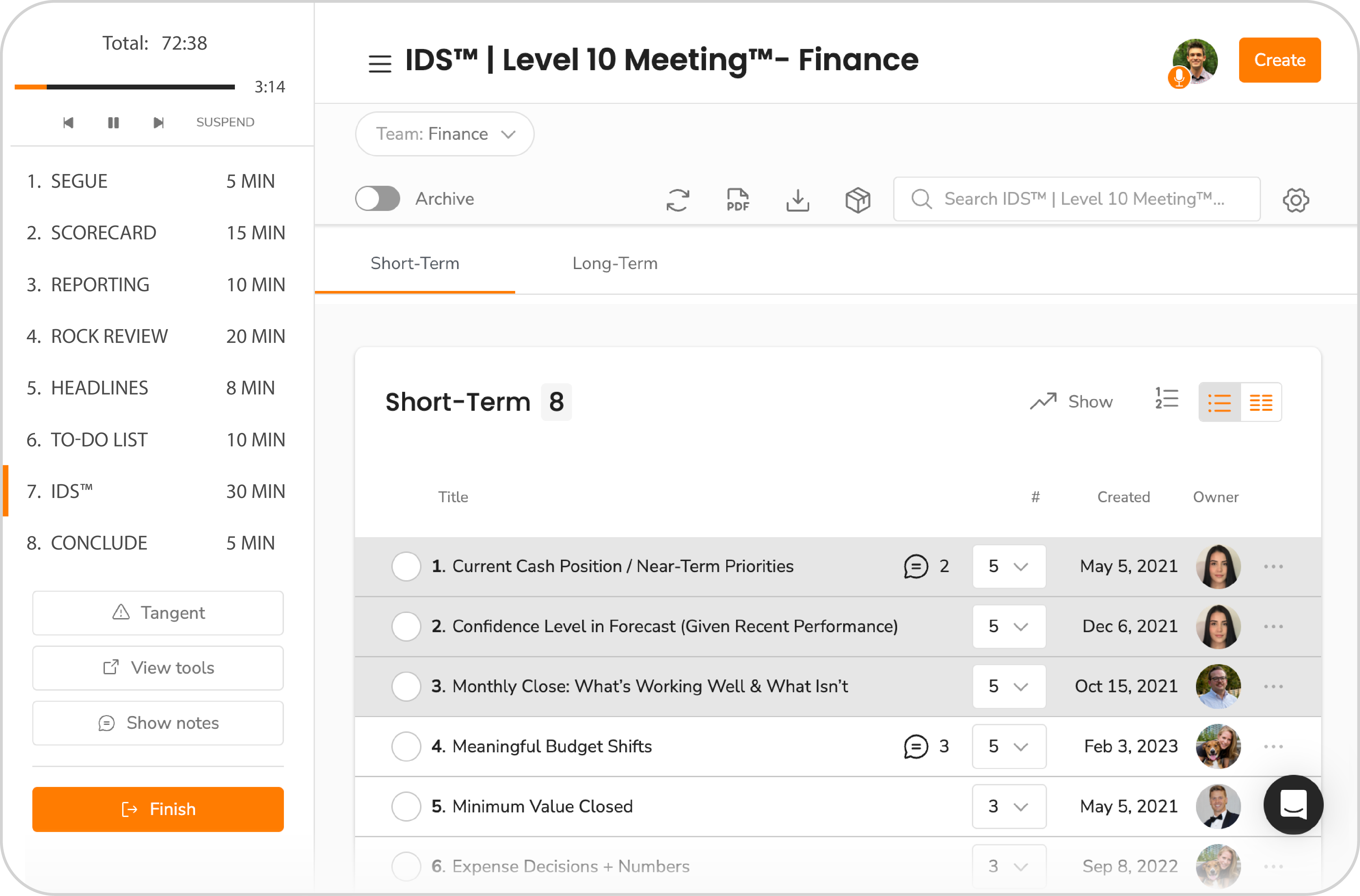
A Level 10 Meeting® is a business meeting. It's not a family council, a shareholder meeting, a succession conversation, or family therapy with a Scorecard. Those other conversations may be essential. They simply need the right forum, the right people, and a clear purpose.
Trying to solve all three systems at once is how a 10-minute purchasing issue becomes a 45-minute tour of family history.
The Three Usual Suspects in Family Business IDS
The details may vary, but three patterns appear again and again.
1. The Founder is still Mum or Dad.
A family business can have a perfectly sensible Accountability Chart, yet the emotional chain of command may still run through the parent.
The Founder may say, “I’m only asking a question,” while everyone else hears a decision. They may invite honest debate, then become visibly disappointed when an adult child disagrees. They may step in to keep the peace, overturn a decision after the meeting, or rescue a family member from accountability.
Usually, this comes from care. Unfortunately, care without clear boundaries can create confusion.
The next generation learns that authority is conditional. Non-family leaders learn that family hierarchy outranks business roles. The Founder becomes the final stop for every difficult issue, then wonders why nobody else takes ownership.
The fix isn't to silence the Founder. It's to make their role explicit.
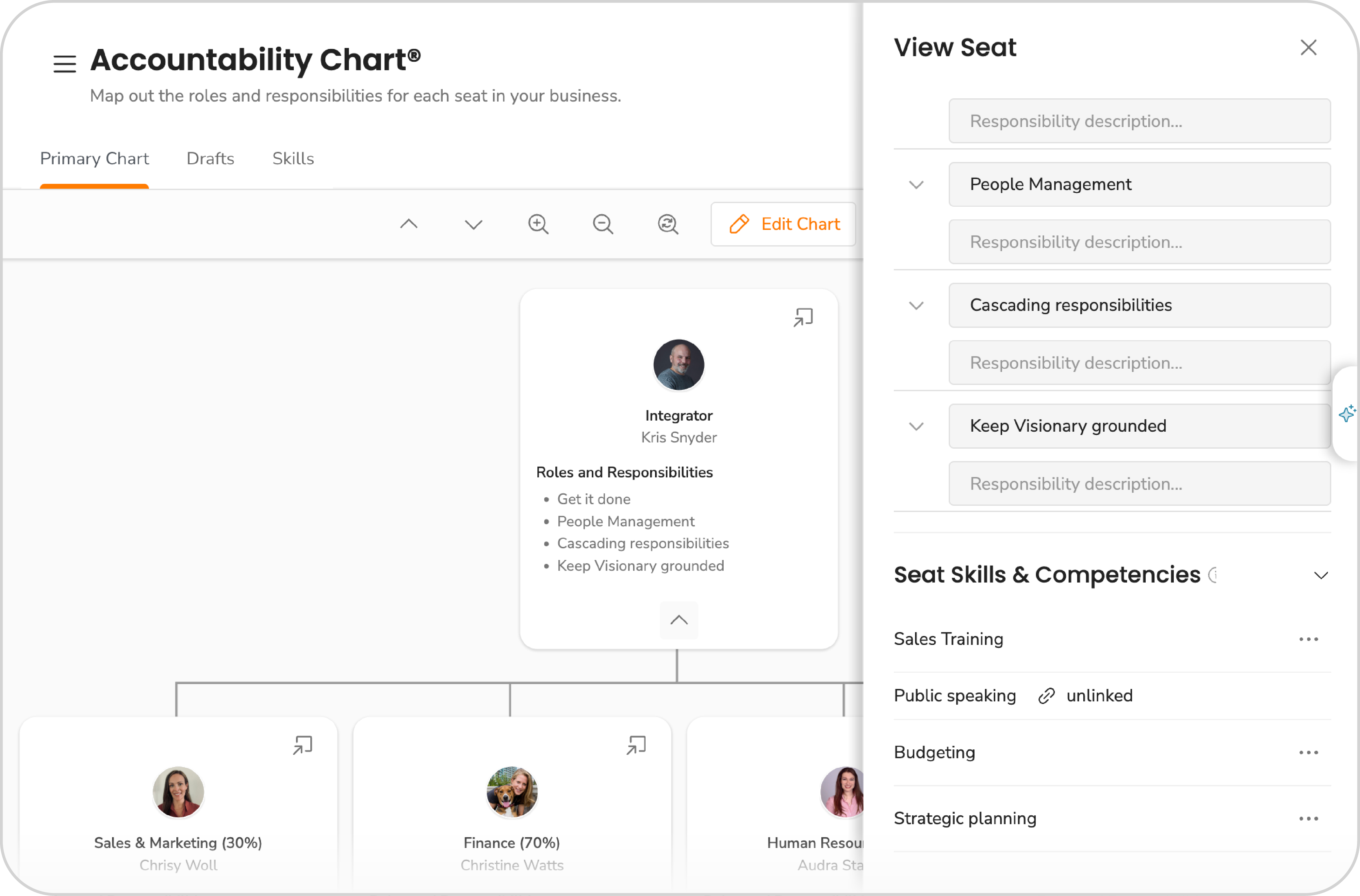
Are they speaking as a parent, an owner, the CEO, or the person accountable for a particular Seat? Each role may have a valid perspective, but it doesn't carry the same decision rights in every conversation.
2. Birth order follows the siblings into the business.
The business may have an Accountability Chart, but the family has had a different one since childhood.
The eldest may be treated as the natural authority, even when a younger sibling owns the relevant business function. The youngest may fight harder to be heard because they're accustomed to being dismissed. The peacekeeping sibling may smooth over every disagreement until nothing difficult is ever solved.
These roles can become so familiar that nobody notices them. An older brother interrupts because that's how the family has always communicated. A younger sister arrives overprepared because she expects to be challenged. Another sibling makes a joke just as the conversation becomes uncomfortable. The meeting then follows the family script rather than the business process.
The solution isn't to pretend birth order has no influence. It's to stop letting it decide who has authority. Inside the business meeting, the Seat must matter more than the family role.
3. Non-family leaders self-censor.
Non-family executives often understand the family dynamics very well. Sometimes too well.
They know which topics trigger old arguments. They know when a “suggestion” from the Founder is actually an instruction. They know that challenging one sibling may be interpreted as taking the other sibling’s side. So they do the political math before they speak: Is this worth it? Will the decision hold? Am I about to become an extra in somebody else’s family dispute?
Over time, capable leaders stop offering their best thinking. They nod, stay neutral, and take difficult conversations into the corridor afterwards. That's dangerous for the business because the people with the most objective view are often the least willing to use it.
A family leadership team must actively protect the voice of non-family leaders. Inviting them to the meeting isn't enough. They need to know that their business judgement carries weight, that respectful challenge is expected, and that family members won't punish them later for saying what needed to be said.
What Actually Makes IDS Work in a Family Business
Family business IDS improves when the team creates a clear boundary around the business conversation.
The first mechanism is simple: Name the hat. A family member can say, “I’m speaking as Head of Sales,” or “This is an ownership concern, not an operational instruction.” That short sentence helps everyone understand where the comment belongs and what authority comes with it.
The second mechanism is to choose an empowered meeting leader, Integrator, or external facilitator who can call things out in real time. It doesn't need to be dramatic. They can simply say, “We’ve moved from the business issue into family history. Does that history change today’s decision?” Or, “I think we now have two issues. Which one belongs in this meeting?”
This is what I like to call "carefrontational leadership" in practice. The facilitator challenges the pattern because they care about both the commercial result and the relationships.
The third mechanism is to agree to the rules of engagement before the meeting gets hot. Who owns the final decision? Can the Founder override it? How will disagreement be handled? What behaviour is unacceptable? What happens when a family issue appears inside a business discussion?
A rule invented halfway through an argument feels like a weapon. A rule that's agreed to while everyone is calm feels like governance.
The fourth mechanism is to move genuinely sensitive issues to the right forum without burying them.
A performance concern involving a family member may need a separate people conversation. A dividend question belongs with the owners. A long-running sibling conflict may need a facilitated family meeting.
“Not here” should never mean “never”. It should mean, “This matters, these people will address it, in this forum, by this date.” That protects the Level 10 Meeting without protecting the issue from being solved.
5 Ways to Improve IDS in a Family Business
These steps are simple enough to use immediately and strong enough to change the quality of the conversation.
-
Start with a hat check: When tension rises, ask each family member which role they are speaking from: family member, owner, or business leader.
-
Decide which circle owns the issue: Put the issue in the business meeting, owner forum, or family forum. Don't leave it floating between all three.
-
Give the facilitator a stop phrase: Agree on a neutral line such as, “We're in family history now,” so the pattern can be interrupted without turning the interruption into another argument.
-
Protect non-family voices: Ask the relevant non-family leader for their view before the family members close ranks, consciously or otherwise.
-
Close every issue with a decision path: Record the decision, owner, and date. When the issue belongs elsewhere, record the next forum, who will attend, and when the outcome returns to the business team.
None of this removes emotion from the room, nor should it. Family businesses are often powerful because people care deeply, think long term, and feel personally responsible for what the business means to the family, employees, and community.
The goal isn't to make the family behave like unrelated corporate colleagues. It's to make sure love, loyalty, and history don’t get in the way of clear roles, honest conversations, and sound business decisions.
Clear boundaries don't damage family relationships. When they're used properly, they protect them.
Final Thought
The sibling team I talked about at the beginning of this article eventually separated one tangled conversation into two separate issues.
The business issue was purchasing authority. The team agreed clear approval thresholds, named the Operations leader as the owner, and set a date to review the impact on cash and branch speed.
The family issue was the pattern of changing decisions, interrupting each other, and using the Founder to end the disagreement. That went into a separate facilitated conversation with the siblings and their father.
Nobody floated out of the room on a cloud of multigenerational harmony. But they did leave with a business decision the team could implement and a family issue that was finally being addressed in the right place.
That's what good family business decision-making looks like. It doesn't mean the family never disagrees. It means disagreement doesn't automatically become disrespect, silence, or avoidance.
It means Dad can be challenged in his CEO Seat without being rejected as a father. A younger sibling can hold authority without having to win the childhood argument first. A non-family leader can tell the truth without wondering whether they've just ruined Christmas.
Most importantly, the business issue gets solved and the family relationship has a far better chance of surviving it. Clarity creates confidence, and in a family business, it also creates breathing room.




.jpg?width=500&name=large_10x_Thinking_5_EOS_Blog_Header_1920_x_1080%20(1).jpg)