
.jpg)

I came out of last year humbled, energized, and more aware than ever that culture isn’t what a company says it believes. The culture of your organization is shaped by the lived experience of how decisions get made, how problems get solved, and how your people treat each other while they do the work.
Last year, we learned a lot about the kind of culture we wanted (and didn't want) at Ninety. Some of those lessons were learned the hard way. Not because we didn’t care, and not because we weren’t trying, but because growth and pressure have a way of clarifying what really matters inside a company.
As I’ve reflected on the year, one thing keeps coming back to me: I don’t think we ever had a low-care company. Care has been present for our entire history. Our people genuinely wanted the best for each other and showed up with good intent every day. We even had the kind of external validation that can make you stop questioning the culture as deeply as you should, including a very high Great Place to Work score. And yet, our culture deteriorated.
When a company grows fast and the environment gets more demanding, the line between high care and what I’d call "protective care" becomes a real dividing point. One supports a productive, humane, and resilient organization. The other creates pockets of comfort that, over time, don’t align with the urgency, accountability, and pace the work requires.
Great leadership isn’t choosing between care and performance — it’s insisting on both. So let’s talk about how founders can lead in a way that honors both the people and the work, especially when the business grows past the point where good intent is enough.
Care Isn’t the Same as Protection
One of the easiest mistakes to make as a founder is equating care with protection. It's human nature. If someone’s struggling, protect them from pressure. If a decision might upset someone, delay or soften it. If performance isn't meeting standards, find a way to be nice about it.
The problem is, over time, this creates a culture where good intent replaces shared responsibility, and that’s where things start to break. Don't get me wrong, I deeply believe founders should care about people. But I also believe care has to include the impact decisions have on the rest of the team, the work, and the company as a whole.
Think about this for a second: If one part of the company is operating at full speed and another part is operating at half speed, that gap doesn’t resolve itself. It turns into silos, second-guessing, and a growing sense that the load isn’t being shared evenly.
Last year, I saw what happens when some parts of an organization over-index on care while others are working hard to balance care and performance. That doesn’t mean the care-heavy teams were full of bad people. Care was simply showing up as protection for some instead of stewardship of the whole company. And while that’s a very human instinct, it becomes risky as an organization grows.
That dynamic not only creates tension between teams, but it also changes how decisions get interpreted. Accountability starts to feel aggressive, more like pressure than purpose. Direct feedback starts to feel personal instead of constructive. And most importantly, performance standards throughout the company become inconsistent.
When an organization gets to that point, the culture inevitably breaks. It isn’t because someone did something wrong. It’s because your people no longer share the same definition of what it means to take care of each other.

Culture isn't just one aspect of the game, it is the game.

Former CEO of IBM
Growth Creates Subcultures
In the earlier days when Ninety was smaller, alignment came more easily. But once you move from 100 people to nearly 200, a different reality shows up. Subcultures naturally form, even when everyone agrees on the same set of Core Values.
Everyone on your team comes in from different organizations, and they all have different experiences, instincts, and ways of communicating. Even though they may agree with the Core Values in principle, they emphasize those values differently in practice. One group prioritizes harmony, and another prioritizes output. One team focuses on execution, while another focuses on how the work gets discussed and processed.
None of that is inherently bad, but it becomes a problem when those subcultures stop trusting each other. By nature, people who are more performance-oriented don’t tend to seek as much social interaction at work as people who are more care-oriented. That difference alone can create distance. This is where we have to get very honest about what kind of company we’re building.
I don’t want to lead a team that’s high performance and low care. I also don’t want a place that’s high care and low performance. Great companies need both, and the humans doing the work deserve both.
Looking back at last year, I believe our leadership team had to reclaim that balance. We had to say, explicitly, this is one company. That meant resetting standards and agreements. It meant looking closely at where good work was happening and where it wasn’t. And then, because reality has consequences, we had to make hard decisions. That included letting some great people go.
I never say that lightly. Letting people go is always painful, and even when you handle it with respect, it still hurts. But as founders, we have a responsibility to all of our Ideal Stakeholders, including the team members who stay, the customers who rely on you, and the investors trusting you to be prudent. You can’t honor that responsibility by ignoring facts.
When one group believes care means keeping everyone comfortable and another believes care means meeting commitments, those are two different cultures trying to run the same company. It’s up to the founder to choose, build, and maintain the right culture with clarity and intention.
Succeed or Escalate: Practical Moves You Can Make Now
I came out of last year with a concept I return to often: Succeed or Escalate. It applies to everyone in the company, not just leadership. But I believe as founders, it's our job to set the standard.
If you see a problem, you either fix it or you go get help fixing it. You don’t step around it. You don’t hope someone else notices. You don’t wait for a meeting that feels safer. You treat the organization like a boat you’re on with people you care about, because that’s what it is.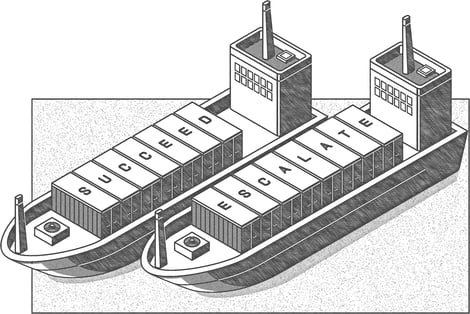
That idea sounds obvious until you’ve lived through a year where issues were visible and still went unaddressed. Since then, we've become more disciplined about the things that matter most for a growing organization, like clear ownership, faster issue resolution, and balancing care with performance. Here are some concrete ways you can start bringing that same discipline into your own company:
-
Define care in terms of the whole company, not just the people nearest to you: Care isn’t only about protecting the people you work with most closely. It’s about taking responsibility for how the whole system holds up. If someone’s underperforming, dealing with it is care for the people who are carrying the extra load. If someone has more capacity than they need, bringing that into the open is care for the teams that are stretched thin.
-
Make accountability clear and singular: If two people own something, nobody really owns it. You can collaborate, support each other, and work through things together, but one person has to be on the hook for the outcome. If not, work slows down fast and frustration builds.
-
Match meeting size to the decision being made: If you’ve got twenty people in a room trying to solve a problem, you’re not really solving it. You’re sharing context. That has its place. All-hands have their place. But decisions move faster and land better when fewer people are involved in the decision-making process.
-
Know when to talk and when to act: Some situations need discussion. Others need movement. The mistake is treating every problem like it needs endless conversation. Part of leadership is knowing when it’s time to stop talking and start executing.
-
Treat hard conversations as part of taking care of people: A year ago, hard conversations felt heavy and draining. Now, they feel more straightforward. That didn’t happen by accident. When leaders speak directly and respectfully about what’s not working, people stop dancing around issues and start dealing with them.
The Standard We Set
If last year taught me anything, it’s that founders can’t outsource culture to good intentions. Culture has to be built through decisions, consistency, and clarity about what your organization stands for.
When a company is growing, the environment is changing, and ambiguity is increasing, people will reach for comfort. Some leaders will try to protect their people while others will push for output. Both usually come from a good place, but good intent alone won’t reconcile them. It’s up to us to set the standard.
In Ninety's case, the standard is high care and high performance together, supported by clear accountability and the expectation that people succeed or escalate. That combination builds the kind of trust that allows us to move quickly without breaking people.
If you sense your culture is splitting into camps, the most caring thing you can do is reassert the operating system, clarify ownership, and make performance standards both fair and visible. That’s how you protect the boat you’re all on.
Want more on this topic? Check out the episode of the Founder's Framework podcast.


.jpg?width=500&name=large_High-Agency_Culture_Founders_Blog_Header_1920_x_1080%20(1).jpg)
.jpg?width=500&name=large_Employee_Loyalty_Founders_Blog_Header_1920_x_1080%20(1).jpg)
.jpg?width=500&name=large_People_We_Admire_Founders_Blog_Header_1920_x_1080%20(1).jpg)