

Ten years into my career, I had worked at a corporation, a higher education institution, and a marketing agency. I’d been in a lot of different kinds of organizations, but none of them had a clear way of setting goals and keeping track of whether we were actually making any progress.
That changed when I joined a small nonprofit that ran a startup accelerator program. A lot of our work involved helping pre-seed startups get off the ground, so our team of about 15 people understood the importance of setting goals and measuring our progress.
One of our corporate sponsors introduced us to OKRs and Measure What Matters by John Doerr. We all read the book and then sat through a two-day training session to learn how to set company and team objectives and key results. I remember sitting in that training trying to understand how all of our team objectives were supposed to level up to our company objectives. It didn't help that we were learning how to manage the whole thing in a Google Doc, which probably should have been red flag #1.
Looking back, we had our goals in one tool, while much of the information we needed to track and discuss them lived somewhere else. Now at Ninety, we hear from companies running on EOS® who ask: If we already use a project management tool like Asana, why would we need Ninety?
Because there’s a difference between a tool that can hold parts of EOS and a platform designed around how all of those parts work together to help you build a better company. Asana is built to help teams manage projects and tasks. Ninety is built specifically for companies running on EOS, with all the tools they need to run their business in one place.
Why We Moved Our OKRs Into Asana
Our five-person marketing team already used Asana for almost everything, so when we realized we could manage our OKRs there too, it originally felt like a much better option than a shared Google doc. We could keep our OKRs in the same place where we were already managing some of our day-to-day work, which seemed like it would make the whole process easier to follow.
Our Art Director, who was also our unofficial IT expert, set everything up for us. Everyone had their objectives and key results in place, we could track progress, and we planned to meet quarterly to review how things were going.
The first problem was that only about 5 of our 15 team members regularly logged in. For most of the organization, their day-to-day work lived somewhere else.
Then by the end of the next quarter, we realized most of the team hadn't even been logging into Asana to update their progress. By the time we met, we were catching the system up instead of using the meeting to make decisions.
Why Asana Wasn't Enough for Our Goal-Tracking Process
Asana was doing what we asked it to do. We put our OKRs into its template, assigned owners, and tracked progress. The problem was Asana wasn't where most of the company worked, and our OKRs were sitting apart from a lot of the other information we used to run the organization. The goals were in one place, but our data, meeting discussions, and other relevant context was somewhere else.
At the end of the day, you’re responsible for keeping your work connected and we weren’t doing a good job at that. We needed a different system.
OKRs and EOS Rocks aren't the same thing, but the challenge of keeping people accountable for their goals is similar. Setting priorities is only the first step. Teams also need a consistent way to review progress and identify any issues that are getting in the way of accomplishing what they set out to do.
That's what I understand much better now that I use Ninety and work with companies running on EOS. In Ninety, Rocks can live alongside your V/TO®, Scorecard, issues, To-Dos, Accountability Chart, and meetings. And because Ninety’s AI companion Maz works with all of your business information that’s already in Ninety, teams can ask questions about that information without having to piece the context together themselves.
Alex Gertsburg, Managing Partner at Gertsburg Licata, experienced this firsthand. His team tried switching from Ninety to Asana but ultimately came back. Hear why they decided Ninety was a better fit for how they run EOS.
How Is Ninety Different From Asana for EOS Teams?
1. Your goals connect to the rest of the business.
For a company running on EOS, a Rock is just one part of a larger system. In Ninety, teams can review Rocks alongside the Scorecard, issues, To-Dos, meetings, and the longer-term goals in the V/TO®, including the 1-Year Plan.
So if a Rock supports a long-term goal or depends on a number you're already tracking on the Scorecard, the team can see those connections in the same place instead of piecing them together across different tools.
That doesn't mean teams have to stop using Asana to manage their projects. Asana can still be where the detailed project work happens, while Ninety keeps the broader EOS priorities, accountability, and operating rhythm connected.
2. Quarterly priorities stay visible throughout the quarter.
This was a big problem with our OKR process. We'd set our OKRs, go back to work, and then come together at the end of the quarter only to realize some people hadn't updated them. By then, we were trying to piece together three months of progress in one meeting.
In Ninety, teams review Rocks weekly during the Level 10 Meetings they're already having throughout the quarter. So if something is off track, a team can IDS® the issue while there's still time to work through it instead of finding out they didn’t accomplish what they set out to at the quarterly review.
3. Ownership is easier to see when the work around the goal is visible.
We assigned an owner to every OKR in Asana so we always knew who was responsible for updating it. What was harder to see was how that goal connected to the work other people were doing.
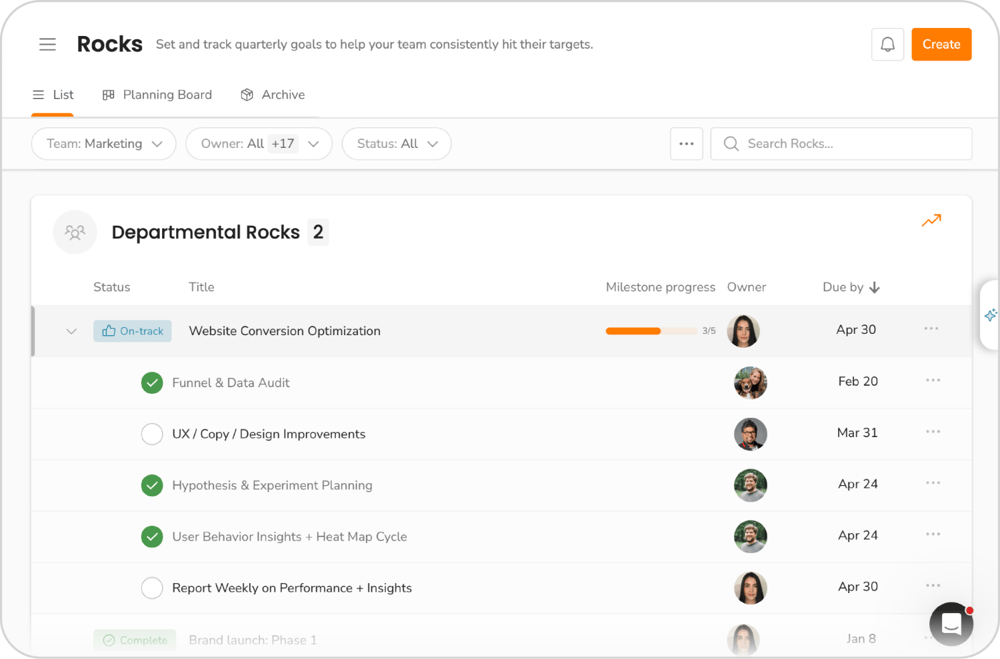
But most of the time, a goal depends on more than one person or team. In Ninety, each Rock has one owner, but the milestones can be assigned to different people. That makes it easier to see how far along a Rock is, who's responsible for the next step, and whether you're waiting on someone else to finish their part. I can see exactly where things stand without having to keep track of everyone's progress separately.
Leaders can also look in Ninety to see how Rocks are progressing across teams without waiting for someone to report back at the end of the quarter.
4. Your Rocks, Scorecard, and Maz can work together to help you execute better.
Let’s say one of my goals was to grow our community by 10%. In Asana, I had to calculate that growth myself, enter the number, and everyone else had to trust that what I entered was accurate.
In Ninety, the numbers connected to a quarterly priority can be tracked on the Scorecard alongside the Rock. That means the team can check progress throughout the quarter instead of waiting until the quarterly review.
And because Maz can draw on that information, you can ask questions about your Scorecard data and get help understanding whether things are heading in the right direction.
5. Quarterly planning doesn't have to start with getting the software caught up.
Our quarterly OKR meetings took hours because we were reviewing goals and updating Asana at the same time. We had to ask where things stood, update progress, and figure out what had actually been completed.
That was really the problem. Our goals lived in one place, while so much of the information we needed to review them lived somewhere else.
With Ninety, all of our EOS tools live together in one system. So when quarterly planning comes around, you're not trying to pull everything back together just to figure out what happened. It’s all right there ready to go. We just have to make decisions.
6. The platform has to be useful for the whole company.
This is where I keep coming back to our 15-person team. Five of us used Asana all the time because our marketing work was there. The other ten people really only needed it for their OKRs.
For most of the company, Asana was basically just the place they had to remember to update their OKRs. Of course, no software can make people follow through. But when reviewing priorities is part of the same system teams use for meetings, accountability, and decision-making, it becomes a regular business discipline instead of another administrative task.
Ninety works differently because Rocks are part of the same business operating system the whole company uses to run the business. It’s where every team holds meetings, tracks key data, manages issues and To-Dos, has 1-on-1s, and keeps longer-term plans visible.
A Better Way to Run EOS
Now that I use Ninety, I’m glad our quarterly goals aren’t something we have to manage off to the side. They’re part of the same system we’re already using to run the business.
If your team is already using Asana to manage EOS, look at how much work it takes to connect your Rocks, Scorecard, issues, and meetings each week. Ninety gives you a better way to manage all of that, with software built around the system you run on. I've experienced the difference, and I couldn't imagine ever going back to managing it the old way.


