


I was working with a leadership team recently who had what looked like a beautifully simple Accountability Chart. Clean boxes. Clear names. Everyone knew who was “in charge” of what.
At least, that was the theory.
Then we started talking about what was really happening in the business.
The Head of Sales was still approving marketing copy because “she used to do that before we hired someone.” The Founder was still the unofficial final stop for almost every difficult decision. Operations was technically accountable for delivery, but Client Success was cleaning up most of the issues afterwards. Finance had the numbers, but no one was really accountable for turning those numbers into better business decisions.
From the outside, the structure looked fine. In reality, the business had outgrown it.
And that’s the part many leadership teams miss. Your Accountability Chart isn’t meant to be a framed family portrait from 2019. It’s meant to be a living, breathing picture of the business you’re building next.
As your company grows, your structure has to grow with it. Otherwise, the very tool designed to create clarity can become a source of confusion, frustration, duplicated work, missed expectations, and the occasional passive-aggressive “just checking in” email. Always a joy.
The Accountability Chart That Got You Here May Not Get You There
When a business is small, everyone wears multiple hats. That’s normal. In fact, it’s often necessary.
One person might own marketing, sales support, customer onboarding, and ordering the office coffee. Another might manage operations, HR, recruitment, and fixing the printer because apparently, they once showed basic competence near a paper tray.
In the early days, this flexibility is a strength. People pitch in, decisions move quickly, and the team is close enough to shout across the room or send a quick message to sort things out.
But growth changes the game. It means there are more customers, more people, more complexity, more handoffs, more decisions, and more risk.
Suddenly, the informal “Debbie just knows how to do that” system starts to break. Not because Debbie is doing anything wrong, but because no human should be the walking archive of half the company’s processes.
This is where many organizations hit a painful stage of growth. They’ve added people, revenue, locations, departments, or product lines, but their Accountability Chart still reflects the business they used to be.
The result? People are busy, but ownership is unclear. Leaders are stretched, but they're unsure what to delegate. Team members want to do great work, but they don't always know where their authority begins and ends. That’s not a people problem. It’s a structure problem.
Growth Creates New Seats, Not Just New Jobs
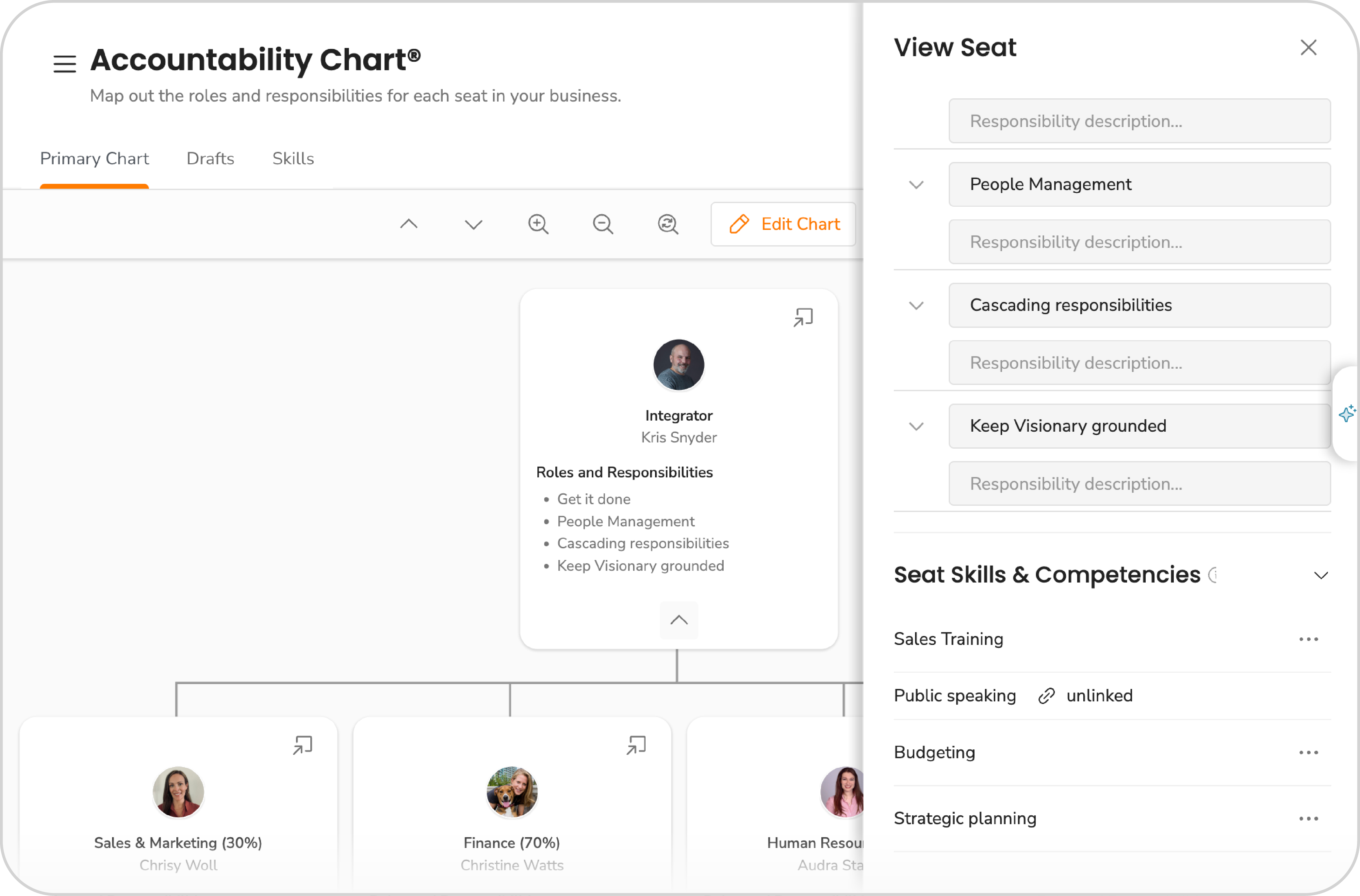
One of the biggest mindset shifts in building a strong Accountability Chart is understanding the difference between people, titles, and Seats.
A title tells us what someone is called. A person tells us who currently fills the role. A Seat tells us what the business actually needs to be accountable for. That distinction matters enormously as you grow.
Too many leadership teams build their structure around the people they have today. They say things like, “Well, Sarah is great with clients, so let’s put that under Sarah,” or “Tom already knows the system, so he can keep owning that.”
That may work temporarily, but it can also create a structure held together by personal history instead of business logic.
A better question is:
“What does the business need now, and what will it need in the next stage of growth?”
You might realize that what used to be one general Operations Seat now needs to become separate Seats for Delivery, Process Improvement, Procurement, and Quality. You might see that Sales and Marketing, once managed by one heroic person with excellent caffeine tolerance, now need separate leadership. You might discover that People, Culture, Training, or Client Experience have become proper strategic functions, not side quests.
This doesn’t always mean hiring immediately. Sometimes one person will still sit in multiple Seats for a while. That’s okay, as long as everyone can see the truth. The danger isn’t having one person in multiple Seats. The danger is pretending those Seats don’t exist.
Your Accountability Chart Should Expose Capacity Issues
A great Accountability Chart doesn’t just show who reports to whom. It reveals pressure points. That’s why some teams avoid updating it.
Let’s be honest, a current, honest Accountability Chart can be confronting. It shows where your Founder is still holding five critical Seats. It shows where a loyal long-term team member may be sitting in a Seat they no longer truly get, want, or have the capacity for. It shows where two departments are both claiming ownership for the same outcome. It shows where no one is accountable for something everyone complains about.
Beautiful? Not always. Useful? Absolutely.
I often tell teams that The Accountability Chart isn't there to make you feel comfortable. It’s there to make the truth visible. Once the truth is visible, you can make better decisions.
You can decide which Seats need to be created, clarified, split, combined, elevated, or removed. You can see where a leader needs support. You can identify where training is required. You can make better hiring decisions because you’re hiring for the right Seat, not just reacting to whoever is currently drowning the loudest. And perhaps most importantly, your people can stop guessing.
Clarity is kind. Ambiguity is exhausting.
The Chart Should Follow the Future, Not Just Document the Present
One of the most powerful uses of the Accountability Chart is to design for the next version of the business. Not fantasy land. Not “when we’re a billion-dollar unicorn with a kombucha tap and a Chief Vibes Officer.” The real next version.
What does the company need to look like at the next revenue milestone? What structure will support the next 20 employees? What has to change before opening another location, launching a new product, entering a new market, or stepping the Founder back from day-to-day operations?
This is where the Accountability Chart becomes strategic. Instead of asking, “Who do we have?” the leadership team should start asking:
-
What structure will help us deliver our vision?
-
What accountabilities need to be owned more clearly?
-
Where are we over-relying on individual heroics?
-
What decisions are stuck because the right Seat doesn’t exist yet?
-
Which leader is carrying too much?
This future-focused approach also helps reduce emotional decision-making. When the structure is designed around the needs of the business, it becomes easier to have honest conversations about fit, capacity, development, and succession.
This is especially important in founder-led and family businesses, where roles often grow organically over time. People step in because they care. Family members help wherever needed. Long-term employees become trusted all-rounders. That loyalty is wonderful, but it can also blur accountabilities.
The Accountability Chart helps separate love, loyalty, history, and identity from the actual needs of the business. That’s not cold. It’s responsible.
If Your Chart Lives In a Drawer, It’s Already Outdated
The Accountability Chart shouldn't be something you update once a year, admire briefly, then ignore while everyone goes back to working around the gaps. It should be reviewed regularly, especially during quarterly and annual planning.
Why? Because growth doesn't politely wait for your next offsite.
People leave. Leaders develop. New priorities emerge. Markets shift. Clients expect more. Technology changes. The business evolves.
Your structure should evolve with it.
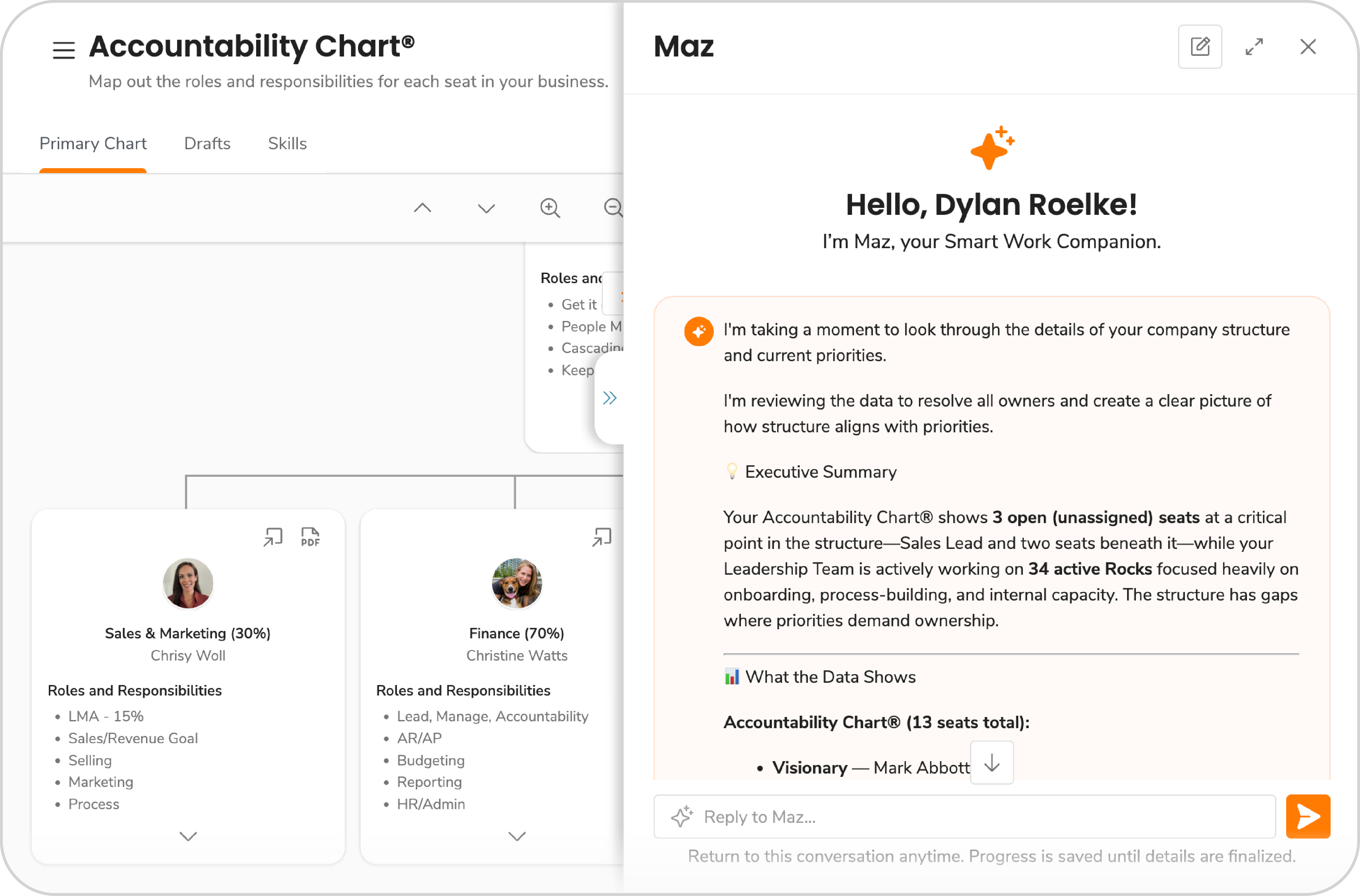
This is where platforms like Ninety can be incredibly useful. When your Accountability Chart is visible, editable, an connected to how your team actually runs the business, it becomes much easier to keep it alive. You can clarify Seats, update responsibilities, share visibility across the organization, and use draft charts to plan future structure before making major changes.
That matters because the real value isn't the chart itself. The value is the conversation the chart forces.
A static chart says, “Here’s what we decided once.” A living chart says, “Here’s how we’re intentionally building the business.” Big difference.
Turn accountability into a working discipline your team can actually use. Check out Ninety’s Accountability Chart tool to clarify Seats, update responsibilities, plan future structure, and keep your organization aligned as the business grows.
5 Practical Ways to Evolve Your Accountability Chart
Here are a few simple ways to keep your Accountability Chart useful as you grow:
-
Review it every quarter: Don’t wait until the pain is unbearable. Ask what's changed in the business and whether the current structure still supports the vision.
-
Separate Seats from people: Design the structure the business needs first. Then decide who currently fills each Seat.
-
Look for overloaded Seats: If one person owns too many critical outcomes, you probably have a capacity risk hiding in plain sight.
-
Clarify the five key accountabilities for each Seat: If a seat has 17 accountabilities, it may not be a Seat. It may be a small country.
-
Build a future version: Create a draft version of what the structure may need to look like in 12 to 24 months. This helps you make better hiring, development, and succession decisions.
Final Thought
Your Accountability Chart isn't just an organizational tool. It’s a leadership tool. It shows what the business truly needs. It reveals where accountability is clear, where it’s muddy, and where the team is relying too heavily on goodwill, memory, or heroics.
As your company grows, the chart should change. Not because people have failed, but because the business has evolved.
The goal isn’t to create boxes for the sake of boxes. No one needs more corporate wallpaper. The goal is to create clarity so your people can do their best work, your leaders can lead, and the business can scale without dragging yesterday’s structure into tomorrow’s opportunities.
Because the chart that got you here deserves respect. But the chart that gets you there deserves your attention.
Don’t let yesterday’s structure become today’s bottleneck. Use Ninety to keep your Accountability Chart clear, current, and actionable so every Seat has real ownership and your team can grow with less guessing. Start a free trial of Ninety.



.jpg?width=500&name=large_Accountability_Without_Micromanaging_EOS_Blog_Header_1920_x_1080%20(1).jpg)
.jpg?width=500&name=large_Falling_Stars_EOS_Blog_Header_1920_x_1080%20(1).jpg)