
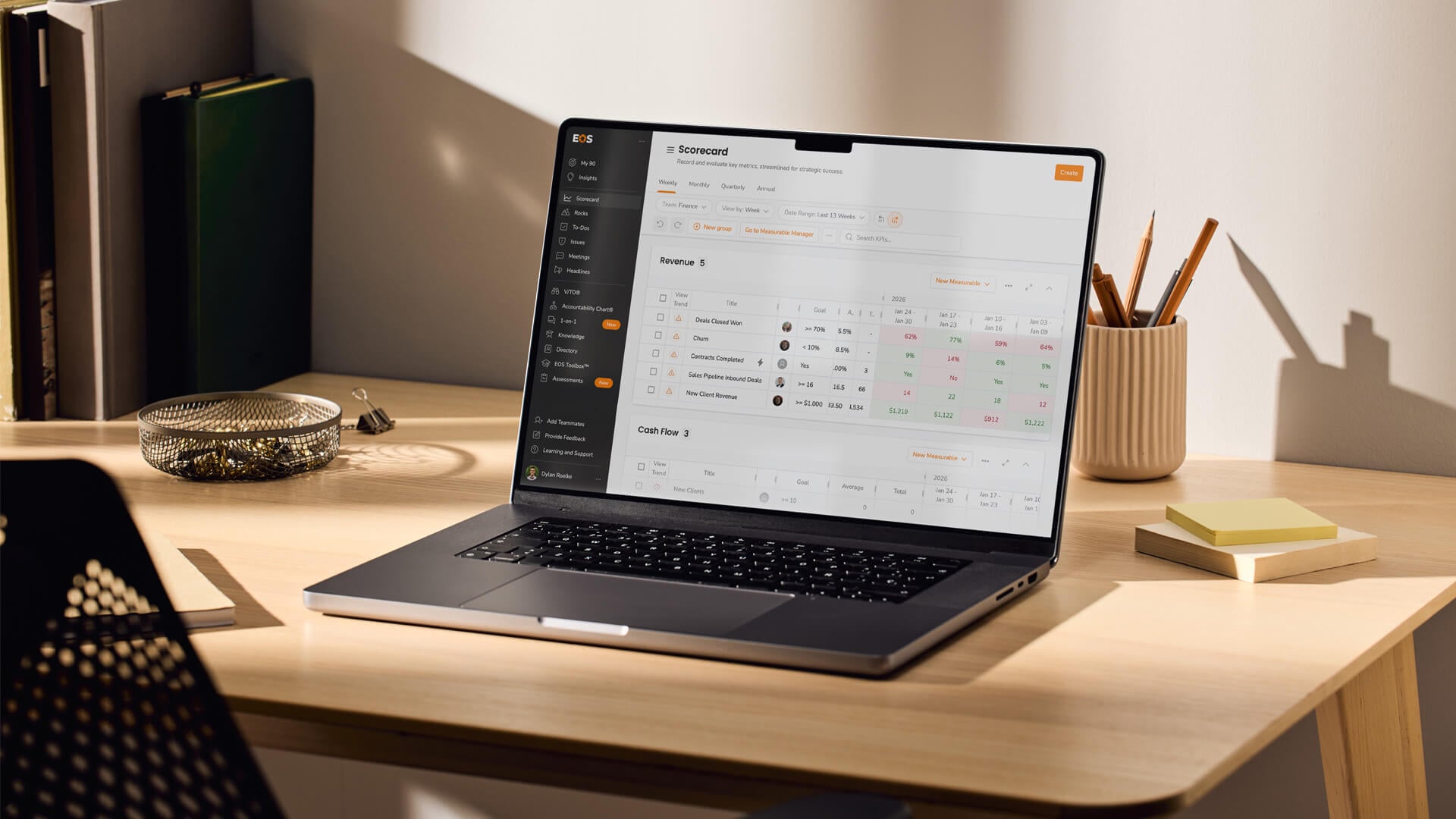

If you've been running on EOS® for a while, you know the Scorecard is supposed to give your leadership team a pulse on the business every single week. It should be simple: clear numbers, each with one owner, either on track or off track.
So why do the same numbers stay red, week after week?
And more telling, why is it always the Integrator or the business owner who's calling it out? Why is the function leader reacting to the problem in the meeting instead of walking in and saying: "I know this number is down, here's what I'm doing to fix it."
In most cases, the Scorecard isn’t broken. The accountability system behind it is.
Before a Scorecard can drive ownership, the team needs clear Seats, clear outcomes, clear leading indicators, and people who know what they own before the number turns red. Let's talk about how to build that foundation.
Where Do Accountability Problems Start?
When I work with a team that has a persistent accountability problem, I almost always find the same two things:
-
The Scorecard is full of lagging indicators: Revenue, closed deals, customer satisfaction scores. All of those are outcomes, results of work that already happened. By the time one of them shows up red, the window to intervene has closed. And when a leader does try to solve it, they're not even sure where to start because there's no leading indicator mapped to it that tells them where the work actually broke down. The problem feels big and ambiguous because they never built the metrics that would make it specific.
-
The Accountability Chart® isn't doing its job: For self-implementing teams, this problem often starts at the top because it was never built well. Building a strong Accountability Chart is a hard exercise. It requires you to have clarity around the future of your business 9-12 months out, not what the Seat has always done in the past. You need to be intentional and clear about what each role and function actually demands, including the skills and experience required to drive those outcomes. You also need to capture what matters without making it too complicated, and be honest about whether the right people are truly in the right seats. Self-implementing teams often rush through it, build it too broadly, or avoid the discomfort the exercise requires. The result is a leadership team where names are in boxes but nobody's truly clear on what executing that role looks like at a granular level.
These two problems feed each other. A vague Accountability Chart produces vague metrics. And vague metrics produce Level 10 Meetings where nothing moves.
Start With the Leadership Team
Before you cascade any accountability practices to the rest of the organization, the leadership team has to be doing it well themselves.
Every leader has to confirm they GWC® their own Seat: they Get it, Want it, and have the Capacity to do it. They also need to take ownership of their numbers. That means the leadership Scorecard has real leading indicators, not just revenue and lagging outcomes. It means LMA® and Quarterly Conversations are happening at the leadership level between the Integrator and core function leaders, and people feel confident in the rhythm.
If that foundation isn't in place yet, asking managers to run the same rhythm with their direct reports won't accelerate accountability. Instead, it will feel like micromanagement, and the system will start to lose credibility. Not to mention, it's hard to coach something you're not yet confident in doing yourself.
That's why installing EOS purely and mastering the foundations on the leadership level is a journey. It’s not something that happens overnight, or even in 90 days. Some of this is getting comfortable with being uncomfortable. You’re learning, you’re running the business in a new way, and you’re trying to master the tools while also being in the day-to-day work.
Part of the journey is being able to rise out of the weeds and take a step back. Get clear as to what’s holding the business back. Look for the patterns that keep showing up.
That work is ongoing. I've seen teams start to slow down because they stop being intentional. They’re too close to the business, so they keep running the meetings, reviewing the Scorecard, and checking the boxes without doing the harder work of building real clarity.
Get it right upstairs first. Then cascade it.
Are the Right People in the Right Seats?
Before you touch the Scorecard, ask one question honestly: Do I have the right people in the right seats?
Not just whether you think they’re the right people in the right seats, but whether each person has 100% clarity on what their Seat requires and what success looks like.
Do they GWC® the full Seat? Not just the parts they’re comfortable with, but the full scope: managing execution, solving problems proactively, and staying ahead of the numbers before they go red.
I worked with a telehealth company where the Head of Sales had been in her Seat for months. When I asked her to define her seat in 3–5 bullets, she was stumped. When I asked what a great week looked like, she listed everything and nothing at the same time. She owned revenue (she knew that much), but she hadn't connected the Seat to what executing it actually required. She was supposed to be managing every stage of the pipeline, doing consistent outreach, and running follow-up with discipline. She should have been making at least five prospecting calls a day, conducting regular pipeline reviews, and keeping a consistent follow-up cadence. When I showed her what success looked like for her Seat, it finally clicked. “Oh, I'm supposed to be doing that?”
That's a GWC failure. And it showed up in the Scorecard as red, week after week, with no explanation. This failure completely stalled the business and frustrated her entire team.
I worked with a law firm with the same pattern. Revenue was down, and nobody could explain why. When we finally mapped their client journey from top of funnel to close, the gap became obvious immediately. Phones would ring, people would schedule an educational webinar, and then... nothing. No one on The Accountability Chart actually owned this critical stage of the client journey (from lead to qualified opportunity to close). It was completely missing. The entire time, the Scorecard had a revenue number in the red, but there was no way to tell where the breakdown was happening because the Seat that owned that work didn't exist.
Tip: Fix your Accountability Chart first. Make sure every core function has a Seat, every Seat has an owner, and every owner is truly clear on what they own and what success looks like.
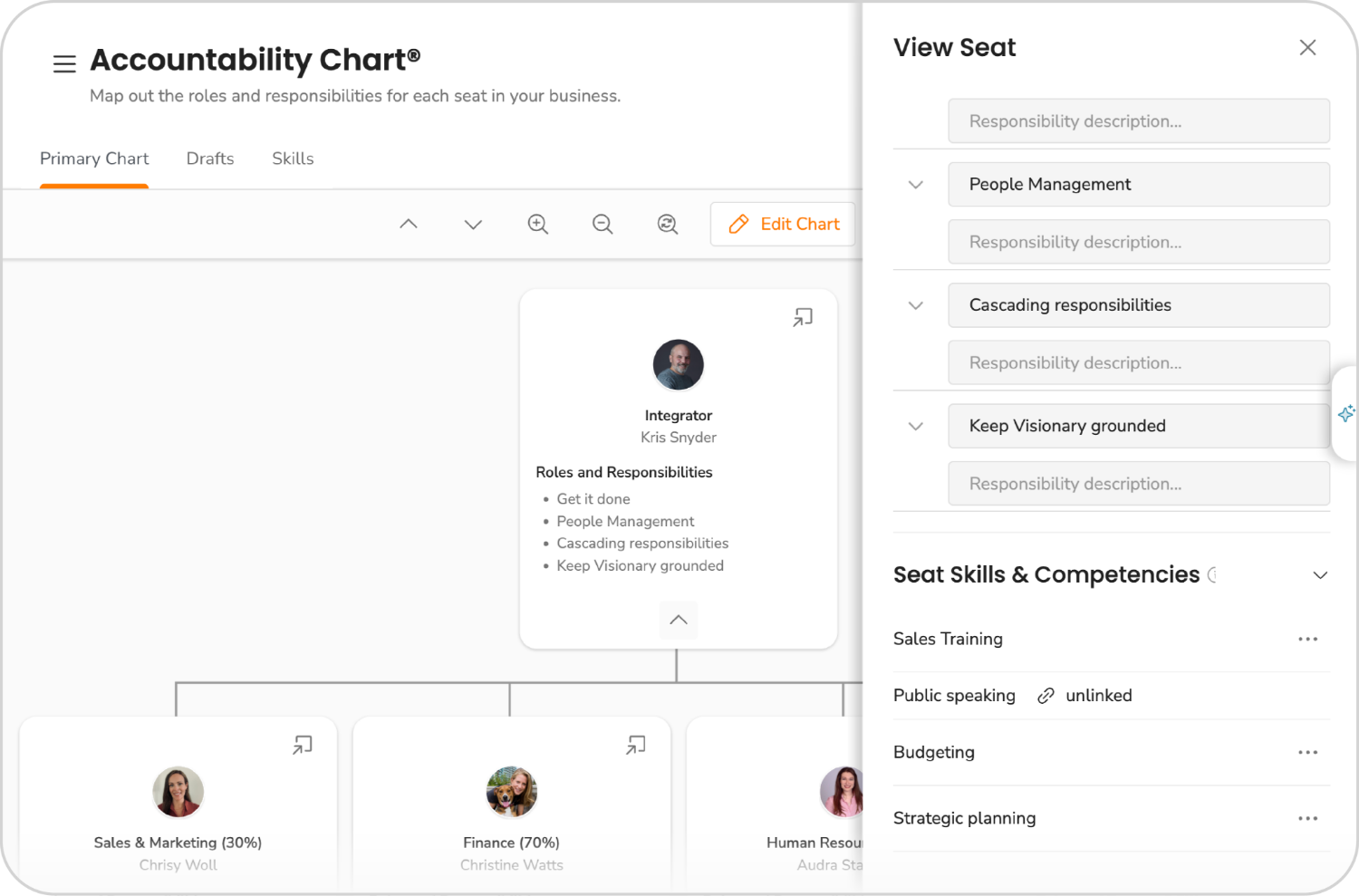
Before you fix the numbers on your Scorecard, clarify who owns the work behind them. Ninety’s Accountability Chart tool helps teams define Seats and document the roles and responsibilities each function needs to own so every number has an accountable owner behind it.
How Do You Build Accountability?
Once you know you have the right people in the right seats, here are five clear steps on how to build accountability:
-
Define the Seat clearly: Think outcomes, not activities. Every Seat should be clear enough to summarize in one sentence, with 3–5 outcomes the person is accountable for delivering. This is not a job description. It is a simple agreement about what the business relies on that Seat to own.
-
GWC the Seat with them: Sit down and walk through it together. Do they Get it? Do they Want it? Do they have the Capacity to do it? You should be looking at the skills, the competencies, and the experience to both execute and problem-solve. If you have concerns, name them now. Share what you see, what they need to work on, and build a plan together.
-
Map how the work flows: For customer-facing functions, follow the customer journey. For example, with Sales, Marketing, Operations, and Customer Service teams, I find it useful to map the customer journey before building any metrics. Not as a formal EOS tool (this is something I do with my own clients), but as a practical way to make the Seat tangible and find any gaps. When you follow the customer through the process step by step, it becomes immediately clear whether every stage has an owner, whether the handoffs are clearly defined, and where accountability breaks down. For functions that don't always touch the customer directly (like legal, finance, or HR), the Proven Process still serves the same purpose. Document the repeatable steps, and the leading indicators will become obvious.
-
Build the company Scorecard with a 70/30 ratio, leading to lagging: Most teams have this inverted. Around 70–80% of your company Scorecard should be leading indicators, which are the activities and inputs that drive outcomes. The other 20–30% percent should be lagging. Each core function should own 2–3 metrics that tell you whether that function is healthy and point you toward which lever to pull when something is off. Revenue down? If you're tracking pipeline stages, you know exactly where to look. No-show rate high? If you're tracking confirmation outreach and qualification steps, you know whether it's a volume problem, a messaging problem, or a process problem. When the Scorecard is built from lagging indicators alone, red just means something is wrong. When it's built with leading indicators tied to how each function executes, red tells you exactly where to go.
-
Cascade to manager and Seat-level activity metrics: The company Scorecard is not the finish line. Below it, every manager should have 2–3 activity-based metrics that tell them whether their team is executing the Proven Process consistently. A manager's job is to ensure the process is being followed or identify where there might be breakdowns that need fixing. The metrics are how you see it in real time. Is your team doing the activities that drive the outcomes? Are they doing them the same way? Where are the inconsistencies? Are the activities flawed? This is the layer most self-implementing teams are missing. They have company numbers but nothing below them. When the company number goes red, you need a map to follow.
What Does Accountability Look Like in a Level 10 Meeting®?
Once Seats are clear, owners know what they’re accountable for, and the Scorecard is tied to leading indicators, you’ll see the change in your Level 10 Meetings.
When The Accountability Chart is vague and the Scorecard is full of lagging indicators, the L10™ looks like this: The Integrator or owner calls out what's red. The function leader explains why. The team discusses it. Nothing changes. The same number is red again next week.
But when the foundation is built correctly, the function leader walks in already knowing, “These two numbers are down. Here's where the breakdown is happening in the process. Here's what I'm doing to fix it. Here's where I need support.” They're leading the problem-solving, not responding to it.
That shift from reactive to proactive, from explaining to owning, is what a well-built Accountability Chart and a correctly structured Scorecard actually produce. The function leader knows their Seat, their numbers, what good looks like, and how to diagnose when they're off.
If the reactive pattern shows up across multiple function leaders, the owner and Integrator need to look at themselves first. Have they been direct and consistent about what's actually expected with both the number and the accountability? Have they normalized those direct conversations, both in the room with the full team and one-on-one?
If the Integrator is always the one calling out what’s red, the team starts to believe accountability belongs to the Integrator. It doesn’t. The fix isn’t just better Seats and Scorecards. It’s the owner and Integrator consistently modeling a higher standard, requiring function leaders to own their numbers, and reinforcing that standard until it becomes part of the culture.
.png?width=7085&height=4500&name=Level_10_Meeting_Product_Shot%20(1).png)
How Does LMA® Move Accountability Forward?
Once seats are defined and Scorecards are built at both levels, the leader's job shifts to LMA, which stands for Leadership, Management, Accountability. The quarterly LMA conversation isn't a performance review. It's a coaching conversation structured around the Seat that focuses on questions like:
-
Are they showing up in the way they're all committed to, exemplifying the Core Values of the company?
-
Are they following the Proven Process consistently and achieving results?
-
Is everyone on the team executing it the same way?
-
Are they completing their Rocks (90-day goals) on time?
-
Where are the gaps: skill, clarity, tools, or confidence?
-
What does this person need to level up?
The question isn’t "Why is this red?” It’s “What do we need to change or improve so we can move this to green?” One makes someone defensive. The other creates ownership.
What Makes the Scorecard Actually Work?
If your Scorecard isn't driving accountability, resist the urge to fix the Scorecard. Start with one honest question: Do I have the right people in the right seats?
From there, be sure that every person has 100% clarity on what their Seat requires, what success looks like, and what it mean to own that Seat fully.
Then it's time to build the Scorecard with 70% leading indicators. Make sure every core function has 2–3 metrics that point you toward the lever to pull, not just whether you're on track or off. Cascade to activity-level metrics below the leadership Scorecard. Make the connection between the Seat, the process, and the number explicit.
When that foundation is in place, the change shows up everywhere. The Level 10 Meeting gets sharper. Function leaders come prepared. Numbers have owners who helped build them and understand what drives them. When something is red, the accountable person walks in with a plan: “Here’s what’s off, here’s what I’m doing about it, and here’s where I need help.”
That's not just accountability. That's alignment from top to bottom. And that's when the Scorecard starts doing what it was always supposed to do: turn numbers into ownership, action, and better decisions.
Ready to build accountability into the way you work? Ninety helps leadership teams connect Seats, Scorecards, Rocks, To-Dos, and Level 10 Meetings® in one place so accountability is easier to see. When the right people own the right numbers, your team can stop reacting to red and start solving what’s really holding the business back. Start a free trial of Ninety now.



.jpg?width=500&name=large_Accountability_Without_Micromanaging_EOS_Blog_Header_1920_x_1080%20(1).jpg)
.jpg?width=500&name=large_Leadership_Habit_EOS_Blog_Header_1920_x_1080%20(1).jpg)