
.jpg)

A few weeks ago, someone more or less called me a dinosaur.
Not quite in those exact words, but the message was clear enough.
A gentleman started appearing on my LinkedIn posts telling my audience that EOS® was old-fashioned, that agentic AI was coming to replace business operating systems, and that frameworks built around human accountability were about to become obsolete.
I’ll be honest. My first reaction wasn’t especially generous.
But once I’d finished muttering at my screen, I did what any good EOS Implementer® should do. I took the issue seriously. I read the paper he sent me. I sat with the uncomfortable questions. I tested my thinking with real leadership teams, real client examples, and my own AI thinking partner, Ellie.
And after a lot of thinking, challenging, and practical application, I landed somewhere that genuinely reframed the entire conversation for me:
AI isn’t disrupting your Accountability Chart. It’s joining it.
That one realization has become the centre of how I now talk to entrepreneurial leadership teams about AI, EOS, and the future of work.
And the more I work with it, the more convinced I am that this isn't a side conversation. It’s one of the most important EOS conversations leadership teams need to be having right now. Not because AI replaces EOS. Because AI makes EOS more necessary.
AI Tests Whether You’re Really Running on EOS
There’s a lot of noise around AI right now. Some people are terrified. Some are breathlessly excited. Some are using AI like a magic vending machine and hoping strategy falls out with the snacks.
But the real question isn’t, “Will AI change work?” Of course it will.
What we need to be asking is, “How do we run a business where some of the work is now being supported, accelerated, or performed by non-human capability?”
That's not just a technology question. It's a Vision question. A People question. A Data question. An Issues question. A Process question. A Traction® question. In other words, it's an EOS question.
AI doesn't sit outside the Six Key Components®. It runs straight through them:
-
It affects your Vision because leadership teams need to decide how AI supports the company’s long-term direction, Core Focus, niche, and 10-year target.
-
It affects your People because AI is now supporting Seats, changing roles, and reshaping what capacity looks like.
-
It affects your Data because AI is only as useful as the quality, accuracy, and relevance of the information feeding it.
-
It affects your Issues because AI will surface new risks, new opportunities, and new tensions that teams need to solve, not admire.
-
It affects your Process because automating a broken process simply makes the mess faster.
-
And it affects your Traction because all the clever AI in the world is useless unless it turns into clear Rocks, measurable outcomes, disciplined execution, and real accountability.
This is why I believe entrepreneurial companies running on EOS are particularly well-positioned to adopt AI well. They already have the language, the tools, and the rhythm. Now they need to extend those same disciplines to AI.
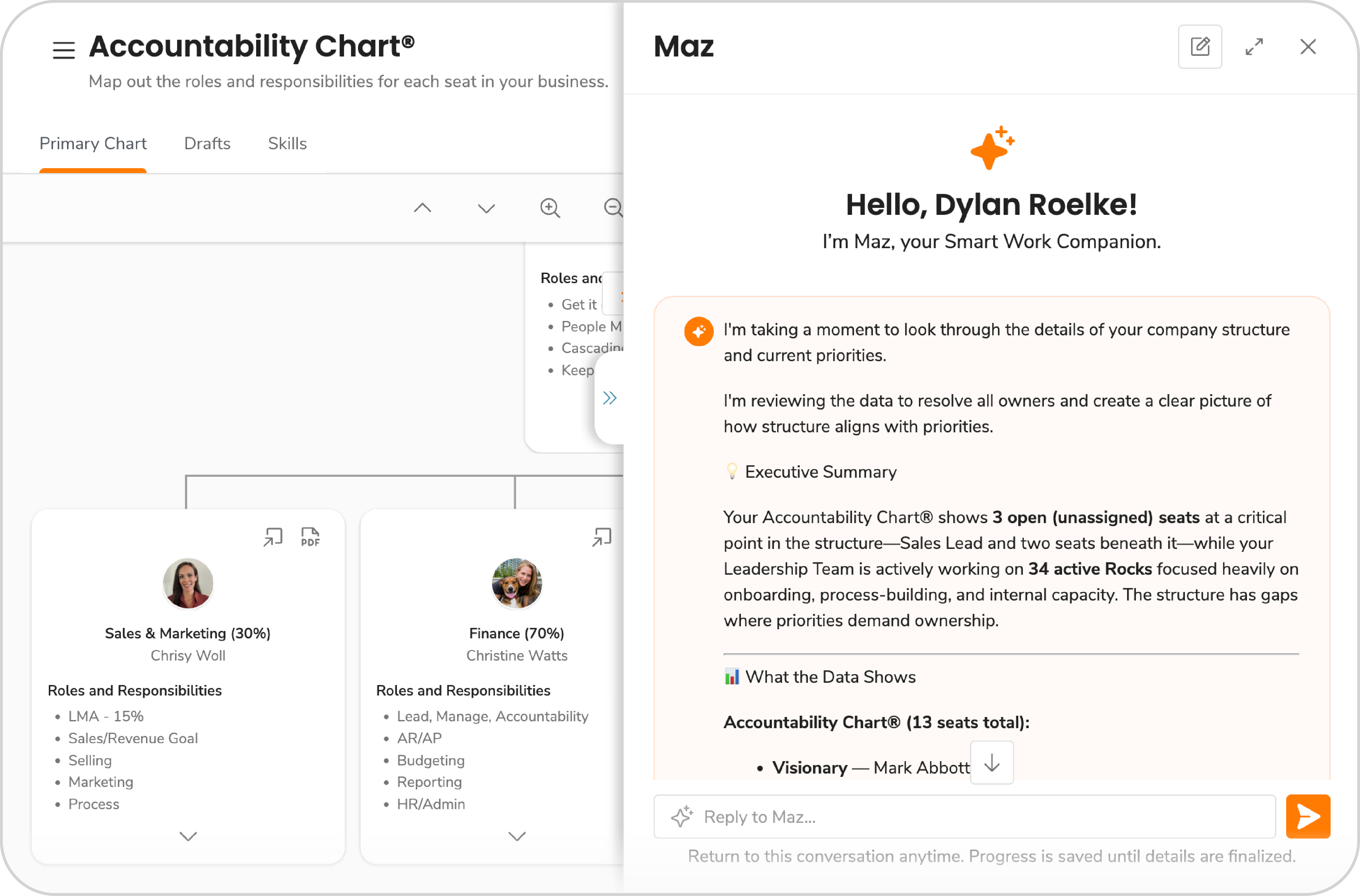
Maz, Ninety’s AI-powered tool, helps EOS® teams ask better questions, sharpen Rocks and milestones, clarify Org Chart thinking, and bring more structure to longer-term goals. It doesn’t replace leadership judgment. It helps leaders turn ideas into action with more clarity and consistency. See how Maz can help your team run EOS better.
Your Accountability Chart Was Built for This Moment
The Accountability Chart® is one of the most powerful EOS tools because it moves a leadership team away from personality, job titles, and vague assumptions.
It asks better questions, like:
-
What are the right Seats for this business?
-
What are the five roles for each Seat?
-
Who is accountable for each Seat?
-
Do they Get it, Want it, and have the Capacity to do it? (We call this GWC®.)
That way of thinking becomes incredibly useful in an AI-enabled business because once you stop thinking only in terms of people and titles, and start thinking in terms of Seats, outcomes, and accountability, AI becomes much easier to place.
AI doesn't become a person. It doesn't carry any moral responsibility or replace human judgement. And it doesn't get a vote in your L10™.
But, it can absolutely support a Seat. For example, an AI tool might support a Marketing Seat by drafting first-pass social posts, repurposing blog content, analysing campaign engagement, or suggesting email subject lines.
It might support Finance by summarising variances, identifying anomalies, or helping prepare cleaner reporting. Or Sales by drafting follow-up emails, researching prospects, or helping segment opportunities. Or even the Integrator by summarising Issues, preparing meeting context, or spotting patterns across Rocks, Scorecards, and measurables.
But here is the nonnegotiable point: AI may support the work, but the human owns the Seat, the outcome, the decision, and the accountability.
That distinction matters enormously.
AI Belongs in the People Component®
This is the part of the conversation that surprises most people. Many leadership teams instinctively place AI in technology, systems, software, or operations.
I understand why. AI looks like a tool. It lives inside platforms. It feels technical. But in EOS terms, I believe AI primarily belongs in the People Component. Why?
Because the People Component is about getting the right people in the right seats. And AI is now affecting the Seat conversation. It changes what work sits in a Seat. It changes what capacity is required. It changes whether a human team member is spending their time on high-value contribution or low-value repetition. It changes what support a Seat needs to succeed. And, in some cases, it changes whether a Seat needs to be redesigned entirely.
This is why I've started talking about:
Right People. Right Seats. Right AI. Right Seats.
That isn't a replacement for EOS language. It's an extension of it. When an AI tool is used inside a Seat, the leadership team should be asking very familiar EOS questions:
-
Does the human owner Get it, Want it, and have the Capacity to manage this AI-supported Seat?
-
Does the AI tool Get the role well enough to produce useful work?
-
Do we actually Want AI involved in this function?
-
Does the tool have the Capacity to perform reliably, safely, and consistently?
The words are familiar. The application is new. That's the point. EOS doesn't need to be rebuilt for an AI world. It needs to be applied intelligently to a new kind of capability.
AI Without a Human Owner Is an Accountability Leak
One of the biggest risks I see with AI adoption isn't that businesses are using it too much. It’s that they’re using it too vaguely.
Someone signs up for a tool. A few people start experimenting. Someone else builds a workflow. Another person plugs AI into the CRM. Another team member starts using it to write client emails. Everyone is impressed. But no one's quite sure who owns it.
That's not innovation. That's an accountability leak wearing a shiny hat.
EOS companies know better than this. If something matters, it needs an owner. If it's on the Scorecard, someone owns it. If it's a Rock, someone owns it. If it's an Issue, someone owns solving it. If it is a Process, someone owns following it.
So if AI is creating work, analysing data, communicating with clients, recommending decisions, or triggering actions, someone must own it. And that someone is not the AI.
If agentic AI is involved, this becomes even more important. Agentic AI is different from simple prompt-and-response AI. It can pursue a goal, plan steps, use tools, retrieve information, trigger workflows, and in some cases, take action with a degree of autonomy.
That can be incredibly powerful. But it can also be incredibly messy if no one has defined the Seat, the boundaries, the rules, the measurable, or the human owner. You wouldn't hire a senior executive and give them vague instructions with no Scorecard, no boundaries, and no one to report to. (Well, hopefully you wouldn’t.) So why would we give increasingly powerful AI tools less structure than we give a new human team member?
The more capable AI becomes, the more EOS discipline it needs.
Use GWC to Evaluate AI Fit
One of the most practical ways to think about AI in your business is through GWC: Gets it, Wants it, and has the Capacity to do it.
Clearly, AI doesn’t “want” something in the human sense. If your AI wakes up passionate about living its best life in your finance department, please unplug it and call someone sensible. But the framework is still very useful:
-
Does the AI Get it? Does the tool understand enough context, rules, data, tone, process, and constraints to produce useful work? If you’re constantly correcting it, retraining it, rewriting it, or apologising for it, it may not Get it yet.
-
Do we Want AI in this Seat? This is the strategic and ethical question. Is this a role where AI involvement genuinely improves the business, the team, and the client experience? Or are we using AI here because it feels modern and impressive? Not every task should be automated. Not every interaction should be AI-assisted. Not every process deserves a bot. Some work is valuable because it is human.
-
Does the AI have Capacity? Can it do the work reliably, securely, and consistently at the standard required? Does it have access to the right data? Are the prompts, workflows, integrations, and guardrails strong enough? Is there a clear point where a human reviews, approves, or intervenes?
This is where the “Right AI. Right Seat.” conversation becomes very practical. The wrong AI in the wrong Seat creates noise. The right AI in the right Seat creates leverage.
Don’t Automate a Broken Process
The most expensive AI mistake I’ve seen isn't choosing the wrong tool. It’s automating a broken process. AI doesn’t magically make a bad process good. It makes a bad process faster, louder, cheaper to repeat, and harder to untangle.
Garbage in, garbage out. Except now the garbage has a subscription plan and an API.
This is where the Process Component® becomes critical. Before you put AI into any process, slow down and ask:
-
What is this Core Process actually meant to achieve?
-
Is it documented? Is it followed by all? Who owns it?
-
Where does it currently break?
-
Is the data clean enough?
-
What decisions happen inside the process? Where is human judgement required?
-
What would a great outcome look like?
Imagine a business with a messy sales follow-up process. Leads come in from multiple places. No one agrees what qualifies a good lead. The CRM is patchy. Sales and marketing blame each other. Leadership doesn’t trust the data.
Then someone says, “Let’s use AI to automate lead follow-up.” Fantastic. Now the AI can follow up with the wrong people, using incomplete information, based on unclear rules, at scale.
That's not transformation. That's chaos with better formatting.
AI should not be used to avoid fixing the business. It should be used to amplify what is already clear, healthy, and accountable.
Bring Your People With You
Another danger is treating AI as a top-down mandate.
Leaders get excited, buy tools, announce changes, and forget that the humans in the business are wondering whether they're being replaced.
Here is my strong view:
AI will not take your best people’s jobs. Bad leadership will.
Most good people don’t want to spend their days copying information between systems, writing the same update ten times, or doing admin that drains their soul one spreadsheet at a time.
They would love to remove low-value work. But they need to understand the plan. They need to be involved in identifying which work AI should support. They need clarity on what changes, what doesn’t, and how their contribution becomes more valuable, not less.
That belongs in your People conversations, your L10s, your Issues List, your Quarterly Pulsing, and your Rocks. This is a leadership conversation before it's a technology rollout.
Ask your team:
-
What repetitive work drains your energy?
-
What tasks could AI help with safely?
-
Where are we compensating for poor process with heroic human effort?
-
What work would you do more of if AI removed the boring bits?
-
What worries you about AI in our business?
-
What guardrails would help you trust how we use it?
Do not install AI over the top of your people like cheap carpet. Bring them into the design.
How to Put AI on Your Accountability Chart
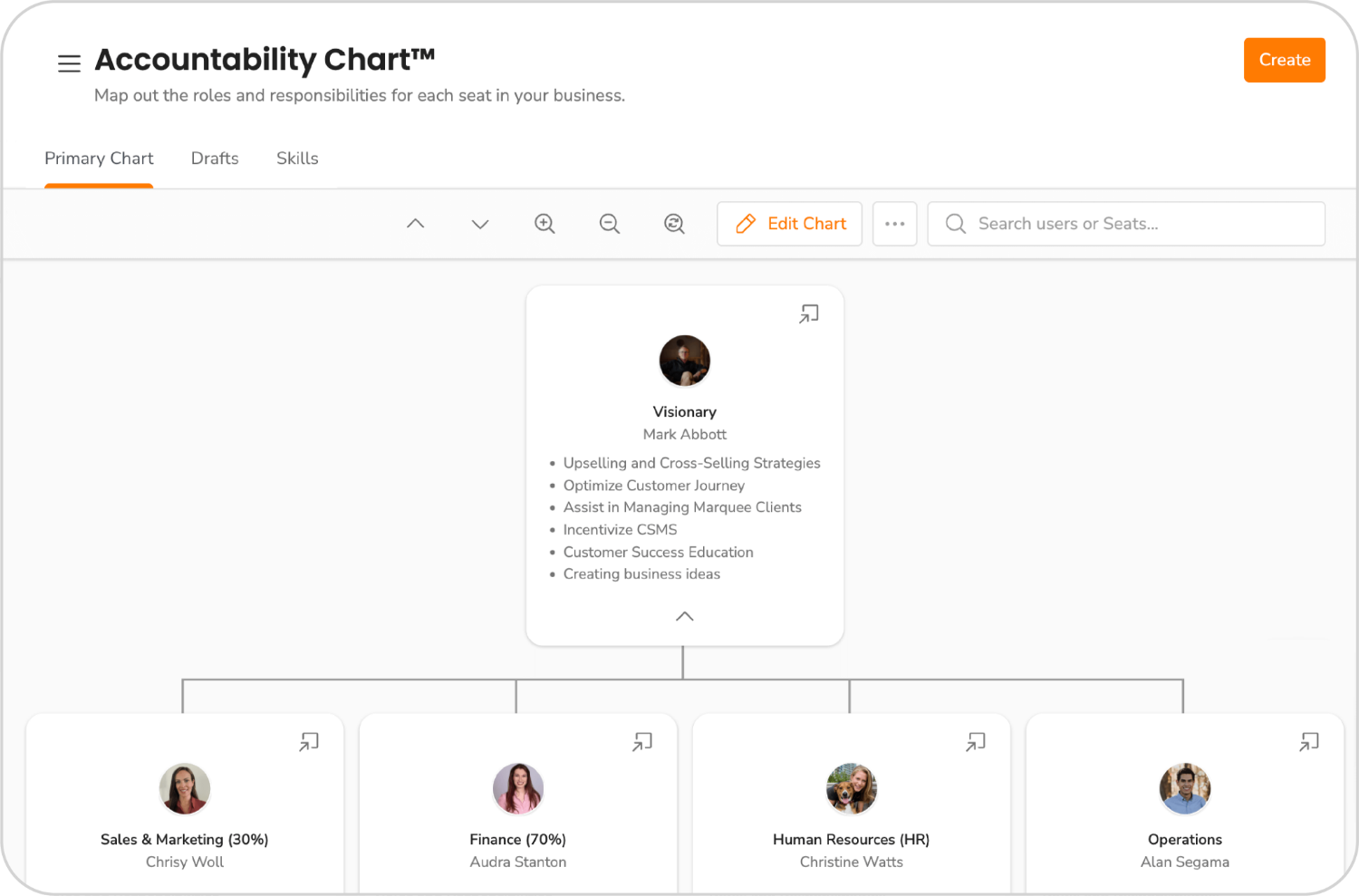
If you’re wondering where to start, don’t overcomplicate it. Pick one AI tool or AI-enabled workflow already being used in your business, then answer these 10 questions with your leadership team:
-
What is this AI here to do?
-
Which Seat does it support on The Accountability Chart®?
-
Who is the human owner?
-
What are the five roles or outcomes it supports?
-
What is it allowed to do?
-
What is it not allowed to do?
-
What must always be reviewed or approved by a human?
-
What data can it access?
-
What Scorecard number, Rock, or measurable result will tell us whether it is working?
-
When would we pause, change, or switch it off?
That's the beginning of your AI Accountability Chart. It's not a six-month transformation project or a 47-page policy document nobody reads. Just one tool, one Seat, one owner, one set of expectations. Start there. Then repeat.
The Future Is AI Inside Human Accountability
After sitting with the challenge that EOS and human accountability might become obsolete in an AI world, I've landed in the opposite place.
AI does not make accountability obsolete. AI makes accountability nonnegotiable.
The companies who succeed with the help of AI won't be the ones chasing every shiny new tool. They'll be the ones that are strong in the Six Key Components. They'll have a clear Vision, the right People in the right seats, and use Data to see what's really happening. They'll solve Issues honestly. They'll document and follow their Core Processes. They'll use Rocks, Scorecards, L10s, and quarterly discipline to create real Traction.
AI can help us think faster, draft faster, analyse faster, summarise faster, and execute faster. But speed isn't the same as wisdom. And automation isn't the same as accountability.
If AI is going to do meaningful work inside your business, it needs to sit somewhere clear. It needs boundaries. It needs measures. It needs a human owner.
The future isn't AI versus EOS. The future is AI inside EOS.
Right AI. Right Seat.
And if believing that makes me a dinosaur, I’ll take it. A well-run dinosaur, obviously.
AI only creates value when accountability stays clear. Start a free trial of Ninety to map your Accountability Chart, clarify ownership, and give your team one place to turn AI-supported work into real Traction®. Try Ninety now.




.jpg?width=500&name=large_To-Dos_Help_Teams_Build_EOS_Blog_Header_1920_x_1080%20(1).jpg)