


Before leading ReadySet Surgical, CEO Kevin von Keyserling helped guide his former company, Keyfactor, through a major transition from consulting to managed services and then into B2B SaaS. One of the major challenges with that shift was reorienting around a completely different set of numbers. That meant changing how his team thought, how they operated, and what they measured each week.
In the consulting world, his team focused on hourly bill rates and utilization. In SaaS, they needed a different set of measurables, including MRR and average contract value. The business had changed, so the old numbers could no longer do the same job.
When it comes to company building, a measurable may be useful in one season and wrong in the next. Not because it’s a bad number, but because it no longer helps people focus on what’s driving progress.
An EOS® Scorecard measurable isn’t there because it has history. It’s there because it helps your team predict results, create accountability, and spot issues early enough to act. When it stops doing that, it needs a closer look, and sometimes it needs to be replaced.
Let’s talk about when you should change a measurable on your Scorecard, why that decision matters, and how to know what a better replacement looks like.
Your Scorecard should make decisions easier, not heavier. If your team is debating the numbers more than acting on them, it may be time to tighten up how you manage your Scorecard. Talk with our team about how Ninety can help you clarify measurables, goals, and accountability so every weekly review leads to better decisions and stronger execution.
TLDR
-
Your EOS® Scorecard should help your team predict results, not just report what already happened.
-
Change a measurable when it no longer creates clarity, accountability, or better weekly decisions.
-
Watch for signs like outdated metrics, unclear ownership, lagging indicators, or numbers that stay “on track” while performance is still off.
-
Before replacing a measurable, check whether the real issue is weak discipline around review cadence, ownership, or follow-through.
-
Ninety helps teams keep Scorecards visible, owned, and actionable so weekly review turns into better decisions and stronger Traction®.
What Is an EOS Scorecard Measurable Supposed to Do?
An EOS Scorecard measurable should help people predict results, not just explain them after the fact. That distinction matters more than most people think.
Plenty of businesses track numbers every week, but that doesn’t mean every number belongs on the Scorecard. Some numbers are useful for reporting. Others belong in financial review or a deeper departmental dashboard. The Scorecard has a different job. It should hold a handful of weekly measurables that help people catch issues early enough to respond and make better decisions.
A strong EOS Scorecard measurable usually does three things well:
-
It’s simple and clear enough to review every week.
-
It’s owned by one person.
-
It gives people an early read on a bigger result.
If a measurable no longer does those things, it deserves another look.
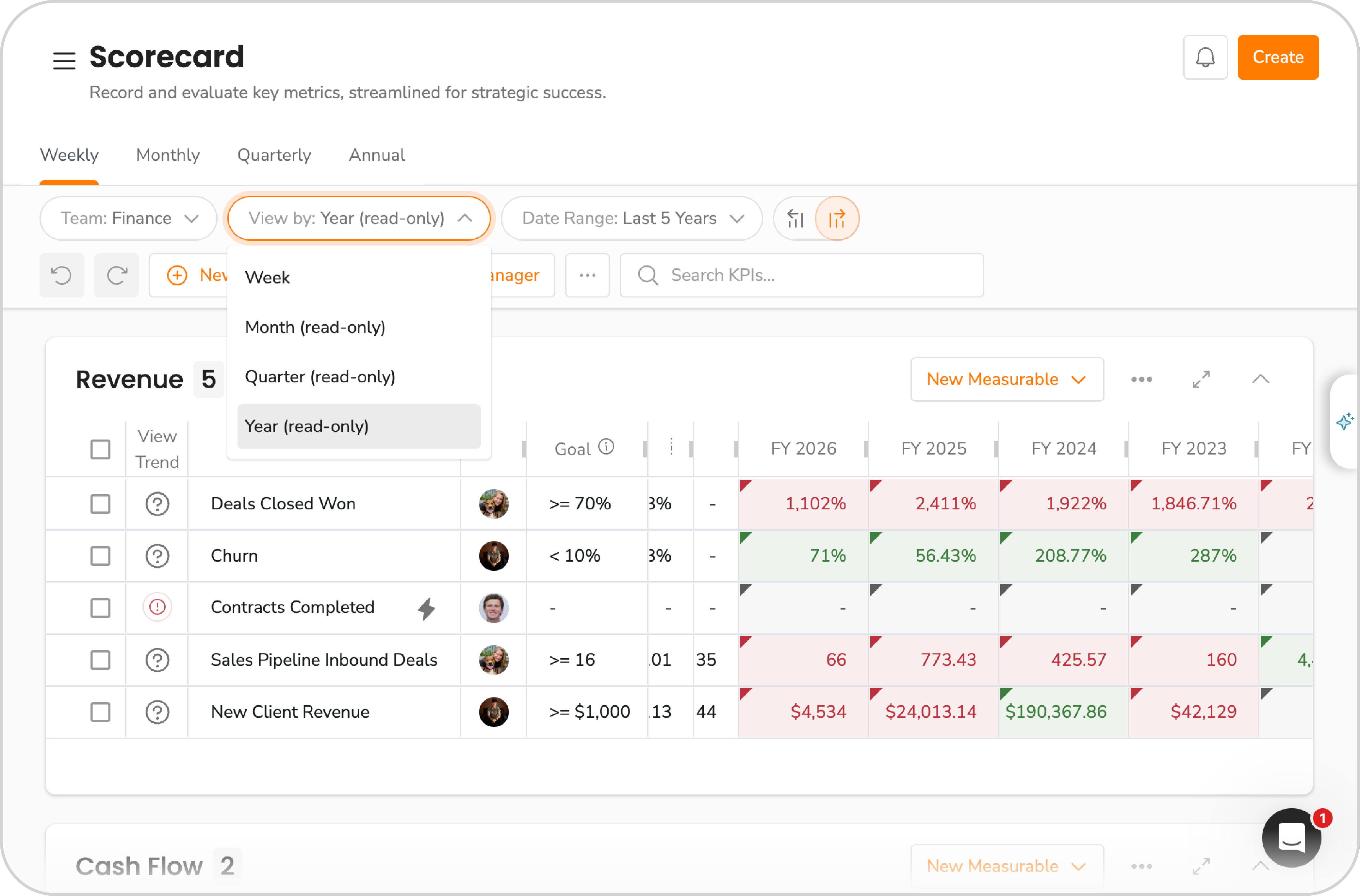
When Should You Change a Measurable on Your Scorecard?
A measurable should change when it no longer helps your team make better decisions. That’s the simplest way to think about it. A number can still be accurate, easy to pull, and familiar to the team, but that doesn’t mean it belongs on the Scorecard. If it no longer helps you catch issues early, stay accountable, or know what to do next, it’s time to review and replace it.
When Kevin’s business moved from consulting into B2B SaaS, the old metrics weren’t bad metrics. They just no longer matched the market the company was moving into. Bill rates and utilization made sense in one model. MRR and average contract value mattered much more in the next one. Any time a business undergoes changes, the measurables have to change with it.
A company doesn’t have to completely reinvent itself for a measurable to stop fitting. Sometimes the change is much smaller than that: The company grows and roles become more specialized, a Seat takes on a different set of responsibilities, the go-to-market strategy changes, or the company adds a new revenue stream. The list goes on.
Here are a five signs that let you know it may be time to change a measurable:
-
It reflects an old version of the business: The company has changed, but the measurable hasn’t.
-
It tells you what happened, but not what’s likely to happen next: It may be worth tracking, but it’s not giving the team enough time to do something about it. That usually means it belongs in reporting, not on the Scorecard.
-
The owner can’t really influence it: If the person who owns the number can’t meaningfully affect it week to week, it’s not the right measurable (or it doesn’t have the right owner).
-
It stays on track while performance is still off: That means the measurable isn’t tied closely enough to the result that matters and isn’t giving the team a true read on performance.
-
It creates more confusion than clarity: If the team spends more time debating what the number means than deciding what to do about it, it’s time to change it.
Remember, a measurable can make sense for a period of time and still need to change later. Changing it doesn’t mean the original number was wrong. It just means either the business has changed or the team has gained better insight into what drives performance.
Before Changing a Measurable, What Should You Check First?
Sometimes the measurable isn’t the problem. Sometimes the issue is the discipline around it. The number may be fine, but people aren’t reviewing it consistently, aren’t clear on ownership, or aren’t using it to IDS® issues when it’s off track. Before replacing a measurable, it helps to pressure test the team’s discipline first.
Here are a few questions worth asking before making a change:
-
Are we reviewing this measurable every week?
-
Is it clear who owns it?
-
Can that person meaningfully affect the result?
-
Does it help us see what’s likely to happen next?
-
Have we tracked it long enough to see a real pattern?
-
Does it lead to action, or does it just get discussed?
Not every weak Scorecard comes from weak measurables. Some come from weak habits. A measurable only works if your people have a clear way to review it, discuss it, and act on it.
To help strengthen his team’s discipline, Kevin didn’t just use EOS at the leadership team level. He extended the operating system across the business so everyone used the same language and the same structure for ownership and follow-through. This is where rolling out Ninety to your entire team can make the difference. When the numbers for every department and every Seat are in one place and visible across the company, it’s easier to decide whether the number itself needs to change or whether the real issue is a lack of follow-through.
The goal isn’t to create a better-looking dashboard. It’s to help the team get clear on what matters and what needs to happen next.
What does a stronger measurable look like?
When it’s time to make a change to your Scorecard, the new measurable should get closer to the work that helps move the business forward. You’re not changing a measurable just to freshen up the Scorecard. You’re changing it because the current number is no longer giving people useful weekly visibility. A stronger measurable helps people see whether performance is moving in the right direction sooner and decide where they need to focus next.
Take a sales team that tracks total revenue on the Scorecard. Revenue is important, but it may be too late to help the team respond in a weekly meeting. A stronger measurable might be qualified meetings held, proposals sent, or opportunities created. Those numbers are closer to the work that drives the result, which makes them more useful to review as a team week to week.
A strong measurable has a few clear characteristics:
-
It connects daily and weekly work to the company’s long-term goals.
-
It can be reviewed every week without a lot of debate.
-
It’s owned by one person.
-
It gives people enough lead time to respond.
-
It points people toward action, not just observation.
Changing a measurable can also change the conversation in a healthy way. It shifts attention toward the work that matters now. It helps people get clearer on what winning looks like. And it gives the team a better chance to solve issues before they turn into bigger ones.
What should you do next?
Start by reviewing your current Scorecard with fresh eyes.
Look at each measurable and ask: Is this number still helping my team spot issues early, stay accountable, and focus on the work that drives results? If the answer is yes, keep it. If the answer is no, don’t keep it just because it’s familiar or because it used to be useful. Over time, even a solid measurable can stop giving your team the clarity it once did.
That’s what makes Kevin von Keyserling’s story so relevant here. As his business changed, the numbers had to change with it. The old measurables fit the old model. The new ones fit the business the company was becoming. That shift didn’t just improve reporting. It helped reshape how the company operated, made decisions, and held every person accountable.
So if a measurable reflects an old version of your business, review it. If it no longer helps your team catch issues early, replace it. And if the measurable is still right, make sure your team is using it with the consistency and discipline it needs.
Remember, the best Scorecards don’t stay static. They get sharper as the business gets clearer.
Want a better way to manage your EOS® Scorecard? Check out Ninety’s Scorecard feature to see how teams track the right measurables and keep accountability visible each week. Then start a free trial of Ninety to see how it works in practice.
Want to hear more about Kevin’s story? Check out this episode of the Impact Moments podcast.