
.jpg)

A couple years ago, I was on a call with one of our clients who owns a rapidly growing business, and he articulated one of the biggest pain points for companies newly running on EOS: “My team is turning all of our Scorecard metrics green, but we’re not moving any closer to our V/TO® revenue and profit goals.”
Can anyone else relate?
Excuse me while I quietly raise my own hand because I’ve been there, too.
This is a surprisingly common issue. When your team shows up every week, hits their numbers, and keeps the Scorecard green, it can feel confusing to realize the company itself isn’t actually moving closer to its bigger goals.
And once that realization hits, the next step is even harder: telling a team that's been doing exactly what's asked of them that the targets are about to change.
As business leaders, we want our teams to feel connected to the company’s success. We want them to understand how their work contributes to the bigger picture. That only happens when the targets on the Scorecard are truly aligned with where the business is trying to go.
The challenge is figuring out how to set those targets correctly in the first place.
When the Scorecard Looks Good but the Business Isn’t Moving
When Scorecard targets aren’t aligned with the company’s bigger goals, teams end up measuring activity instead of progress.
And when the wrong metrics or targets stay in place too long, several things begin to happen:
-
Execution starts to lose meaning: If people are hitting their numbers but the business isn’t improving, the Scorecard can begin to feel like a routine exercise instead of a useful management tool.
-
Trust can also erode: Teams naturally begin asking, “If we’re doing what we were asked to do, why isn’t it working?”
-
Leaders lose clarity: Without the right indicators in place, it becomes harder to see whether the business is actually moving in the right direction.
The Scorecard is meant to function like a dashboard for the leadership team. It should quickly show whether the company is on track. But if the numbers on that dashboard aren’t tied to the outcomes that matter most, the whole system becomes less effective.
.png?width=4163&height=2744&name=EOS_Product_Thumbnails_Scorecard%20(1).png)
The Turning Point Leaders Eventually Reach
At some point, most leadership teams experience a moment where the disconnect becomes obvious. Maybe it happens during a quarterly planning session when the team reviews the numbers and realizes the company isn’t progressing toward its annual goals. Maybe a key initiative stalls even though the Scorecard looks healthy. Or maybe someone finally asks the uncomfortable question: “If we keep hitting these Scorecard targets every week, will we actually reach our goals?”
When the answer is unclear, or worse, when the answer is no, that’s usually the moment leaders realize something has to change.
The encouraging news is that fixing the issue doesn’t require rebuilding the entire system. It simply requires reconnecting the Scorecard to the outcomes the business actually cares about.
Three Ways to Set Better Scorecard Targets
If your team’s Scorecard is green but the business isn’t progressing, here are three practical steps you can take this week.
1. Start with the Outcome You Want
Before deciding what belongs on your Scorecard, leadership teams need clarity on the outcome they're trying to produce. One way we illustrate this at Amplify is with a framework we created called Cash Flow Mountain.
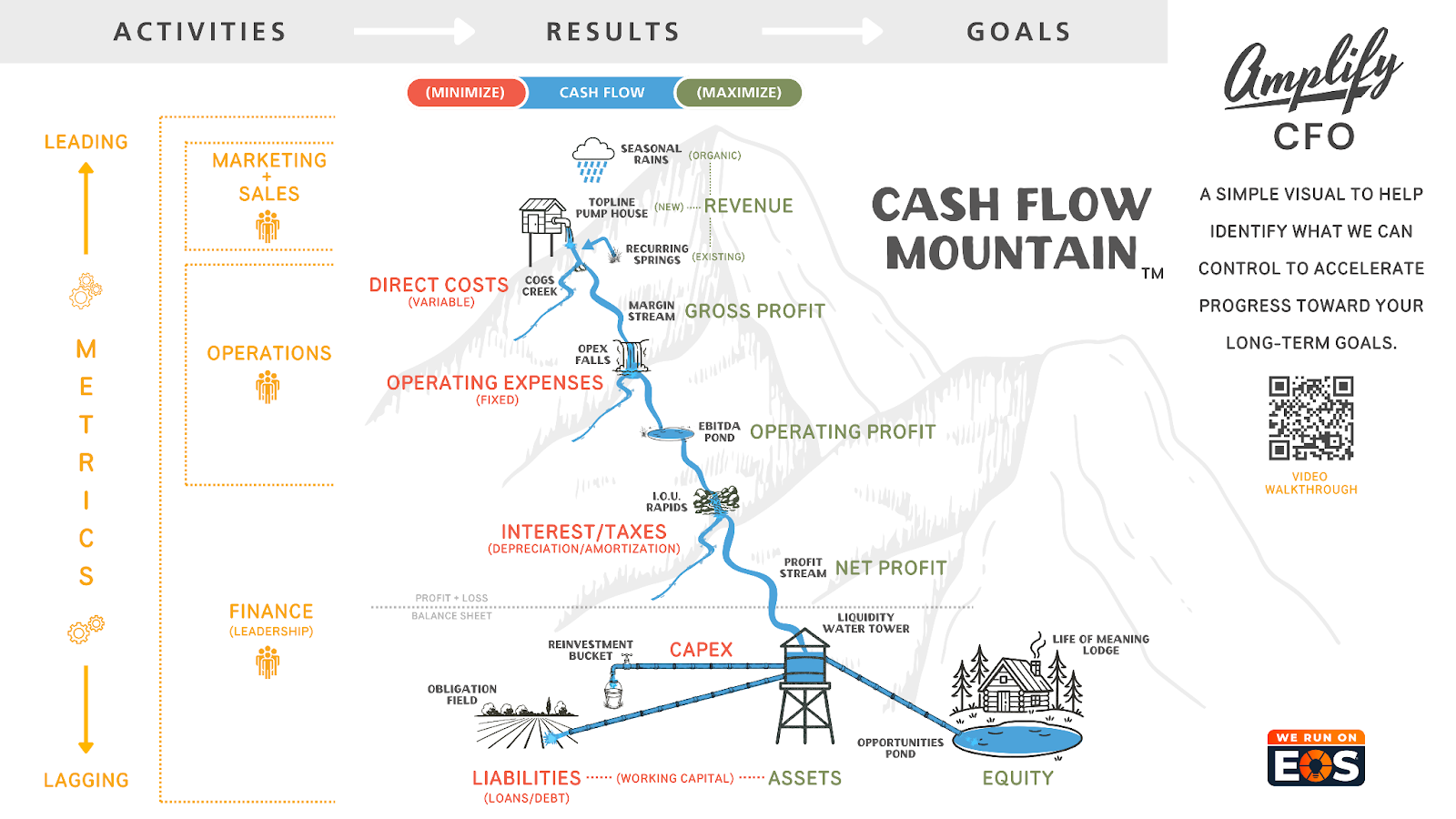
At the right side of the mountain (at Life of Meaning Lodge) is the long-term outcome the business hopes to achieve. On the left side are the weekly activities and departmental metrics that show up on the Scorecard.
Between those two points is the flow of the business itself. Like water running down a mountain, the financial statements help us understand how activity eventually turns into real results.
Starting with the end in mind helps leadership teams work backward from the outcomes they want to the activities required to produce them.
It also creates an opportunity to ask an important question: Why does that outcome matter?
Instead of choosing an ambitious number simply because it sounds impressive (“We want to be a $10 million company”), leaders can clarify what that result actually enables. Maybe it funds expansion, creates stability, or allows the owners to build the life they want.
When the outcome is meaningful, it becomes much easier to align the rest of the business around achieving it.
2. Focus on Leading Indicators
Once you’ve clarified the outcome you want (your revenue and profitability targets), the next step is identifying the Scorecard numbers that actually drive those results.
These typically fall into three categories:
-
Revenue drivers are activities that directly create new sales or customers for the business, like qualified opportunities, sales calls, proposals sent, or lead conversions.
-
Operational drivers are the processes and productivity measures that determine how efficiently the business delivers its products or services. Examples might include utilization rates, units produced, or on-time project delivery.
-
Financial indicators show whether the business is actually generating revenue and profit from its activities. These might include weekly revenue, gross margin, or labor cost as a percentage of revenue.
But choosing the right metrics is only half the work. You also need to determine what the targets should be.
One of the most effective ways to do this is by creating a forecast that shows how weekly performance adds up over the course of a year to produce your desired revenue and profit.
This matters because a “good week” for a $3 million business is not the same as a good week for a $10 million business. If your targets don’t reflect the growth you’re aiming for, your Scorecard may stay green while the business falls off track.
When metrics and targets are tied to a clear forecast, each week’s Scorecard becomes a meaningful sign that your team is moving toward the results you want.
3. Revisit Targets as the Business Grows
Once your Scorecard metrics and targets are aligned with your long-term goals, the final step is creating a rhythm to make sure the business stays on track.
A simple way to do this is through a monthly financial review. When the books close each month, you can compare your actual results to the forecast that helped set your Scorecard targets.
We often use a framework we call the MAP Review, which stands for:
-
Measure: Compare last month’s results with what you expected.
-
Adjust: Identify what needs to change based on what you learned.
-
Predict: Update your expectations for the months ahead.
This monthly rhythm helps leadership teams continually validate whether their Scorecard targets are truly driving the outcomes they want.
Without this process, long-term goals and Scorecard metrics can slowly drift apart. But with a regular MAP Review, teams create a built-in opportunity each month to recalibrate, stay aligned, and keep the business moving toward its long-term goals.
Keeping the Scorecard Connected to Progress
When a Scorecard is set up well, it becomes one of the most powerful tools in your EOS toolbelt. It helps teams stay focused. It creates accountability. And it allows leaders to quickly see whether the business is on track.
But that only works when the numbers on the Scorecard are truly connected to the outcomes the business cares about. If your team’s Scorecard is green but the business isn’t moving forward, it may not be an execution problem. It may simply be time to adjust the targets and create clearer financial visibility so everyone can see the roadmap ahead, understand their role in the journey, and help keep the company moving toward its biggest goals.
And when the Scorecard turns green again, it will be something the whole team can celebrate.
When your targets are tied to the outcomes that matter, your team can stop guessing and start making meaningful progress.
Already using Ninety? Access your Scorecard to put these learnings to work.
Not on Ninety? Start your free trial today and start creating better alignment, visibility, and Traction® across the business.
If you’re working toward your V/TO® goals and want more confidence in how your Scorecard is supporting that path, Ben and the Amplify team would be glad to listen and explore it with you. Feel free to reach out.



.jpg?width=500&name=large_%20EOS%C2%AE_Scorecard_Helps_EOS_Blog_Header_1920_x_1080_v2%20(1).jpg)