
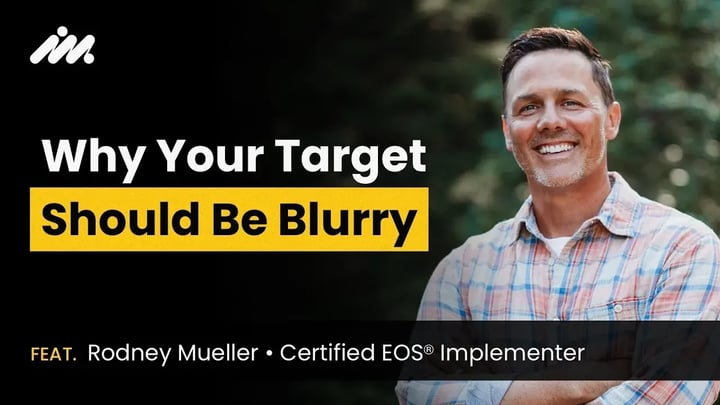
Why Your Target Should Be Blurry
Rodney Mueller joined the Army at 17, and by his late 20s he had run nine marathons, finished business school, and was making six figures, yet he hit a breaking point when none of it made him happy. That led him to 15 years of executive coaching and then to EOS®, where he could push the vision work he loved doing with founders through an entire organization instead of leaving the follow-through on their shoulders.
In 2009, as a drill sergeant at Fort Knox getting 60 soldiers ready for war, he discovered that elite marksmen aim the opposite way most people do: they focus on the front sight and let the target go blurry. His platoon set marksmanship records at a post that has been training soldiers for a hundred years.
Rodney walks Christine Watts and Kris Snyder through how that lesson became Perfect Aim, his goal-setting method built on one question (if I achieve that, why would it matter?), and why the V/TO® already follows the same pattern from a blurry core focus down to precise Rocks. He also shares the keynote that got him fired from his next two speaking slots, and why karaoke is his favorite leadership exercise.
Key topics
- The counterintuitive way elite marksmen aim, and what it means for business goals
- Perfect Aim: asking "if I achieve that, why would it matter?" before chasing a number
- How the V/TO® moves from a blurry core focus to precise Rocks and to-dos
- Moving from one-on-one executive coaching to EOS® with full leadership teams
- Learning to perform authentically: a failed keynote, guitar practice, and karaoke
About Rodney Mueller
Rodney Mueller is a Certified EOS® Implementer and executive coach who grew up outside St. Louis. He has served 25 years in the Army, including active duty as a drill sergeant at Fort Knox, and spent about 15 years in executive coaching and leadership development, including five years in Silicon Valley, before becoming an implementer. His upcoming book, Perfect Aim, teaches his goal-setting method across five major areas of life, from career and business to relationships, well-being, and impact.
Learn more: rodneymueller.com
Connect with Rodney: LinkedIn
Mentioned in this episode
- Soul Stories by Gary Zukav
- The Last Word on Power by Tracy Goss
- The Automatic Millionaire by David Bach
Audio Only
Christine Watts
[0:00:00]
Welcome to Impact Moments powered by 90. Today, we are joined by Rodney Mueller. Rodney joined the Army at 17, and he was doing everything that he thought would make him happy. He was running marathons, got his MBA, had a great job, and it still wasn't enough. And he hit a breaking point that led him to executive coaching, then to EOS, and he discovered he could take the vision work that he really loved doing and push it through an entire organization. So you guys will love this conversation. He shares his impact moment of how he thinks about every goal that he sets and the methodology that he really has behind that, and even ties it back into when he started at Fort Knox, where he discovered that the best marksmen in the world aim completely differently than everyone else, and how he applies what he learned on the rifle range now to business. So I hope you enjoy the conversation. Let's get into it. Welcome to Impact Moments Powered by 90. I'm Christine.
Kris Snyder
[0:01:05]
I'm Kris Snyder.
Christine Watts
[0:01:06]
And we're joined by Rodney. Thanks for being here.
Rodney Mueller
[0:01:09]
Glad to be here.
Christine Watts
[0:01:10]
Awesome. Well, tell us a little bit about yourself. You're an EOS implementer. So give us a little bit of a backstory into how that came to be. Would love to hear your background.
Rodney Mueller
[0:01:20]
Yeah, so it's a bit of a circuitous path, but it really started, I won't give you the long story, but it started with I grew up with an absent father, single mom, just outside of St. Louis. And what that left me with is kind of at a really young age, bound and determined to be successful. And I realize now through lots of therapy that that was more about not wanting to rely on other people. So I was really determined to be successful at a young age. joined the Army when I was 17 while also going to college and kind of going that path. And so really by my late 20s, I had kind of pursued this path of achievement and achieved a lot of things that I thought would make me happy. Um, really had a great career in the army, uh, ran nine marathons, uh, completed business school, was making six figures, which from where I came that was wealthy. And, uh, at a point there, I just kind of reached a bit of a breaking point. Like I, I had done all the things I thought would make me happy, but I wasn't. I was disconnected, overworked, exhausted, like a lot of our entrepreneurs experience. Um, and, uh, a friend was going through this crazy, uh, in-depth intensive coach training and leadership development program. And, uh, so I thought it would move me closer to my purpose and what I really enjoyed. And so went through that program, not intending to become a coach, um, but really discovered that was my work. That was about 15 years ago and, uh, built in executive coaching, leadership development, practice, um, And how I came to EOS was kind of after doing that for many years, I realized that I was working with a lot of founders and CEOs, and I was helping them really get clear on their vision. I was helping them be happier, healthier, more balanced, become better leaders. have better relationships. But what I wasn't helping them with was pushing that down through the whole organization. And I was leaving this burden on a lot of founders who don't love following through and execution and the details. So then I found EOS with a client and I was like, you should do this. And I thought, you know, I should do this too. I think this would help serve my clients better. So anyway, that's how I came to EOS.
Christine Watts
[0:03:36]
Wow, that's interesting. So your client found EOS and brought it to you? Is that what I heard?
Rodney Mueller
[0:03:43]
Essentially, I had read Traction probably around when it came out and I was like, oh, that's a nice book. You know, nothing rocket science in the book. But when I looked at it through the lens of my client's small business, about 100 employee health care practice, I was like, oh, my God, that's exactly what you need. Yeah.
Christine Watts
[0:04:00]
So. So, yeah.
Rodney Mueller
[0:04:02]
Yeah.
Christine Watts
[0:04:02]
So you heard about it again a second time and jumped right in right away. Like how how was that decision making process for you becoming an implementer?
Rodney Mueller
[0:04:13]
Um, well, really what was happening is I was pretty burnt out. I was, I was, uh, um, uh, turning 40, my second daughter was being born. So I think maybe like a lot of dads, I was very scared and like, and, and also turning 40, I didn't think it would be a big deal, but I was like, what am, what am I gonna do with the next 10 years? Um, you know, this kind of major important part of life. And so, uh, I started looking at EOS, but it was a very big investment of time and energy and a pivot in my business. And so, uh, I was highly skeptical. They told me they had a great community. Um, I, I liked the work, but I was very skeptical. So I kicked all the tires. I talked to a bunch of people and ultimately had a sense that it was the right, right path, uh, to help my clients better. And I couldn't have been more, more correct.
Christine Watts
[0:05:05]
So. And so you transition from really like just working with that owner or entrepreneur to working with the full leadership team, it sounds like, and then ultimately like taking it throughout the business. Is that what I heard, too?
Rodney Mueller
[0:05:17]
Yeah, exactly. So I had been more one-to-one executive coaching. I did some team coaching and leadership development in organizations, but really taking, especially the traction components of EOS, you know, how do you run a great meeting? How do you, you know, I spent five years in Silicon Valley and everybody would talk about right people, right seats, but nobody actually knew how to do that. We all know what it meant, but how do you actually do it?
Christine Watts
[0:05:43]
So.
Rodney Mueller
[0:05:44]
Those things, along with a strong vision and creating healthy culture with the whole team and rolling it out, that's what made a huge difference.
Kris Snyder
[0:05:53]
Do you miss the one-on-one founder visionary work?
Rodney Mueller
[0:06:01]
Yes and no. I mean, there's a there's an element of depth that you can get into with an individual that's really special, where you get to really impact, you know, how they see themselves, how they think about what's possible for their business and their organization. Um, you know, how they show up as a parent, uh, how they show up in their romantic relationship. I still think I get to do that as an EOS implementer. It's a little less deep, but the dynamics are so challenging and interesting because you're working with multiple humans. You're working with the team dynamics. You're working with the, the business dynamics as well. So, so yes and no. Um, I, I far more enjoy what I'm doing now because I think it gives me more opportunity to make more impact on more people.
Christine Watts
[0:06:49]
So.
Rodney Mueller
[0:06:50]
Yeah.
Kris Snyder
[0:06:50]
I mean, the reach is different, right? For sure. The depth is, my interpretation is the depth is different too, because you are working with five people at one time for eight hours versus a person for whatever the meeting cadence was before. Totally. Totally.
Rodney Mueller
[0:07:06]
Yeah. Yeah. And, and there's a lot more community around EOS. You know, I think that that's the thing that I love the most is, um, you know, as a one-to-one executive coach is very intimate, private conversation. And I think as an implementer, I really relate to myself, like being part of the team. Um, obviously my role is a little bit different, but I'm part of the team. Um, it's more focused locally, whereas as a coach, I was, you know, really distributed across, across the country and sometimes across the world.
Christine Watts
[0:07:34]
So.
Rodney Mueller
[0:07:34]
Um, I get to make an impact in my backyard too, which is cool.
Kris Snyder
[0:07:38]
Well, the, the, um, the marketability, it was what I, I found that like Kris could create Kris's operating system, but who cares, right? When you have whatever we have now, 850, 870 other people, and I think we've got 14 or 15 people in my market, Cleveland, right? So you're not out there alone. People take it sometimes as intimidation by there's so many implementers, you're like, If everyone's carrying 20 clients and most of the time that's not true, there's still in Cleveland 12,000 target market companies. Like we're not even close. Not even close, yeah.
Rodney Mueller
[0:08:12]
And that was one of my, you know, one of the biggest pain points I had is being like kind of a solopreneur. I had to earn trust every single time with a new client and, you know, with EOS and I think a well-earned brand and reputation. Um, it, it is proven and practical. So that trust hurdle is much, much less. And so I actually had people reach out and be like, I know EOS, I love EOS, I want EOS, which was extremely refreshing to me. Yeah. After years of being in the, you know, in the cold, dark, lonely place by myself. Yeah. Describing each time what you do and how you do it versus like, oh, it's a proven process.
Kris Snyder
[0:08:52]
You know, 300,000 companies, let's go.
Rodney Mueller
[0:08:55]
Yep. And you don't have to customize every time. And I think that that's the biggest thing is like, you can, when I think about it's genius, really the three uniques for EOS, like helping get aligned on vision, creating discipline, focus and accountability with traction and, and creating a healthy culture. Um, I can say that when I look at comparing myself as an implementer versus what I did as a coach. EOS would kick my butt every single time because I could do vision and health super well, but not providing traction, that's super frustrating for the entrepreneur. And so comparing what you get from EOS versus just an individual coach, it's a tough comparison, plus all the free resources to help roll that out through your organization.
Christine Watts
[0:09:41]
Yeah, that's so true. And you've mentioned impact a few times. And so I want to get into your impact story. So that moment where you felt like a critical decision or thing that happened and what the ripple effect of that was.
Rodney Mueller
[0:09:53]
Yeah. So, so I mentioned earlier, so now 25 years in the military, and probably the biggest impactful moment for me was, it was 2009. I was in Fort Knox, Kentucky. I'd been called to active duty as a drill sergeant, which nobody believes, but, and I'm probably the only drill sergeant life coach you'll ever meet. Um, but those things are very interrelated. But, uh, so it's 2009, you know, Iraq and Afghanistan are still ongoing. Um, I'm getting ready to accept my, my first basic training platoon of 60 soldiers. Um, and of course, as a drill sergeant, I wouldn't show this, but I was, I was very present to the weight of that responsibility. Um, because training these young men, 17, 18, 19 year old, I mean, uh, they are even as a 27 year old at the time that they're young, they're boys. Yeah. And I have 10 weeks to turn them into a soldier and prepare them to go to war and, uh, not get themselves dead or other people. And so, um, One of the biggest kind of training milestones in the military and army boot camp is marksmanship, so qualifying on their M16 weapon. And so I was like, that's pretty important. I need to really make sure that how I'm gonna train them is really the most effective. So I made this still mind-blowing discovery to me, which was when I looked at how do the best people train marksmanship, they train it completely different than we had been doing in the Army. And what I realized is that I had been aiming the wrong way for 10 years in the Army, even though I was doing pretty well, and pretty much all of my peers were also aiming the wrong way. So what I discovered is that basically the most elite marksmen, they focus on two fundamentals. One is how you aim, and the second is, to a lesser degree, a smooth trigger squeeze. And so when you aim, the intuitive way that people aim is they focus heavily on the target that they're trying to hit. So if you're trying to hit a piece of paper or a deer or whatever, You focus on the target. The proper way to aim is actually to let go of control and to focus on the front sight of the weapon and let the target be blurry. And so, totally counterintuitive. We all want to control hitting the target. We want to control the aim. We're squeezing and forcing. So armed with that knowledge, I was like, I'm going to scrap the way that I had been trained, and I'm going to focus only on training my soldiers in this way. Um, so that's all we did. I literally gave them a PowerPoint presentation about why we're going to aim this way and give them the context. And then we drilled that for three weeks straight. Um, and through that process, we get to the qualification day. So qualification day is like, uh, uh, you sit down with targets that pop up randomly 50 to 300 meters and you have to qualify. It's a big serious day and bootcamp the first big milestone and, um, Uh, with that training, we, we set records for marksmanship at Fort Knox, Kentucky, which has been training soldiers for a hundred years.
Christine Watts
[0:13:05]
Wow.
Rodney Mueller
[0:13:06]
Um, a hundred percent, uh, within two attempts and 99% after the first attempt. So it was a, it was a massive breakthrough. I went from being a mediocre shooter to shooting 40 out of 40 targets just with that shift in how I aim. And the reason for that is it, it taps into the subconscious superpower that when you focus on the front sight, let the target be blurry. It taps into the subconscious supervisor to perfectly align the weapon. And so that was the impactful moment. And the reason is not just because I became a better shooter and trained my soldiers better, but because I was becoming a coach at the same time. And I realized as I was setting goals, and coaching goals with leaders and myself, that we do the exact same thing with our goals. That we overly focus on the form of the goal, so the revenue number, the things that we think we need to fix, and we don't allow ourselves to set a blurry target. What's the experience or intention that we're after in the business? Why is that sales number important? So ever since then, I've kind of applied that same mindset and developed a goal-setting methodology that I call Perfect Aim. So it's about tapping into that subconscious superpower to align the company and to align ourselves with what we're really after, and we're more effective at hitting that.
Kris Snyder
[0:14:28]
I think it's a, I'm just reflecting as you, as you were describing it, so often the goals are given, um, or decided by someone and not explained.
Rodney Mueller
[0:14:39]
Exactly.
Christine Watts
[0:14:40]
Right.
Kris Snyder
[0:14:40]
Like that is the target. That is a, you know, 10 million, whatever the number is.
Christine Watts
[0:14:43]
Right. And.
Kris Snyder
[0:14:45]
And yes, we want them to buy into the purpose, cause, passion. But if those things aren't really connecting, right, then that drive, that emotionality is missing.
Rodney Mueller
[0:14:55]
Completely. And then what you have is you have employees who are, they want to do a good job. I think most people really want to do a good job. and they want to hit their number, but the spirit and creativity of a human being is not engaged when they're just like, do X, work eight hours, hit this sales target. And I think it's incumbent on leaders to really enroll them in the why. Both so they hit the right target, because you could easily hit your sales number and not get the right clients. You could easily hit the sales number and degrade the future of your business. So explain the why I think unlocks more commitment and inspiration in your people, but also helps you hit the target more precisely.
Christine Watts
[0:15:44]
I think it's a great way to articulate even the like, what does it look like aspect of the VTO, because I think a lot of people do go right to the quantitative, here is the number that we need instead of the qualitative, like here is what it's going to feel like or what it's going to be like without trying to attribute a certain dollar value to it.
Rodney Mueller
[0:16:01]
It's one of the biggest mistakes that I see, I think actually is. And it's interesting because when I, when I came into EOS, one of the things that I loved was the VTO mindset, the concept is super aligned. So when you think about the core focus, it's, it should be blurry. It's kind of like, it's, it's a blurry target. It's not precise. It's not specific. And then as you go further, the three-year picture, also blurry. It's not a detailed strategy or plan. As you get into the one year, it gets a little more precise. You're getting a little more dialed in. And then as you get into your 90-day priorities or ROCs, that is a lot more specific. And then your to-dos are very specific. So it follows that same concept if we apply it correctly. But I often see that It's almost like we set the core focus in the three-year picture and then we like forget about all of that. And then we're like, okay, what do we got to do this year? And they're not aligned. Yeah.
Kris Snyder
[0:16:59]
It's, it's interesting too, for me, because there, um, when we're doing core focus work and purpose, cause, passion statement, right. And like, this is your, I have a dream speech, not your, I have a plan speech and the challenge for them not to try to make the plan about it. And I'm like, it's directional in its nature. It doesn't have to, it doesn't, you don't have to know exactly how you're going to do that. Um, people to disconnect from that. It seems, seems challenging. Totally.
Christine Watts
[0:17:24]
Do you have clients resist the concept at all or just having to over-explain it to get there? Do you encounter any sort of tension there with people not wanting to go there?
Rodney Mueller
[0:17:34]
I think that we as human beings have a natural resistance because we like to be in control. It's the same as aiming the weapon. It's very difficult to let go and just let the target be blurry. And so I think there's a natural resistance, absolutely, that I see with clients because you're like, well, Why does the why matter? Why do I need to get that so precise? And my perspective is that everything comes from that space to really have like, you know, a 10x goal or a 10x mindset. If you just say, here's my goal and I'm going to 10x it, there's no power, there's no integrity, there's no foundation to that. So I think that really, from the core focus, we look at how do we bring that into reality? And that's the, like, to me, it's almost like an engineering conversation, but I think people have a natural resistance to that for many reasons.
Christine Watts
[0:18:32]
Yeah, it's interesting because I even think like myself, even like a while ago, it was like, we have so much to get done. We don't have time for team health. We don't have time for like all, you think you don't have time for all of these things, but they're actually really foundational things. And we even went through this exercise, I think I've talked about it before, where we were talking about the company vision. And then we all went around the table at the leadership team and said like, what's your vision? What's your why?
Rodney Mueller
[0:18:58]
And like,
Christine Watts
[0:18:59]
our company vision should be big enough so that each of our whys can fit underneath that so that we're all learning and growing. And at the time I was like, ugh, this exercise is going to take a long time. We have so much to get done, but it's really valuable work to actually take a step back and think about it that way so that you can set yourself up to have more meaningful progress.
Rodney Mueller
[0:19:19]
But that piece is what distinguishes extraordinary elite companies and teams over almost everyone else is when you tap into the purpose of your collective human beings, and that's all aligned moving in one direction. That is incredible. You know, when you take the most elite teams in the military, I always use Army Special Forces as an example, because it's a 12-member team who are often referred to as force multipliers, which means they can achieve with 12 what it would normally take 100, which is very relative to many of my clients. There's, you know, 12, 20 employees. Wow, what if you could achieve with 12 what it would take 100 employees to do? What would that be like? And the reason they're able to do this is there's incredible alignment on purpose. They are all willing to die for that purpose. Imagine a company where you would be willing to die for your purpose. Maybe it's not that serious for our businesses, but that unlocks a whole different level of commitment in your people.
Kris Snyder
[0:20:17]
Yeah, well, especially if there's a downstream effect, but maybe, you know, the purpose of the business isn't, but what it's doing for others is, and that could be the die part, right? But there's a big emotionality. component to figure out when you say you're going to die for something.
Rodney Mueller
[0:20:34]
Yeah, yeah, yeah. I mean, it's maybe not that serious, but you know, like, I think that all, I think that all people have a purpose. And I think it's usually not an accident that we are attracted to a certain company. And so when we can articulate that and remind people that, you know, what you're doing day to day connects to the purpose that you brought into the company and our collective impact. So I think it makes a huge difference from that perspective.
Kris Snyder
[0:21:03]
So when does the book come out? Are you getting close?
Rodney Mueller
[0:21:06]
I keep thinking I'm getting close. The book should be, I think officially it will come out in the fall. So it'll talk about, you know, some of the conditioning and resistance that we have because of the way we've been trained and conditioned to think about goals. I'll teach them the perfect aim method, which is kind of what I talked about, but really If I were to give you guys something, if you don't read the book, it's just basically, if you just do this one thing, which is like, whenever you set a form-based number, so a sales target, or even personally, if you're setting a goal, like I wanna lose weight, all goals, when I talk about perfect aim, you should ask yourself, well, if I achieve that, why would it matter? What's the experience it would provide me? So every perfect aim goal should have the objective or experience or intention, And then if we fulfilled on that, what's the result? So you're really bringing that experience into reality. And then I teach how to apply that to five major areas of life, career, business, romantic relationship, well-being, and self-expression and impact.
Kris Snyder
[0:22:12]
So are you bringing this into the EOS Impact Library?
Rodney Mueller
[0:22:16]
Um, it's not, it's a different publisher, so I don't know if it'll be part of the EOS Impact Library directly. Okay. Yeah.
Kris Snyder
[0:22:25]
Just curious.
Rodney Mueller
[0:22:26]
Yeah.
Kris Snyder
[0:22:26]
There's, there's been 17 books now through the EOS Impact Library and I'm just fascinated by all the ones that keep coming. Totally.
Rodney Mueller
[0:22:33]
Yeah. A lot of great books coming out right now.
Christine Watts
[0:22:35]
So, yeah. I'm curious to ask about the VTO again, because I feel like I get the question a lot of how often should we go back and revisit that, whether it's the vision itself or the goals. And so talking a little bit about that process when you're going through that perfect aim process.
Rodney Mueller
[0:22:52]
I mean, the VTO should be reviewed often. I think that, you know, when, if you're running, if you're working with an implementer at least once a quarter, but getting precise on that why I think really informs everything else. You know, it's, it's a bit like, I think about like, If you're not really clear on the why, it would be like designing a $100 million building and not understanding what the experience you want the occupants to have, right? The thing with the business that is exciting and annoying is that you're always building the building. It's always in process. And so if we're not clear on that why, and landed on it, and it's simple and clear, then it's really difficult to set a 10-year target, a three-year picture, a one-year plan, or rocks, like all of those are threaded through that. So, I think like most businesses always work in progress and we're always honing and becoming more clear about like why we are here and how we bring that into the world.
Christine Watts
[0:23:56]
So.
Kris Snyder
[0:23:57]
Well, yeah.
Christine Watts
[0:23:58]
Well, I almost hesitate to ask this question because of your background, but we always like to ask out of all of your success and the things that went well, also the flip side of that and something that was really hard and a failure. And so if you look back, what would you say is one of your biggest fuck ups and like what happened as the result of that and what'd you learn from it?
Rodney Mueller
[0:24:19]
Gosh, I think I've fucked up a lot of things. You know, most of them informed by always being afraid that I wasn't good enough. And so when you're afraid that you aren't good enough, if you don't work on that internally, then you show up and you don't show up authentically. You don't show up in your highest and best. And so, there's an impact. Probably the one that always comes to mind that's the most embarrassing, I think, is I like about 10 years ago, I had got booked for three speaking engagements for the local business networking chapter. And, uh, I got booked for the first one and I, in my defense, I had, I was, I was like, I had just been in Germany for a month for the army off time zone and I was prepping last minute for the keynote. Um, and I thought I had, I prepped, I did all the things that I thought I should do. And I go to deliver the keynote and I did okay, I thought, but they hated it and fired me from the next two.
Christine Watts
[0:25:28]
Oh no.
Rodney Mueller
[0:25:28]
Yeah. It was very embarrassing. And it was like, it was also like at a point in my business where I was like, Oh, this is like, it was like a big opportunity and like, and yeah, they fired me for the last two. That was very embarrassing. It was like also local network, you know? But what I realized is, you know, the main reason I failed is that I was talking at them. I wasn't, I wasn't sharing stories. And so your content can be amazing, but if you're not connecting and you're not sharing authentically and using stories, then it never lands well.
Christine Watts
[0:25:58]
So.
Rodney Mueller
[0:25:59]
Now I'm like, I can always at least do a mediocre talk because if I use a story and then deliver a little bit of content, it's going to be at least mediocre, which is better than getting fired from the next two talks.
Kris Snyder
[0:26:10]
I find, I mean, I love smaller rooms, right? Cause I feel like I could connect better with them and have more, not a constant conversation, obviously.
Christine Watts
[0:26:19]
Right.
Rodney Mueller
[0:26:19]
But it's almost like crowd work.
Kris Snyder
[0:26:21]
If I can do that, I'm a good, but if I go to much larger rooms, you know, especially when you get like over 200 some people, then it's just like this, I'm not connecting. Like even if I think I'm telling a story, it's just, it's just harder.
Rodney Mueller
[0:26:33]
Yeah.
Christine Watts
[0:26:33]
I know it's crazy, but also that's why I kind of love presenting for webinars because you're getting a constant piece of feedback from people in the chat. And I'm looking at that and I'm answering a question and it's so much more dynamic than standing up in front of a room where then we're having to control when somebody else can speak. So I know not everyone loves a webinar, but that's also why I love a webinar. That's true.
Rodney Mueller
[0:26:57]
I'm looking to enjoy it though. You know, it's interesting. Like, I think that I get anxious before every talk. I mean, anxious before talking to you guys. But what I'm finding is really fun is like learning how to, how to both be authentic and perform. And a keynote talk at the 200 is a performance. I mean, I much prefer a coaching conversation, much prefer a conversation like this, right? Because you're connecting in a different way.
Christine Watts
[0:27:27]
Right.
Rodney Mueller
[0:27:28]
But a keynote is a different animal. It's a performance. It is a show.
Christine Watts
[0:27:31]
You're up there and it's just you.
Rodney Mueller
[0:27:33]
Yeah. And so learning to master, like, how to be authentic and impactful while performing is like, I think, an incredible challenge.
Kris Snyder
[0:27:42]
Yeah, it is because you're, you are crossing that line, um, to, to, you know, an enjoyable performance versus that workshop coach moment where that's, that's just different.
Christine Watts
[0:27:54]
Right.
Kris Snyder
[0:27:54]
Totally. And, you know, I think Gino's keynote last year, if you saw it at the U.S. con. He did a great job. It was on his exit, you know, kind of from starting at EOS to exiting EOS. And you could just tell he had put so much time and intensity into every pause, every motion. And you're like, damn, that's, that's a performance.
Rodney Mueller
[0:28:18]
Yeah. That's one of the things I'm loving about, um, I dabble in guitar, but I've been playing every day for the last like six months. And I think that like when you can, um, practice things like that, uh, that are not directly related to your work as a leader or speaker. Um, I think it's important for leaders. I say this for companies all the time. I like finding a way that you can, um, play with performance. So like, you know, with guitar, I could never do it for many years. And I was like, Oh, I just need to let myself make noises and not try to do it perfectly. Um, that practice has helped me flow more when I'm leading a room or doing a talk. Um, and my number one leadership, uh, exercise oftentimes for, uh, leaders that especially are nervous about performance herself is to go and do karaoke, especially if you're nervous about karaoke. You can do it where you know no one.
Christine Watts
[0:29:10]
Right.
Rodney Mueller
[0:29:10]
But if I was mortified of karaoke, Um, but I took it as a leadership development practice and it was amazing because I was so nervous. My body had all kinds of reactions, but then I would go and do it where I didn't know anybody. I'm like, I'm not going to die. Yeah.
Christine Watts
[0:29:26]
It doesn't matter. I'm never going to see them again.
Rodney Mueller
[0:29:27]
Yeah. Yeah.
Kris Snyder
[0:29:28]
I think I liked your guitar. Um, I, when I turned 50, my kids bought me a guitar cause I've talked about it. I was, you know, apparently 50 year old men do. And, um, it was the worst because I took lessons and I was determined, but I was determined to get good. And they eventually fired me. He's like, you're not good. You should stop coming. And I was like, that was, that's demoralizing. But I never tried to make noises. I was literally trying to hit the notes to play a song right in that approach.
Rodney Mueller
[0:29:56]
Yeah, exactly. And that's, that's a lot of like, for me, like, you know, this concept of perfect aim, it came a lot out of like, my own choking underperformance, you know, like, I, I remember I loved baseball growing up, and I was pretty good. So I was on the starting shortstop of my high school baseball team. And, uh, uh, I made three errors in one inning, and I realized that my desire to perform outweighed my ability to play anymore. I couldn't play. It was like I had to do it perfect. So all that to say is like, you know, that is kind of how I approached things. I had to do it perfectly and I lost sight of the why. And so when it came to guitar, I was like, you know, like, what am I, I'm not trying to be a rock star here. I mean, I want to have the experience of being able to, to make sounds that are pleasant to me. And so when I look at it, well, what would my actions look like if I were coming at it from that place? It's totally different. It's like, oh, I can just put it in my living room and make noises that sound good versus trying to make myself do something that doesn't matter.
Christine Watts
[0:31:04]
I love that idea of transferable skills too. Like you talked about karaoke. I feel like other people do improv or whatever it is, but like kind of getting yourself out of your own head. That's why I still love playing sports too, because it's just like different situations to handle. hard conversation or putting yourself out there or getting out of your comfort zone. So, yeah, it's cool.
Kris Snyder
[0:31:24]
Totally.
Rodney Mueller
[0:31:24]
And like in karaoke, I mean, it's like you you have the bodily experience of all the things. And so when you move through that and you don't die, it's how you build confidence, like how you build trust in yourself experientially is through something like that.
Kris Snyder
[0:31:40]
So, yeah, I'm always so like not Upset or pissed off necessarily when you go to a karaoke bar, and there's these people who are just incredible really I was gonna get up there, but not after you
Christine Watts
[0:31:58]
That's my problem.
Kris Snyder
[0:31:59]
I've only been to good ones, like the Julian piano bar. That was really good.
Christine Watts
[0:32:03]
Or the, um, we have a good spot in Atlanta where it's all live band and everybody that gets up there is like incredible.
Rodney Mueller
[0:32:10]
I just try to choose like the funniest song to sing and then really emphasize, you know, my, my acting of the song and then.
Christine Watts
[0:32:18]
everyone into it.
Rodney Mueller
[0:32:19]
It's all good, yeah. That's the trick. It's better to be funny than good, I think, at karaoke, right?
Kris Snyder
[0:32:25]
I think so. That's my approach.
Christine Watts
[0:32:28]
Well, my last question for you, what are you reading or watching or listening to right now that's, like, helping you grow personally or professionally?
Rodney Mueller
[0:32:38]
I have been immersed in my own book lately. Um, but you know, I would answer that maybe in a little bit different way. Like, um, I, uh, of course there's a lot of great EOS books. I love the data book that just came out recently, but, um, because I was searching for guidance and wisdom at a super young age, I was seeking self, I wrote probably a thousand self-help books by the time I was like 28, which is weird. I also say that like, Oprah was like a pseudo parent father because it was on every day at four o'clock when I was at my babysitters and she introduced me to so many teachers and mentors. I'll share two and then my favorite book ever One is Gary Zukav that I read when I was 15, a book called Soul Stories, and it really helped me see for the first time that there was like some deeper awareness and consciousness than just my thoughts. That was hugely impactful. She also introduced me to like Automatic Millionaire, which had me saving like my change when I was 18. And Eckhart Tolle became pretty popular as well. But so a lot of teachers in that phase. And so if there's any Oprah fans, I might be alone in that. But hugely influential. And then one of my favorite books, I think, is really aligned with our conversation. It's called The Last Word on Power by Tracy Goss, kind of an obscure book. But she was a coach consultant that did organizational reinvention for Fortune 500 companies. And what's really cool about her work is, and by the way, it took me years of quoting the book, reading the book multiple times to realize that the book was about power. And it's called the last word on power. I should have known, but it's all about reinventing the way that we think about creating our future. And so she talks, she really gets into, um, this process of going through what is your impossible commitment? And I would say that's our core focus. Basically, what is that deeper? Why? And then from that place, declaring your future, um, how you bring that into reality from that impossible commitment. So I was like, Oh, power is that it's about how do we bring something that seems impossible into a possibility? And the faster we can move that possibility into reality, the more power and impact we have. So, um, that's not a current, but that's my favorite book. And I wish everybody would read it. The first three, four chapters are, you know, okay, they're kind of corporate reinvention talk, but the meat of that book is hugely impactful, especially for business leaders.
Christine Watts
[0:35:21]
Well, and I love the tie-in to what you're working on, too, of, like, really looking at the target and pulling it into reality. It sounds like there's a lot of overlap in concept there.
Kris Snyder
[0:35:28]
Totally.
Rodney Mueller
[0:35:28]
Yeah. Yeah.
Christine Watts
[0:35:29]
Awesome. Well, thank you so much for being here. Really appreciate it.
Rodney Mueller
[0:35:33]
Thank you for having me. Thanks for being great partners to us with EOS. I love Ninety and its impact to our clients.
Christine Watts
[0:35:40]
Thank you. Thanks. All right. Well, thanks for watching Impact Moments powered by 90. We'll see you next time. I loved how Rodney talks about how we spend so much time fixated on a target, a revenue number, headcount, goal, deadline, anything, and we forget to ask why it matters in the first place. And I think his perfect aim method is really nice and simple. If you achieve the goal, what experience would it provide? And if you start there, the actions just line up naturally. And it's the same pattern the VTO follows where you can zoom out and look really high level about who the business is and where you're going, keeping it blurry at the top and then precise at the bottom. So really fascinating analogy there and perspective from Rodney. I know at Ninety, we believe the system should help you stay connected to the why, not just the what. And so you've got the scorecard tracking numbers and rocks tracking priorities, but everything is ultimately connected back. to your VTO and your accountability chart and those bigger picture things that really matter and drive your why. So thank you so much for listening. If this episode made you think differently about how you set goals, track progress, anything like that, please like, subscribe, share it, and we'll see you next time.
Recent Podcast Episodes
-
Episode 19 — When Two Founders Want the Same EOS® Visionary Seat
Shane Spillers was running three restaurant brands in Dallas-Fort Worth in 2014 when a consultant handed him a copy of Traction, and his team's attempt to ...
-
Episode 18 — Why Your Target Should Be Blurry
Rodney Mueller joined the Army at 17, and by his late 20s he had run nine marathons, finished business school, and was making six figures, yet he hit a breaking point when none ...
-
Episode 17 — Purpose Over Profit
Benaye Wadkins Chambers is the president and CEO of Crossroads Community Services, a food distribution and public health organization in Dallas that distributes through 148 ...