
When Two Founders Want the Same EOS® Visionary Seat
Shane Spillers was running three restaurant brands in Dallas-Fort Worth in 2014 when a consultant handed him a copy of Traction, and his team's attempt to self-implement left them more frustrated than when they started. Hiring Mark Winters as their implementer changed that, and five years later Shane became an EOS® implementer himself, landing three clients by early March 2020 and losing all three by March 17. He has now facilitated nearly 500 sessions.
In this conversation with Christine Watts and Kris Snyder, Shane shares the gold nugget that changed how he runs quarterly sessions: stop speeding through the V/TO® review to buy more time for IDS®, and slow down instead, because teams that marinate on their vision move faster through the quarter.
He also walks through an all-day Accountability Chart® session with two 50/50 founders who both wanted the Visionary seat, and the simple moves (narrowing the seat to three roles, taking breaks, handing someone a stuffed squirrel) that had a decade of dysfunction turning into real talk by four o'clock.
Key topics
- Slow down to speed up: why rushing the V/TO® review leaves meat on the bone
- Self-implementing, failing fast, and the "EOS® mirror" a professional implementer holds up
- GWC® conversations and the director of operations who resigned the next day, with the relationship intact
- Two 50/50 founders, one Visionary seat, and an all-day Accountability Chart® session
- Breaks and session room animals (the squirrel, the sacred cow) that help teams say the hard thing
- Building a world-class practice, from the agenda to where clients park
About Shane Spillers
Shane Spillers is an Expert EOS® Implementer based in Dallas who has facilitated nearly 500 sessions since getting his first client in January 2020. Before becoming an implementer, he owned and operated restaurants in Dallas-Fort Worth, including Eno's Pizza Tavern, Oddfellows, and Union Bear, and ran them on EOS® for four and a half years with Mark Winters as their implementer. Outside the session room, he helps make an independent short film every year.
Email: shane.spillers@eosworldwide.com
Learn more: implementer.eosworldwide.com/shane-spillers
Connect with Shane: LinkedIn
Mentioned in this episode
- The Qualified Sales Leader by John McMahon
- Culture Index
Audio Only
Christine Watts
[0:00:00]
Welcome to Impact Moments powered by 90. Today I'm joined by Shane Spillers. Shane owned three restaurants in Dallas when he found EOS in 2014 and he hired Mark Winters. They implemented for four and a half years and then he eventually became an implementer himself. So really interesting how he's seen both sides of that coin, both running on EOS as an entrepreneur going through that process and then also now as an EOS implementer. He got his first three clients as an implementer in March 2020. So he lost all three of those when COVID hit. And he's been on a rocket ship ever since. So he didn't let that slow him down too much. And he's gotten to his 500th session. In this conversation, Shane shares a few of the tips he's picked up along the way, like not speeding through the VTO review, using stuffed animals to help people say things that they've been avoiding. But he also tells a fascinating story about a full-day accountability chart battle between two founders that really both wanted the same seat. So really interesting perspective from Shane, great tips, great stories. Let's get into it. All right. Welcome to Impact Moments powered by 90. I'm Christine.
Kris Snyder
[0:01:18]
I'm Kris Snyder.
Christine Watts
[0:01:19]
Great. And we've got Shane here with us. Thanks for joining.
Shane Spillers
[0:01:21]
Happy to be here. Thank you.
Christine Watts
[0:01:22]
Great. So I'd love to learn a little bit more about you. You're an EOS implementer. Where did you get your start and how did you find EOS to become an implementer?
Shane Spillers
[0:01:30]
I found EOS, I was given a copy of Traction by Mark Bolin, a culture index consultant out of Dallas. And it's so funny, I run into him at the most random of places, and I get to see him in Dallas periodically, so we got to connect over that. Uh, so I, I found it through him. We, uh, I own and operate restaurants in Dallas, Fort Worth. Uh, at that time, uh, back in 2014, it was three brands, Enos Pizza Tavern, Oddfellows Restaurant, and Union Bear. And we had scaled so much, we needed to get people right in our organization. So that's where we brought on Culture Index and Mark helped us a ton. And it helped a lot, but it didn't solve all of our issues. And he gave us a copy of Traction. And through that process, we attempted to self-implement EOS. Thankfully, we failed quickly at that, and we hired a professional. That professional was Mark Winters. So, we implemented in 2014 with Mark Winters, and I gotta tell you, in our very first session, he held up what I refer to as the EOS mirror on our leadership team. The realities and the deficiencies were made known, He really just did such a masterful job of facilitating some really intense and interesting conversations with our team. And it helped us get to where we needed to go, helped us understand what we needed to say yes to, what we needed to turn off in our organization. and really paved the way on the team that we needed to have in place to go do those things. So that was back in 2014. We were with Mark for about four and a half years. Uh, not because we didn't understand EOS. We understood it at that point, yet we still found a ton of value by having Mark as a facilitator of our quarterly conversations and the meetings that we were holding. And I got to tell you, it just, it made all the difference. Uh, and so, uh, in 2019. I made a shift, a professional shift, uh, to reduce the restaurant load, uh, on my time and my schedule and really focus on EOS implementation and taking on other clients. Went through bootcamp and. Got my first client in January of 2020. I got my second client in February of 2020. I got my third client at the beginning of March in 2020.
Christine Watts
[0:03:54]
Wow.
Shane Spillers
[0:03:55]
March 17th, I've got zero clients.
Christine Watts
[0:03:58]
Yeah.
Kris Snyder
[0:03:58]
COVID, right?
Shane Spillers
[0:03:59]
It shut everything down for us. But I got to tell you, through that process, my restaurants needed my presence. And so it was a blessing to not have a massive client load at that time and to be able to revert back into and focus on supporting our team and pivot the way that we needed to. And I got to tell you, it was also nice that we had 90 in place in our organization because it really helped us be on the same page a lot faster. We had a lot of systems and processes in place and through our remote environment, even with the three restaurants that we had in place at that time, we could navigate everything that we needed to with Ninety. So it was awesome. But that was my origin story on EOS and becoming an EOS implementer.
Kris Snyder
[0:04:43]
So we've had, I don't know how many folks I've been kept track, Christine. Um, it's been interesting. The EOS implementers talking about either they self-implemented or they were highly associated to. So tell us a little bit about like you, you said you failed fast. How did you know you failed before you met Mark on the implementation?
Shane Spillers
[0:05:02]
Yeah, we were more frustrated than when we started.
Kris Snyder
[0:05:04]
Okay, that's a good indicator.
Shane Spillers
[0:05:07]
But you didn't doubt the system. Didn't doubt the system.
Christine Watts
[0:05:10]
Believed in the system.
Shane Spillers
[0:05:12]
Just frankly for us, we needed, needed is a strong word, valued having somebody in the room helping us facilitate our conversations. and helping us label the things that we were thinking and feeling because that individual had seen it before. He could help us navigate those conversations, and that's what we needed. And we were just ill-equipped to be able to handle that of our own volition. We had a bunch of smart people on the team, really talented people on the team, but that doesn't make us a great team. We needed to be able to communicate well, and that's what helped us connect the dots.
Kris Snyder
[0:05:47]
And I think the three roles of an EOS implementer between, you know, teacher, coach, facilitator, and we talk about a two year, you know, graduation as a possibility. I agree with you in that teaching side, you don't typically need much more than two years to have figured that out. But that role of facilitator and even coach at times, right, from a team perspective is still got a lot of value in it.
Shane Spillers
[0:06:11]
Absolutely it does. So we teach EOS according to the book, purely. We don't bastardize it. We don't make it more than what it is. We simplify it down and basically, through our experience, just make sure that people understand what Geno is talking about with these tools and disciplines that we just label as EOS. The facilitation piece of it, that's more art than science, of course. And a great facilitator is a curious creature.
Christine Watts
[0:06:38]
right?
Shane Spillers
[0:06:38]
And one that is deeply in tune with the dynamics happening in the room, the body language, the tonality, the facial expressions.
Kris Snyder
[0:06:47]
And I got to tell you on that note, I use a set of animals in my session room.
Shane Spillers
[0:06:51]
I think y'all probably have seen them, the squirrel, the cow. So again, those little bitty things help us help the team have better, richer conversations that ultimately get resolution, which is what they need us for. That's what we help do is get to the resolution and facilitate that process. And then of course the coaching piece of it slash sometimes a little therapy.
Christine Watts
[0:07:14]
Right.
Kris Snyder
[0:07:15]
It feels like it at times.
Christine Watts
[0:07:16]
Right?
Shane Spillers
[0:07:17]
So, and that could be individual or group. Uh, and I certainly don't lead with that when I talk to potential clients about implementing with implementing with me yet at the same time, in almost every single one of those relationships, there's that aspect of it and the coaching slash therapy that can and sometimes does occur.
Christine Watts
[0:07:36]
Well, you talked about Mark holding up a mirror to you guys when he first came in. What is, like, in reality, what does that mean? Like, what was he doing and what was he highlighting for you guys?
Shane Spillers
[0:07:47]
he was forcing us to deal with our realities. And whether it was our inability to express them accurately or desire to not express them, he helped us by just uncovering that and serving it up and facilitating that conversation. And so in our particular case, that was, we had some accountability chart challenges. And by going through and labeling the functions that we needed to have in place, Going through the process methodically around, you know, do you get it? Do you want it? Do you have the capacity to do it? And having real talk conversations around that and clarifying what the business needs rather than individual preferences. It forced us down this path of dealing with the realities. And the cool thing is it, it was a really respectful conversation, intense yet respectful.
Christine Watts
[0:08:39]
Right.
Shane Spillers
[0:08:41]
Our director of operations resigned the very next day, uh, because he didn't want the seat. And that's what bubbled up in that, in that very first focus day session. Yet the way he did it and the way that we worked with him, I could call that guy up today and we would go have a beer if we were back in Dallas. And so I think that that's a really critical piece. The relationship is still intact. And so I, I applaud Mark and frankly, Gino for the way that our facilitation works. Cause it's healthy.
Christine Watts
[0:09:12]
Yeah. How quickly post-COVID did you jump back into ELS implementer status? Yeah.
Shane Spillers
[0:09:20]
So that's, that's an interesting question. Uh, it wasn't until September that I got back into the session room. And when I say back into the session room, that just means I was behind a computer screen and we were doing it virtually.
Christine Watts
[0:09:35]
Right? Right.
Shane Spillers
[0:09:36]
And again, that's where having 90 as a platform already spun up with my clients, it helped me get back in and do that expertly because we could navigate those tools, we could make those decisions, and we had everything right there ready to go. What me and my other bootcamp buddies and a lot of other EOS implementers had to do is also figure out, well, how do we do the whiteboard stuff? And how do we actually facilitate these conversations in a virtual environment? So September of 2020 is when I started doing sessions again. And from there, it just sped up after that. And it's been on a rocket ship since. I have effectively done 499 sessions as of last week. Friday is going to be 500 in our community.
Kris Snyder
[0:10:21]
That's a big deal.
Shane Spillers
[0:10:23]
So I'm really excited about that. I'll be an expert the day after we do our annual QCE.
Kris Snyder
[0:10:29]
Well, it's still gonna count.
Shane Spillers
[0:10:30]
Yeah, it will.
Christine Watts
[0:10:31]
Do you have a celebration planned?
Shane Spillers
[0:10:33]
We're working on that.
Kris Snyder
[0:10:33]
Okay.
Shane Spillers
[0:10:34]
We're working on that. Nice.
Christine Watts
[0:10:35]
Yeah.
Kris Snyder
[0:10:35]
My admin keeps beating me up about that.
Christine Watts
[0:10:37]
Yeah.
Kris Snyder
[0:10:38]
I could recommend some good restaurants in your area.
Shane Spillers
[0:10:40]
Oh, you know a couple. Yeah, in the M3. Yeah, that's great. That's awesome.
Christine Watts
[0:10:46]
Let's go. So, you came here today with an impact moment, a story that meant something to you. You could see the ripple effect afterwards. What do you have? Yeah.
Shane Spillers
[0:10:56]
So my thought is speed, you got to slow down to speed up. You have to slow down to speed up. And what I mean by that is there was a couple of years into my tenure of being an EOS implementer, and we gather as a group of local EOS implementers in the Dallas-Fort Worth market. And in one of those gatherings, we were giving gold nuggets and tips and tricks on how to do great session delivery. And we were specifically talking about the quarterly pulsing session. And one of my gold nuggets that I offered up to the team was that a lot of my clients will ask for more time to IDS, right? That's their ask going into the session, which arguably that's a really good thing. And so what I would do, looking at the agenda, is speed through the VTO review piece of it. Now, well-intended, and I shared that as a way to put time back on your side through the session, throughout that session, and then there was an expert in the room, Leonard Linsky. And his gold nugget was, don't speed up through the VTO review. Actually slow down and gobble up as much time as humanly possible in that very important section of the VTO. And it just hit me like a train, a truck. And it really caused me to question why I was doing that. And I was doing that because I wanted to deliver value to my clients. So the intent was good. It was right. Yet at the same time, That opportunity, they don't get enough visibility. They don't look at it enough. In fact, some of the feedback that I receive from my clients is that they don't look at the VTO mid-quarter. And so that is our time to really marinate on the words on the page, the meaning behind those words, and what we're really doing to operationalize every aspect of the VTO. And as well-intended as my objective was of, hey, let's get into IDS, it was actually leaving a little bit of meat on the bone there. And so what we really wanted to do and what I found value in doing is slowing down and really going through every aspect of the VTO and carrying that forward into my sessions since. The richness of the conversations, the way that we can celebrate people that are living their core values, the language that we use in our core values, the core focus and making sure that's real sharp and actually operationalized to the extent that we are making decisions on what we are going to do, and sometimes more importantly, what we are choosing to say no to. And making sure that that's practical and applicable for everybody on their team where those decisions are getting made. As well as, you know, that tenure target and making sure we're really excited about that version of a North Star. and then clear on the marketing strategy. And so just slowing down, going through that, and making sure that it resonates with the team. And as a facilitator of that conversation, they know I've taught it. I've taught it multiple times, yet at the same time, I'm looking for anything that just doesn't feel quite right in the way that they're reacting to it. And if they're not excited about it, you know who else is not excited about it? Anybody else on their team outside of that room. And so we've got to get them super excited about it because that's our playbook. That's our, the root of the story is that they need to be telling inside the organization. So they have to be excited about it. They have to actually remember everything that's on that thing. And so that's the charge that I give to my leadership teams is commit this to memory. Do the storytelling based off of this playbook right here.
Christine Watts
[0:14:32]
Do you feel like when you made that transition was there a resistance like impatience in the room and people wanting to like continue to like hurry you along?
Shane Spillers
[0:14:42]
Always.
Christine Watts
[0:14:42]
Yeah.
Shane Spillers
[0:14:43]
And that's my opportunity to facilitate a conversation around why it's important to slow down and the impact that it's going to have. And what I found is that the teams that do this and adopt it and do slow down with me, they come back and they get to where they want to go faster. They make some of those people moves because it's crystal clear on what they need to do. They prioritize a little bit better. And so that's where we gain. It's what, we might slow down a little bit in the session, but they gain speed in the quarter. And that's, I think what matters.
Kris Snyder
[0:15:16]
It's interesting. I, I haven't had that as much as I've had people want to, um, shorten the tools or not do a tool tool time.
Christine Watts
[0:15:24]
Right.
Kris Snyder
[0:15:24]
Because they want more time in IDS. They'll be like, we've got a lot of big issues to talk about. Can we skip the tool? And early on, I would do that because I'd be like, okay, cause back to your value. And then you're like, we're so far behind on tools because I'm allowing that to happen.
Christine Watts
[0:15:39]
Right.
Kris Snyder
[0:15:40]
And they're not getting the value. They just don't understand in that moment, the value of that tool. Cause I've never seen the tool. as part of the implementation.
Shane Spillers
[0:15:47]
That's fair.
Kris Snyder
[0:15:47]
So it's interesting how that IDS piece they find value in and they want to do more of versus the rest of it still coming into clarity form.
Shane Spillers
[0:15:56]
I think, I think that's right. And I think part of it is, uh, you know, an implementer, a facilitator of the conversation, letting them understand that as we go through and refine your VTO, we're technically IDSing some really key stuff. As we teach you a tool, we're IDSing because we're going to figure out how to operationalize what we're going to do after we teach the tool. Rock setting, IDSing, we're solving a lot of issues when we set our rocks, right? We get clear on who's going to own those things and what those priorities are going to be. That issues list whittles away at the very end if you do all of that other stuff really, really well. So it's, that's, it's just been a shift in my approach and it's, it's really made a ton of difference with my clients.
Christine Watts
[0:16:40]
Yeah, it's interesting to think about, you even talked about it earlier, that third party in the room is able to see. And when you're going through the issues list, it's like, well, we haven't covered process yet, but we're talking about process through the entire issues list. And so that's something that like when you're in it and you're solving it, you're not really thinking about that aspect to zoom out. But having that third party in the room is going to shine light on those areas.
Shane Spillers
[0:17:04]
I love it.
Christine Watts
[0:17:05]
Yeah.
Shane Spillers
[0:17:05]
We, we get so many reps on doing this with our clients.
Christine Watts
[0:17:08]
Yeah.
Shane Spillers
[0:17:09]
We can, we can read the tea leaves a little bit on what they're actually dealing with and help them focus their conversation around the things that are going to help them move the needle the most. And you know, one of the things that we've talked about early on in EOS implementation is that it is a space based learning process. That's the approach. And we need a little bit of space after we teach these tools to go and then do, teach and then go and do.
Christine Watts
[0:17:33]
Yeah.
Kris Snyder
[0:17:34]
So we had a conversation not too long ago and we were sharing some best practices with each other, right? Like, what, what, what are you doing? What works? And I want to, I don't, I'm not gonna remember the exact statement, Shane, but you said something about being competitive and wanting to be the best at what you do. Paraphrase like that, wasn't it? It wasn't competitive with anyone else. It was like being competitive with yourself to be the best. Am I getting that wrong? Do you remember that at all?
Shane Spillers
[0:18:00]
I, I, I strive to have a world-class practice.
Kris Snyder
[0:18:05]
I think that probably was the way in which you were describing it.
Christine Watts
[0:18:07]
Yeah. Yeah.
Shane Spillers
[0:18:08]
So I aspire to that knowing that, you know, perfection is impossible, but landing in the realm of excellence is a happy place. And so I obsess over what I can do to deliver value to my clients, what I can do to, uh, simplify their experience so that as they're walking in the session room with me, They are masterfully prepared for the work that we're about to do. We have thought through, me and my practice manager have thought through the pain points, the friction points, every step along that way, even to where are they going to park? What are we going to eat? All the things that we need to do so that as we land and we get that session started promptly at 8.30, we are ready to go. We're masterfully prepared. And the team is set up for success to win that day instead of dealing with any sort of little frustration. And so it all comes down to setting very clear expectations, providing clarity on the objectives and the agenda, making sure that the team knows what needs to be done and how to frame up their day so that when we start doing that thing that we've talked about doing, it actually is going the way that it is intended to go.
Christine Watts
[0:19:17]
Yeah, managing that human energy. Yeah. Um, I'm curious. So you've talked a lot about your successes, the things that have gone well, you're hitting your 500th session and you can choose if you want to answer this from like the client entrepreneur side or as an EOS implementer.
Shane Spillers
[0:19:32]
Sure.
Christine Watts
[0:19:32]
But if you look back at a hardship, a failure, what would you consider a biggest fuck up for you and what was the impact and things that you learned from that? Wow.
Shane Spillers
[0:19:44]
How much time do we have? I, the biggest, goodness gracious. Um, I'll tell you, I shared this story earlier today, actually, uh, working with a new client, uh, on their accountability chart, uh, a team that, um, started over a decade ago to 50, 50 founders. So 50%, 50%. inability to actually make any decisions, effectively creating silos in the organization. I would say the challenge there was helping them with the accountability chart and really getting them crystal clear on visionary and integrator seats. And it took the entire day until four o'clock to walk out with some resolution.
Christine Watts
[0:20:36]
But you stayed in it. With them, you didn't move on. We did not move on.
Shane Spillers
[0:20:40]
How could you? How could you? We have this massive thing that really, we talk about implementing the five foundational tools and the focus day, vision building day one, vision building day two. And if the accountability chart is one of those foundational tools, it has to be the rebar within the foundation because it ties everything together. It's the common thread. And so without clarity at that level, There's not much sense in building a foundation without that in place, because it's going to fracture, it's going to break. And it's the biggest people issue that we have to go solve for. Now, what I've learned from that is, here's how we got unstuck. as we were defining the seat for the visionary, because both of these gentlemen were vying for that seat.
Christine Watts
[0:21:28]
And that was the conflict. That was the conflict.
Shane Spillers
[0:21:30]
And there were two effective factions on that team, both vying, supporting their version of the visionary, right? So lots of dysfunction. And frankly, these folks that were on the team, super high performing, yet haven't had a real opportunity to speak truth in a public forum. And so just a lot of siloing in that organization. And we got them unstuck. We got them to the point where we were able to effectively decide on the right version of a visionary. And for us, it took really distilling it down the seat itself to the three roles or responsibilities that were the most essential. And once we aligned them what those three things were, then we were able to get unstuck there. But I have to tell you, it took the fullness of the day. I don't think I was really prepared for
Christine Watts
[0:22:22]
With the entire leadership team?
Shane Spillers
[0:22:24]
Yes.
Christine Watts
[0:22:24]
Wow. Yeah. Wow.
Kris Snyder
[0:22:26]
I had a private equity bought two companies. One was in Cleveland, one was in Seattle. And they tried to put them together, but they didn't really try that hard. And so it wasn't working. And so the one gentleman knew about EOS. And so they're like, from private equity, they're like, we're going to bring you in. You're going to help us figure out the, you know, bring these two companies together through EOS. Five hour accountability chart.
Christine Watts
[0:22:49]
Yeah.
Kris Snyder
[0:22:49]
Five hour, because the two presidents, which were acting as co-presidents, both wanted to be visionary.
Christine Watts
[0:22:55]
Yeah.
Kris Snyder
[0:22:56]
The moment they, you know, it was like the title, the whole thing. And so the day was just awful. I mean, we had two men, I think 11, 12 people in that room because they just basically took both leadership teams and tried to throw them together without a decision maker in the room. And so my phone called back to the private equity guy. I was like, look, you got to do something. Like this doesn't work. And they're not going to make the decision. Like you got to make the decision. So he called me back. He's like, I fired them both. I was like, oh, OK, we can do this now. You just got to go find a new leader to put in place. So you did not solve yours in the room? I couldn't. I don't have the power to solve it. I didn't have the power to solve it. And they were not willing to solve it because they were both competing for the moment.
Christine Watts
[0:23:39]
Yeah, it's challenging.
Shane Spillers
[0:23:41]
It's challenging. I will say credit to that team at the end of the day, by the end of the day, after four o'clock, they really opened up and shared some things that were on their hearts and minds for a while. That's great. So I'm telling you though, like it's, we may have, burned more time than we're typically budgeted to do that. But good God, 10 years of dysfunction and now by four o'clock in an afternoon, we're having some real talk, respectful conversations.
Christine Watts
[0:24:09]
Yeah.
Shane Spillers
[0:24:09]
I'll take that.
Christine Watts
[0:24:10]
So other people that are dealing like with those team dynamics or accountability chart issues, you talked about simplifying the seat and getting down to like the primary thing that, yeah, we talk about five, seven roles and responsibilities, right? You correct me, but you said, let's take it down to three. Were there other things that you did in the room to like help get people to the place where a decision could be made?
Shane Spillers
[0:24:33]
truth of it is it's a little bit of a blur at this point.
Kris Snyder
[0:24:37]
That's honest. What I would typically do is
Shane Spillers
[0:24:44]
take breaks throughout that time and just give people time and space. So as we have a conversation, there's usually a moment, sometimes it's natural, sometimes I have to insist that we take a break, to give everybody a little bit of time and space to process. And sometimes what happens in those breaks can help unlock what's going on in the room.
Christine Watts
[0:25:09]
Yeah, it's really interesting. Cause I mean, I even find this at our quarterly planning meetings where you're in the middle of a discussion and we do a break, everyone breaks together and then it's a casual conversation on the side and there's something that happens when you're not trying to all solve it as the group where you can bring something new and fresh or like I can be more vulnerable one-on-one than maybe I would be if I have an idea and bring it to the whole group. So it's like an interesting concept, like more frequent breaks. Yeah. Yeah.
Shane Spillers
[0:25:37]
The other thing, and I mentioned it earlier, using our animal friends that help us label the things that we might see, think, feel, or experience in the context of the session. And when I see something, I'll call it, oh, that sounds like it might be a sacred cow or hay. I think we're squirreling or chasing a squirrel outside of the room. Let's keep it focused right now. And then offering the animal to somebody for them to gently articulate that. If they're calling out one of the animals, helping them label those things. It just it normalizes the type of conversation in a way we're gonna have that conversation. It makes it okay to go there to that point because I agree sometimes outside of the session on the break we'll have those one-on-one conversations. At the same time we want to get to the point where we're able to have that level of honesty, openness, and transparency with everybody sitting at the table. Now, that takes time.
Christine Watts
[0:26:33]
That does not often happen on day one, but I believe that we can get there, and just reinforcing that to the best of the ability. Yeah. So what are you watching or listening to, reading, just to help you grow personally or professionally?
Shane Spillers
[0:26:50]
So professionally, I am reading Audible, uh, Qualified Sales Leader by John McMahon. Have you read this?
Kris Snyder
[0:26:59]
No, I'm not.
Christine Watts
[0:27:00]
All right.
Shane Spillers
[0:27:01]
Highly recommend. Uh, he is a renowned CRO and basically talks about practical, uh, sales methodology for enterprise level SaaS companies. So highly, highly, highly recommend. I'm really into it right now. So it just, you know, talking about the quarterly reviews that you do and the ways to have those conversations and the ways to think about forecasting and the ways to come up with targets and then the role of a sales leader or a sales manager relative to the sales rep. It's fascinating for me and it just gives me insight that I think will help with my clients. So that's what I'm reading professionally right now. But I also, I'm really into movies and so I've got a couple friends. My cousin, he owns a VFX company that does movies. His movie right now is Iron Mung. It's in the theaters. And that's doing really well. And so I have these adjacencies. And so sometimes I get pulled into these special projects. And so making short films is kind of the side hustle, the side gig.
Christine Watts
[0:28:11]
Yeah. Yeah. Wait, is the VFX company on Ninety? Because we do have one that uses us. And I'm like, is it them?
Shane Spillers
[0:28:18]
Not yet.
Kris Snyder
[0:28:18]
Oh, OK.
Shane Spillers
[0:28:19]
But I am working on them. I am working on them.
Christine Watts
[0:28:22]
Yeah.
Shane Spillers
[0:28:23]
It's a lot of fun.
Christine Watts
[0:28:25]
Yeah. That's cool. So wait, what's your side project right now that you're working on?
Shane Spillers
[0:28:28]
So I'm in between side projects.
Kris Snyder
[0:28:30]
OK.
Shane Spillers
[0:28:30]
But two years ago, we did a short film called George. It's about a guy that has a passion for baking cakes and he works at a crematorium. And at a certain point, those two worlds intersect. And so it's a dark comedy.
Kris Snyder
[0:28:44]
That's pretty dark. That's pretty dark.
Shane Spillers
[0:28:47]
But it's got Adrian Martinez as the lead actor. He's been in a ton of stuff. And then Angela Sarofan, who has been in a ton of stuff as well. She was Superman's mom in the most recent Superman movie. And she's been in a ton of other movies like Twilight and Westworld and a whole bunch of other stuff. And we shot that in New York. Uh, the most recent project last year, we shot in Dallas. Um, but yeah, we, we, our goal is to do a short film every year. And so we'll see what the project is for this year.
Christine Watts
[0:29:18]
That's cool. I love a passion project.
Shane Spillers
[0:29:20]
That's awesome.
Christine Watts
[0:29:21]
Yeah.
Shane Spillers
[0:29:22]
Awesome.
Christine Watts
[0:29:22]
Well, if people want to get in contact with you, how should they do that?
Shane Spillers
[0:29:26]
Yep. So they can email me, shane.spillers at EOS worldwide. Uh, just do a Google search, Shane Spillers, uh, EOS, and you'll probably find me in Dallas. Uh, that's probably the best way to get in touch. Awesome.
Christine Watts
[0:29:41]
Well, thank you so much for being here. This was a really fun conversation.
Shane Spillers
[0:29:43]
Yeah, my pleasure. It's been a lot of fun. Thank you.
Kris Snyder
[0:29:45]
Appreciate it.
Shane Spillers
[0:29:46]
Awesome.
Christine Watts
[0:29:47]
Well, thanks for joining Impact Moments powered by 90. See you next time. Shane said something I think every leader needs to hear. Slow down to speed up. It's so tempting to rush past the vision work and get to the issues, but teams that take the time to really sit in the VTO and have that solid foundation end up moving faster during the quarter and setting better rocks. It's the same principle we see in everything that we do at 9B. The system is only as powerful as the clarity behind it. So if the team is not excited about the core focus or core values or 10-year target, nobody else in the organization is going to be either. Shane's challenge to his clients is simple. Commit the VTO to memory and use it as a playbook for every story you tell inside the company. I think both of those things are critical. Actually having that in your memory and a part of you and telling stories inside your company as being the way to get things done. And that's how alignment really becomes real. So I really appreciated that perspective from Shane. Thank you so much for listening. If this episode made you rethink how you're spending time during your sessions, like, subscribe, share it, and we'll see you next time.
Recent Podcast Episodes
-
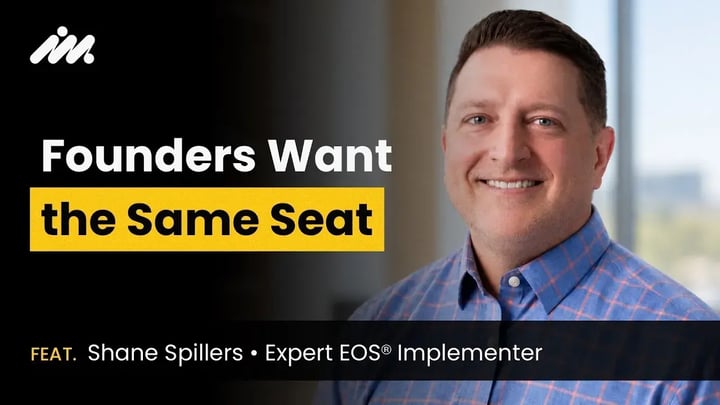
Episode 19 — When Two Founders Want the Same EOS® Visionary Seat
Shane Spillers was running three restaurant brands in Dallas-Fort Worth in 2014 when a consultant handed him a copy of Traction, and his team's attempt to ...
-
Episode 18 — Why Your Target Should Be Blurry
Rodney Mueller joined the Army at 17, and by his late 20s he had run nine marathons, finished business school, and was making six figures, yet he hit a breaking point when none ...
-
Episode 17 — Purpose Over Profit
Benaye Wadkins Chambers is the president and CEO of Crossroads Community Services, a food distribution and public health organization in Dallas that distributes through 148 ...