
Running a Nonprofit on EOS®
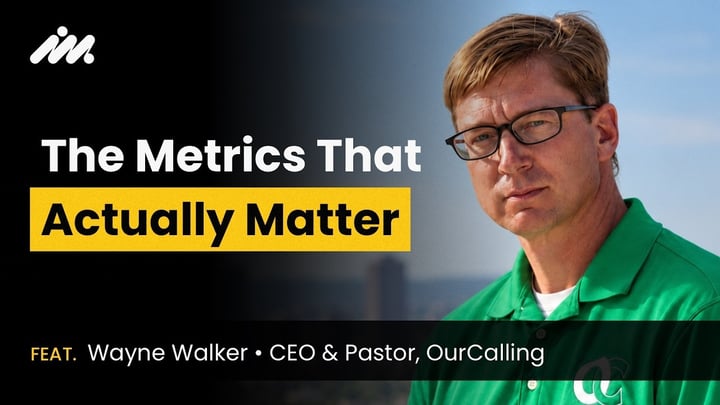
Wayne Walker is the pastor, CEO, and founder of OurCalling, a faith-based nonprofit in Dallas that serves the unsheltered homeless community: the roughly 80% of the county's 10,000 homeless neighbors who sleep outside because there are only about 2,300 shelter beds. When COVID locked every shelter in the city, his team stopped asking where people could go tonight and started asking what actually gets someone off the streets for good. The answer became a for-profit software company, an AI platform that weighs about 100 markers on a person to find their best exit plan across a vetted network of 800 agencies, and a national app from Neighbor Solutions that delivers 90,000 referrals a day. Last year OurCalling's team of about 70 helped almost 1,400 people permanently off the streets, entirely on private funding. In this conversation with Christine Watts and Kris Snyder, Wayne explains why the classic Integrator seat never quite fit a nonprofit where 40% of the CEO's job is fundraising, and how years of measuring the wrong things taught him the difference between outputs and outcomes. Meals served and showers given are easy to count, but the real question is whether somebody's grandma is still off the streets a year later.
Key topics:
- Why the Integrator seat looks different when 40% of the CEO's job is fundraising
- The COVID Impact Moment: every shelter on lockdown, and the AI-driven exit plans that came out of it
- Measuring outcomes instead of inputs and outputs, from the Scorecard to the dashboard
- Hiring and letting people go on values, and OurCalling's three Cs
- Right person, right seat decisions in nonprofits and family businesses
About Wayne Walker:
Wayne Walker is the pastor, CEO, and founder of OurCalling, a 17-year-old Dallas nonprofit whose street outreach teams visit about 4,000 locations a year and serve roughly 10,000 people experiencing homelessness. OurCalling is 100% privately funded, runs an outreach navigation center downtown, and recently opened a tiny home community for elderly and disabled homeless neighbors. A former software developer, Wayne also built Neighbor Solutions, a data and case management platform for human service organizations that, like OurCalling, runs on EOS®.
Mentioned in this episode:
Audio Only
[0:00:00]
Welcome to Impact Moments powered by Ninety. Today, we're joined by Wayne Walker. He's a pastor, he's the CEO and founder of OurCalling, and that is a nonprofit that works with the unsheltered homeless community in Dallas. You will hear his passion for this topic throughout the episode. And he's got a team of about 70 people working and serving about 10,000 people a year. He's really innovated the business over the last few years. When COVID shut everything down and every shelter in the city was closed, Wayne had his team finding completely different solutions for how to get people off the streets. And that led to a lot of different business ventures. So it led to a software company, a national app delivering 90,000 referrals a day. an AI platform that matches people with best exit plans. And so really fascinating to see how he's been able to evolve the business and really focus on outcomes instead of outputs. And those outcomes being so meaningful to the community, like getting people off the street. So excited for you guys to listen. Let's get into it. Welcome to Impact Moments, where we dig into the big questions and big moments that happen with leadership teams running on EOS. Today, we're joined by Wayne. Thank you so much for being here. I would love to dig into a little bit of an intro about yourself, how you found EOS, how you're running on it as a company to really get started.
Wayne Walker
[0:01:26]
Sure. So my name is Wayne Walker. I'm the pastor and CEO and founder of Our Calling. We work with the unsheltered homeless community. So in any city you think about homelessness, you know, most people when they think about homelessness, they think of two things. They either think of a panhandler or they think of somebody in a shelter. We work with the unsheltered homeless community. So in most cities, and Dallas is very similar, 70 to 80 percent of your homeless population are not in cities. There's a few cities in shelters, I mean, that are not in shelters, and there's a few cities where that's not the case. You know, like New York City has a rule, they have to have a shelter for every person, so they have like 50,000 shelter beds. But in Dallas, we have about 2,300 shelter beds spread out at six shelters throughout the county. But we have about 10,000 people that need those beds. So you just do the math. About 80 percent of our homeless population is on the streets every day. That's who we work with, about 10,000 folks a year all over the city. all over the county, and Dallas County is huge. So you think of Texas being a really big state, if every square mile in Dallas County was put side by side, it would be wider than the state of Texas. I mean, it's over 900 square miles. It's a pretty big county. We have street outreach teams that go all over the county. We visit about 4,000 locations a year. And, you know, we got involved in EOS, I don't know, probably five or six years ago. We had a staff member who had done it at a previous place and tried to come in and tell us about it. We tried to self-implement and that crashed horribly. And then we brought in a real implementer and we've been using it ever since. And so it really helps us keep focus on the right things. It helps us, you know, predict, work on our predict muscle and then be able to tackle the big issues when they come across.
Christine Watts
[0:03:15]
Yeah, I think a lot of people go through that journey where they're trying to self-implement. How did you know the system was right, you guys were just doing it wrong? Like, were there little things that were happening while you were self-implementing that were giving you the glimmers that this was the right path to go down?
Wayne Walker
[0:03:29]
I think any small team becomes an echo chamber, right? So even when we talk about homelessness, right, which we work with every day, we talk about it in ways that we understand, we use acronyms we understand, and then an outside person sits in the room and says, wait a minute, that's not what I see when I walk around town. And so bringing in an outside voice is always important. I mean, we have a executive coach that works with our entire team, brings outside wisdom. We do a lot of outside training that comes in. Why would we not want to bring someone outside to look at us and say, what you think is working is actually not working? Let's hold people accountable. That's another thing that's hard to do internally, is to hold people accountable to implementing a structure. Because it's very easy as an organization to say, well, that might work for most organizations. It won't work for us because of X, Y, and Z. But to bring in someone from the outside, an outside implementer that says, no, that really would work. And the problem is actually you guys are having this issue. You know, there's some things, I'll even say there's some things in the Ninety or EOS model that, you know, we don't think works really well in the nonprofit space. But for the most part, having an outside professional, and again, In an organization that wants to be productive, you want to have the best tools you can. You want to have the best cameras you can. You want to have the best software you can. And for us, the best tool to help us implement our team, until we find something better, is the OS. And we have an amazing implementer that brings in outside wisdom from other organizations, who's also worked with nonprofits, who can help us pull those pieces together and say, this is the best way. And we've seen so much fruit in that. Right. It's just worked really well.
Kris Snyder
[0:05:16]
Wayne, it's okay to give your implementer a shout out.
Christine Watts
[0:05:18]
Yeah.
Wayne Walker
[0:05:19]
Oh, our implementer, his name is Kurt Swindoll. There you go. And he's amazing. He's worked with a lot of for-profits and nonprofits along the way. His name might sound a little bit familiar. His dad was Chuck Swindoll, a real famous pastor across the U.S. So he's got a unique understanding of the pastoral aspect and nonprofit aspect, but also for-profit. He's worked with a lot of corporations as well. and Kurt has led us through some really significant areas of growth. We're a small nonprofit, and the first, you know, we're, what are we, 17 years old now. This year, we have experienced about 40% growth year over year since we started. There's been a few years where it's been down to about 20%. And that's just phenomenal growth for any organization, right? If you think of how many customers you guys have, if you have 40% growth in customer base year over year, man, you guys are rolling in it. So as a nonprofit, how do we maintain, you know, our income strategy, which is fundraising, how do we maintain that and the growth of the homeless population, which actually is bigger than 40% some years? And so how do we put handles around that and do it in a way that makes sense? And also, you know, as a Christian, how do I take my faith, which I believe all truth is God's truth, and say, look, some of these principles are business principles that actually come back from like the Old Testament, the book of Proverbs. How do I take these and implement these back into an organization in a way that's not bringing corporate into faith, but actually recognizing that, hey, To be productive and to be effective, we need to put some, some parameters up, some boundaries up, hold people accountable and move forward in a, in a way that makes sense.
Kris Snyder
[0:07:02]
So I'm curious, I've coached a, I'm also an EOS implementer, by the way. So I've, I've coached a variety of nonprofits. I've got one that I'm just getting ready to start again. What do you think are some of the EOS tools that don't quite work with nonprofits?
Wayne Walker
[0:07:16]
Well, I've never known a nonprofit CEO that doesn't have an intimate, direct connection to finance and fundraising and operations. And so to me, when you put an integrator role in there, sometimes it, you know, traditionally in an EOS role, everybody works for the integrator, right? And the visionaries working directly with the integrator. And I think that works in a lot of corporate settings. Cause I have a lot of peers that are corporate guys and they use it and it works really, really well. But my, I mean, 40% of my job is probably fundraising. Right. And talking to donors and being, so having to work through an integrator to work with my chief fundraiser and finance as well. Right. So much of that is so intimately integrated into what we do where I can't step back from, if I was a corporate guy and say, I'm going to step back from my integrator and let him manage a sales team, let him manage a marketing team, let him manage your operations team and me just kind of vision cast and work on great relationships. As we've worked with even bigger nonprofits, peers that we've reached out to that have worked with EOS, I feel like sometimes the integrator role can create a little bit of a distance between the CEO and some of the other pieces that have to be, you know, I have to be a chief fundraiser for the organization. I have to tell the story. I have to be, you know, those divisions in the relationships that I'm pursuing, those critical relationships are with donors. And some of those donors, you know, want access to me on a regular basis. Right. I'm speaking to the media. We were in the front page of the paper last week. Right. We're in a couple of different TV stations last week for our tiny home community that just opened up. So I have to be so much involved in there. I also test weird when you do the test of visionary versus integrator. I'm like 65% visionary and what's the other, you know, 45%, uh, visionary 35.
Kris Snyder
[0:09:16]
And, uh, so I'm like a little bit of both mixed into one, but again, once I build the system and set it all up, I'm like, I don't want to run this thing.
Wayne Walker
[0:09:24]
Y'all take this thing and run with it.
Christine Watts
[0:09:26]
So, was that like a big conversation with you and Kirk when you first brought him on? Like, you're so convicted about it now, like, I am visionary integrator and I think everyone needs to do really what's best and makes sense for their organization. Well, I don't serve as visionary integrator. Oh, okay.
Wayne Walker
[0:09:44]
I test as both and he, he says I'm the unicorn. Um, but you know, to me, the way we have it structured, I think it makes sense for us. And I think every organization needs to say what makes sense for you. Um, you know, for us, what makes sense is we have integrated all of our operations and all of our programs and our tiny home community under, uh, our COO, which kind of functions in that role. But the cultural aspect with, as a nonprofit, the cultural aspect under our administration team is our chief people officer, as well as our CFO. And so basically I have four direct reports, right? One of them manages all of our programs and operations. And we have 70 employees, so he's got probably 45 of those, right? And then I have our fundraising team and our administration team and our finance team. And our finance team is only two people. You know, two and a half people, our CFO, you know, all the compliance we have to do with our auditors and stuff. So it's, but it's such an intimate connection, right? Like only I, in a nonprofit world, for example, only I can approve a wire over a certain amount, right? Only I can answer the questions that a foundation needs. And as we've tried to have a third person do that, like an integrator role, it just, just didn't work for us. Maybe we're doing it wrong, but it just didn't work for us.
Kris Snyder
[0:11:10]
Well, I, I truly believe that, you know, like your, your EOS implementer is giving you guidance, but at the end of the day, you guys get to make the decisions. It's your, it's your organization, it's your nonprofit that you're building and running. And you know, what doing it wrong looks like is when it doesn't work.
Christine Watts
[0:11:24]
Yeah.
Kris Snyder
[0:11:25]
But if it's working, then I think you're doing it right. And that's the, that's the ultimate test. Um, and for those playing along at home, as we talk about visionary and integrator, if you want to check out rocket fuel, that's really where the exam that Wayne's talking about, you can take.
Wayne Walker
[0:11:37]
Um, it's, it's not uncommon.
Kris Snyder
[0:11:39]
I don't have a math related to, I mean, you're a visionary with integrator tendencies, right? Like you still have the ability if you so choose to, but where you probably find your highest and best use and maximum output is when you're enabled to go be the person who's out in the community, recruiting, fundraising, doing the things that, you know, you uniquely can do.
Wayne Walker
[0:11:58]
You know, and I, it's funny because I've tested a couple of times and a couple of years ago I tested about, it was like, um, 53, 47, right? Of one versus the other. But over the years as things have happened and I've started to let things go, now it's, it's a little bit broader gap there. And I would prefer to not be the integrator. I just like to build things, right? And I like to hand them off. I used to be a software developer. We built our own software company to do all the data piece of what we do and launched a for-profit to be able to do that as well. So, yeah, I just like to build things.
Christine Watts
[0:12:35]
Have you seen that as an EOS implementer, like people's scores changing over time as they're able to like delegate and elevate what they're doing?
Kris Snyder
[0:12:43]
Yes. And I think it's not like, what I love about EOS is it's really simple. I mean, there's all kinds of validated, you know, assessments, Christine, as you know, whether it's Colby or Myers-Briggs or whatever it is. But I think the, the EOS related assessments are just mostly meant to give you direction and it's like a point in time and where you're at and how you're feeling and the next action that you need to take. And they say 50% of the time that EOS-run companies running on EOS have an integrator and the rest of the time it's really a visionary integrator seat mix. And I do think that, again, in Wayne's situation, if it works for you, it works. Don't try to force it until you, you know, until you maybe there's a day coming where you don't, right? And that integrator is now into the position where you can let them do wires or, And if it doesn't occur, it doesn't occur. But if it happens, then great. Give yourself more of that space and grace to enter into the seat of your unique abilities, because that's really what it's trying to get us to do, is go be in a place where we're actually maximizing our talents.
Christine Watts
[0:13:44]
Well, I'm curious to dig into your impact moment that you brought. The story that came to mind when I asked you to think about an aha that you or your team experienced as you were going through the EOS implementation process.
Wayne Walker
[0:13:56]
So through, we've had a couple of them over the years, you know, and I'm kind of one of the guys when, when someone tells me something can't be done, I'm kind of like, hold my coffee. Here we go. So, you know, I would say COVID had a piece in this that, You know, during COVID, every single shelter went on lockdown, like they would not let a person in because they were afraid COVID was going to come in. And of course, we were told that every homeless person was going to die of COVID. There's going to be bodies everywhere. Praise God, there wasn't. There was a lot of death, but not really within the homeless community like anyone expected. And so when we're at a point where you don't have a place to put a homeless person, All the shelters are closed. All of them are on complete lockdown. It was so weird because we actually worked with the governor's office to become the first homeless COVID testing site. At the time, COVID tests were brought in by National Guard armed guys with AR-15s and, you know, armed and metal locked boxes. And these are COVID tests. Of course, now you can get them at Walmart. But at the time, you know, we had these drive-through COVID testing sites. But again, you could not go through them unless you could drive. And a lot of people experiencing homelessness don't have a car. So, you know, we set this thing up. But the problem, going back to the problem, was we could not find a place to send somebody. You know, especially if you limit your choices to only shelters. And, you know, at the time we evaluated what we were going to do organizationally. We never shut down at all. We stayed open the whole time. Our numbers exploded. We had lines of people wrapping around the whole block coming every day to, you know, eat, you know, and just get access to basic services. So our calling, let me go back and do a little definition. I think this would help. We're not a shelter. No one sleeps at our building. Our goal every day is to help people navigate, right? We are a faith-based group. That means we're very exclusive in what we believe, but inclusive in who we serve. So we are the only place in the county that anybody can come. Shelters often will say, well, this is for families only, or for men only, or for women only, or whatever. We are all inclusive at our facility. So we have single adults. We have people with pets. We have families with kids. We have domestic violence victims. We have sex trafficking victims. We have people in all genders and lifestyles, people from all different faiths and walks that come to our place. So we're not a Christians only, no one else can come, or straight only. There's some of those in town that trans individuals can't come. or families only, we are the one place where anybody can come. And we're navigating people through the process of trying to figure out, okay, how do we help you? Like, what's the most important thing? We think faith is important, and so part of that conversation is, can we talk to you about God? We think that's very, very important. Now, to us, that's voluntary. If you're not interested in that, cool, no problem. You know, Jesus is not the chips and salsa to get the meal at our calling. But we think it's important, so we are going to ask people and try to introduce them to the God that we believe that can restore them. But also trying to figure out, going back to the big question, how do we help someone get off the streets when all the shelters are closed? When the shelter is not the best fit? You know, so for us, the aha moment was putting down some very significant goals of what we're trying to, what are the outcomes we're looking for and how to find alternative ways to get people off the streets. And, you know, I'll cut to the good part. We ended up launching a for-profit software company, building out a technology solution that does this. We actually now use artificial intelligence to identify and evaluate about 100 markers on a person to figure out their best exit plan. And we've built a network of about 800 agencies around the country that we've vetted to make sure that's the best place. So we won't send you anywhere we wouldn't send our own kids. So today when we're working with a sex trafficking victim, our system in the background is going to analyze all the data points on her to figure out where's the best place she can go today. And it might be a place in another state. It might be a place that's real expensive. But if that's the best place for her to go, then we're just going to pay for it and we're going to send her there. And because of that, we're able to get a lot of people off the street, like a significant greater number off the streets than our peers. Not because we're better, just because we have a better tool. Like EOS is a better tool to manage your organization. And so for us, one of the aha moments was just coming up with the, what is the problem we're trying to solve? How do we break that up into consumable pieces, you know, creating issues, if you would. And then how do we create, tackle this problem? And during COVID, it was beautiful because initially we sent a number of our staff members home, the ones we thought would be more susceptible to COVID. We kept them on payroll the whole time and said, okay, now your job is research. So I love the illustration of you don't learn how to throw a free throw in the middle of the game. Like, you probably should know that before the game starts. Because when there's 80,000 people screaming at you and, you know, all the craziness, it's not the time to try to figure this out. For us, a similar example, when a woman comes up to us who's fleeing domestic violence, that's not the time to figure out where she can go. You should have been practicing that and figuring that out months ago, maybe a year ago. Your team needs to be constantly working on where can we send a domestic violence victim today? Where can we send a domestic violence victim with seven kids? Where can we send a domestic violence victim that doesn't speak English? Where can we send one who has a cognitive disability? Where can we send one who's also addicted to fentanyl, right, or has a dual diagnosis, or that has, you know, some kind of cognitive challenge? Right? So our team's doing all that homework in the background, makes us ready so that the middle of the game, when we're throwing the ball, when it's time for us to throw a free throw, we can do it.
Christine Watts
[0:20:00]
Yeah.
Wayne Walker
[0:20:00]
And so it's coming up with all the research pieces on the back end and building a platform that's really designed for that.
Christine Watts
[0:20:06]
Yeah, that's fascinating. And you mentioned before the interview started, you used to be a software engineer, so you had some of that DNA already. How was it changing either the rest of the organization or starting something that was net new that was really completely different than what you guys had done?
Wayne Walker
[0:20:22]
Well, as we look at what other organizations do to address homelessness, unfortunately, there's not a lot of good answers. And so, you know, you have some people are just going to say, put them in a shelter or make them all go to a treatment center, which maybe that's what some people need, maybe not, or put them all into free housing, right? Get them some kind of government subsidized housing, which might be a good option for some people. The problem is it's not the best option for everybody. And I think that, you know, when we evaluate these problems and say, look, everybody's problems are actually different. There's some similarities. But how do we analyze each person differently? How do we build a team that can analyze all these different outcomes? Because it's, I think it's easy in a nonprofit world to work, look at inputs and outputs. but not outcomes. For example, so we can track how many people we serve every day and how many GPS coordinates our teams are going to today. We can look at outputs, like how many meals we served and how many resources did we give out and how many case notes did we do and all these other survey questions we collected. But outcomes doesn't just mean we got someone off the streets. It means they're staying off the streets. Right. The outcome. Right. Right. So you may be, have a business and you're like, raw output and outcome is we sold 10,000 products. Well, great. Are they all breaking in the customer's hands? Is now your customer service going crazy because you built some software that's terrible. Right. So how do you choose the outcome, which is actually that customers have a product that meets their need long-term or that you're making people happy and they're recommended to their friends. How do we get people off the streets and help them stay off the streets for the rest of their lives? Not just like for the next three weeks or the next six months or out of sight, out of mind, we're going to throw you in this cheap apartment and forget about you. And now, you know, we can't see you. So obviously it must be a home run. So to me, the aha is analyzing, figuring out how to analyze the problem, how to break it down into pieces, how to build a solution for this. And it's really weird because we couldn't build the solution within the nonprofit. We actually had to build a for-profit to be able to do this. because other nonprofits want it. And as a nonprofit, you can't sell software because it jeopardizes your 501c3. If you're set up to work with the homeless, it gets really complicated from a liability and tax standing. So we started this for-profit to build this software. And it's just, and we use EOS in that as well. We use EOS in our nonprofit. And then to be able to sit back and say, wow, look at what's happening here. I mean, last year, We have 70 staff members, a little bit under that last year, and we were able to get almost 1,400 people permanently off the streets, which is crazy, unheard of in this kind of a space. But we also built an app, our national app used all over the country. We built a platform called Neighbor Solutions, and the app is used all over the country. It's actually now starting to be used in Europe and Mexico and Canada. It delivers 90,000 referrals a day across the country. Like a woman in her car with her two-year-old saying, where can we go tonight? A dad with his family saying, how can I feed my kids today? Someone looking for a shelter or a police officer working with someone. Okay, I have a woman here. I need to get her into a domestic violence center. Where can we go? He's going to use our app to find those places. And to be able to use some technology and now integrate AI into so much of that, it's just been so beautiful to see.
Kris Snyder
[0:23:53]
That's amazing.
Christine Watts
[0:23:54]
It really is. I'd love to, you have so many things going on between that app and then your organization also needed a fundraise for that. How do you drive that like outcomes-based mentality throughout everything that you're doing? I'm thinking like you're meeting your level tens, like that cadence is really important. Is there a certain thing that you do through that meeting cadence to help people really keep going back to that outcomes-based mentality?
Wayne Walker
[0:24:22]
So we track a ton of data, right? We also built a, launched a tiny home community. There's a lot of tiny home communities around the country. Ours is specifically for, well, the best example I have is if you've ever been in the stage of life where you're caring for aging parents, right? So that's what this is for. It's for the elderly and disabled homeless. So everybody there is in wheelchairs or walkers or has cancer or memory care issues, long-term care needs. It's ridiculously expensive and really challenging. So we've got that, and then our street outreach teams, and our outreach navigation center downtown, and then our company. Putting all the pieces together, we track a ton of data, but I always go back to the EOS picture of, you're on an island, right? And a plane drops a piece of paper to you. And that one piece of paper needs to give you some measurable data points to know, are we working on the right things? To me, I think you have to figure out what are you trying to measure. It's very easy for us to throw up a dashboard, and we have tons of dashboards where you've got 800 data points on there. Most of those are ancillary in inputs, outputs, but not really outcome-based, not really based on, you know, how do you boil this down and say what are the five most important things we're trying to measure every day? I'll give you an example. Volunteers. We have 3,500 volunteers a year. We have a lot of volunteers in our organization. If I look and just say how many volunteers showed up today, man, we're doing great. We have X number a day. That's awesome. However, if I look at it beside the needs, We need volunteers in our women's center. We need volunteers in guest services. We need volunteers in meals and volunteers in our warehouse. If I break it up by where people are serving, I actually may look at areas and say, that area is critical. We don't have anybody serving there. We got plenty in our warehouse, plenty in here, but no one's cooking food today. And no one's able to help in our women's center today. So again, figuring out not just data points, but what data points actually matter. And so we, we build dashboards all the time. I built one a week ago that ties into our HRIS system, right? So our HRIS system, you track what employees are here today and what out, you're out for PTO, that kind of stuff. Analyzing that with our volunteers to say, Hey, look in our operations department, we have a manager and a director out today. Plus we're out, we're missing 14 volunteers we need. All that ties in together. So again, I would say finding out what are the data points that really matter from a structural, can we operate today? And what's the data points that matter? Are we being successful today? So fundraising for us, every dollar given to us last year, none of those are guaranteed this year. We're a hundred percent privately funded. So we don't get any government funding. We talk about Jesus. And because of that, the city won't give us any money. That's fine. Right. But because of that, we have to work really hard on communicating with donors and showing that what we're doing is effective. So going back to those numbers, we're not just trying to prove to ourself that we're being efficient. We have to earn the respect of donors to be able to say, if you give here, we're able to do this. Well, what is the this? Donors don't want to just give us money because we feed people. Great. I can go buy cheeseburgers and pass them out downtown. That's easy. But are we actually able to move the needle and change someone's life? Because it really comes down to the story today. In your city, a grandmother is sleeping outside. Somebody's grandma. She's 70 years old and her family's abandoned her and she's on the streets. Giving her a sandwich doesn't help. Giving her a pair of socks, that's fun, that's cute. She's still a grandma and she's still on the streets. Because the average age of the people we serve is almost 60. So someone's grandmother's on the streets, and if we're really making a difference, we're gonna get the grandmother off the streets where she's not homeless anymore and she's in a safe, healthy environment. Not off the streets where she's in a crazy place with 300 other people that wanna hurt her, but again, outcomes. Can we get someone's grandmother off the streets today? And can we put her in a safe and healthy place where she'll stay off the streets and stay healthy? That's hard to measure.
Christine Watts
[0:28:49]
It is and I'm sure so many of your employees need to like carry that same level of passion and enthusiasm that you have for all of those things too. Is there anything specific that you do like through hiring or like retaining employees that helps like keep anchoring back to like what your company culture is?
Wayne Walker
[0:29:08]
Well, I think if you, you know, were to look at our VTO, you know, our values is super important. You know, can we say these are our values and actually follow through on those? Right. Um, you know, I tell employees all the time, it's the weirdest conversation when someone starts, here's how to lose your job. Right. But you really need to have that at the beginning.
Kris Snyder
[0:29:30]
A hundred percent.
Wayne Walker
[0:29:30]
Right. At the beginning. You have, we have these values. And if you don't follow these values, you're telling us you don't want to be here and we're going to let you go somewhere else where you can do whatever. Here's your job description. If this is the job you're hired to do, if you want to do this, we'd love for you to be here. The day you decide you don't want to do this and you communicate that by just not doing it, It's pretty simple. And so we use those values in our job descriptions, and we're constantly going back and refining our job descriptions. We're constantly going back and evaluating our values. Organizationally, are we following this through in everything we do? You know, at our calling, we have our values, but then we have these three elements that we say are the three C's in everything we do. Are we caring with dignity? Are we connecting with intentionality? And are we creating healthy community? Now for us, we want to care with dignity for someone on the streets. That means we ask the question, would your mom? Would your mom eat that? Would your mom want to be talked to that way? Would your mom call that clean? If not, we're going to start over. But again, that care with dignity doesn't just account to the homeless. Are we caring with dignity for our donors? Are we treating them like they're part of our team and not like a cash register, right? Are we caring, are we communicating well with them on things that worked and things that didn't work? Same thing with our staff. Are we caring with dignity for each other in the way that we handle tough situations? Are we caring with dignity for our volunteers? Are we giving them the jobs we don't want to do because it's dirty? Well, actually, they're not getting paid to be here. We are. We're here to actually serve them. Are we caring with dignity for all those constituencies? Are we connecting with intentionality to all of them? We're not here to hang out. We're here to help you get off the streets. You know, are we creating healthy community? Is this a healthy community internally with our staff? Is there gossip? Is there rumors? Is there crazy? Is there fear, right? Or is there, you know, real accountability that shows truth and honesty is the way we practice those values. And so to me, it's trying to figure out how do we do this in light of our faith? How do we do this in light of a system like EOS as an operating system designed to help us guide and guard it? And as a software guy, you know, I speak the language of operating system. You know, I do. So years ago, I got so sick and tired of software development. I said, I'll get tired of working on the next version of an app. I want to work on the next version of a person. No matter what app you build and whatever features you deliver, and you guys deliver a lot of cool features, six months, nobody's going to care. They're going to the next features, the next app, the next integration, next. And so I think that's the same way with people. How do we help people develop to the next version of themselves? How do we help see restoration? And so, you know, I, I've crawled under a lot of bridges with people looking for their kids. I've crawled under a lot of bridges or people looking for their parents. You know, and in that moment, the family doesn't care about what kind of food we serve, if our vans are the same color as our shirts and our logos on them. And, you know, they don't care what our impact report looks like. They don't care about EOS. They care about, will you find my daughter? And can you help her get off the streets? Because she's getting hurt every single day out here. That's it to me, it's coming back to the impact piece to say, are we doing what we say we're doing? And can we measure that in a way and hold our team accountable from beginning to end on the whole process?
Christine Watts
[0:33:00]
Well, we've, we've talked a lot about your success and the, the app you're building, your tiny homes project. And so the other thing we asked you to bring was a screw up moment. Like, what was that moment that you think of where a mistake was made and like the team needed to show resiliency or you had that kind of, Oh, like this did not play out how I wanted it to.
Wayne Walker
[0:33:22]
I'm going to go back and tell the same story. So I think it's looking at the wrong data points. Right. So, you know, I love Peter Drucker. I read a lot. Um, you know, if you can't measure it, you can't manage it. Right. But he also says, if you measure the wrong thing, you're going to do the wrong thing. Right? So if we're measuring the wrong thing, like how many meals we serve every day, how many people take a shower, how many people get their laundry done, how many people walk in the door, and that's all we're measuring, who cares? McDonald's serves a lot of people, and their food is not so healthy. There's a lot of places that have showers, but their showers are dangerous. Right? So are we measuring the right thing? I think there was a couple of years we were measuring the wrong things. And there was a, man, we are not doing a good job because we're measuring inputs and outputs, uh, but not really measuring outcomes. And, you know, as a data guy, as a data nerd, you know, I like to look at the data even per employee. Like we can look at per employee, how many people do you meet with this week? How many case notes did you do? How many survey responses did you collect? How many GPS locations did you go and visit? That's all fine and dandy, but it doesn't measure the true impact. Because if you're working with someone, I'll just tell you a real story. If you're working with someone who's on the autism spectrum who's nonverbal and has no arms and legs, which we have individuals like that on the streets, that no shelter will take. There is no housing available for them. The police don't know what to do. Actually, the police call us all the time, right? We don't know what to do in this situation. That person can't be measured on a matrix that says, did you get everything done in 30 minutes and move to the next person? And how come you're not working with eight people a day? Right? When you put in the human element in the middle of that, you recognize like, that's a woman who's fleeing trafficking. And right now she needs a woman to put her arms around her and just weep with her. as we work on a process to get her off the streets. Right. And so we can't just be measuring the simple number things. Right.
Christine Watts
[0:35:38]
And it sounds like it took you like a bit of time to like see that you needed to change those numbers that you look at. I'm sure other clients go through that same scenario where they're like trying to wrestle with are these really the right things that we should be monitoring? Yeah.
Kris Snyder
[0:35:52]
And I think the probably guidance you got similar, Wayne, is just, just start. Like you're, you're going to figure it out, the five to 15 numbers on a scorecard, hopefully leading, not lagging.
Wayne Walker
[0:36:02]
Right.
Kris Snyder
[0:36:02]
And then, you know, what's on the hardest part is deciding that outcome and then the scorecards really activities to the outcome. And when they get, when people get caught up, they get caught up in the activities and measuring the activity versus going, no, I'm, I'm clear on the outcome that we're trying to actually get to. But you do learn along the way. I think that's when, when I've, when I've coached clients, the real issue is when they, they're not learning. They're not actually going the next quarter when we get together, they're like, Hey, I, we, you know, three things we need to change this next quarter are like, that's awesome. Because you learned in that experience that, yeah, we were measuring that, but it wasn't really the thing that we were trying to get to. So let's change it and then just go play the game again. The other, the other part that we see, cause you mentioned your, your data guy, data nerd is people start to like, just want to put in reporting. Oh, I've got power BI.
Christine Watts
[0:36:51]
Yeah.
Kris Snyder
[0:36:51]
And then they spend time in their weekly meeting, just looking at numbers and you're like, that's fine. And there's a place for it. But right now in that level 10 meeting, we're trying to look at these leading indicators that give us something to go solve and tell us if we're off path, off path. And if we're off path, let's use the power of the room, the power of the team to get us back on track so we can go get to those outcomes that Wayne's talking about. And it is, it's a journey, right? Cause I always like to tell clients it's okay to change because new information shows up. You didn't know that COVID was going to happen. None of us did. And then it happens and you go, okay, new information. We just got to figure it out.
Wayne Walker
[0:37:25]
Right.
Kris Snyder
[0:37:26]
And that happens. Uh, you mentioned before we got started, like inclement weather is going to happen. You can't predict it, but it happens. And then it's like, what are we going to do about it? I also love the fact that, you know, the pursuit of mastery is the practice. So you're getting ready for that foul shot, whatever shot you got to take.
Wayne Walker
[0:37:41]
Right.
Kris Snyder
[0:37:42]
And just getting the people along the way. And part of the EOS discipline is your 20 tools, right? And getting those tools, especially as you grow again, getting the next folks inside the organization to see the tools to be practicing in the pursuit of mastery so that we're ready. We're ready when those things happen.
Wayne Walker
[0:37:58]
In our industry changes all the time. You know, again, we're privately funded, but a lot of our peers, actually all of our peers have significant government funding. And as government funding changes, priorities change, that program we used to get send you to doesn't exist anymore. That one just got shut down. Those people that were put in housing and HUD funded all these housing and now they're having challenges to figure out, are they still going to be in housing? And if not, they're going to fit. So the crisis like a COVID happens all the time. It happens when inclement weather happens. It happens when, you know, funding sources change. A foundation changes its mind and was giving towards these eight organizations and now they want to give towards a different project that has nothing to do with human services. And so we've got to figure out how to pivot and how to evaluate and how to figure out what's important to measure and how to be flexible.
Christine Watts
[0:38:46]
Do you find a lot of that happens during those quarterly planning meetings that you have with your leadership team? Do you, a lot of the like strategic conversations and pivoting and how do you make sure those meetings are run well?
Wayne Walker
[0:38:59]
Well, we love our quarterly meetings. They're off-site at a quiet place where we can spend time, you know, spend time just fellowshipping and hanging out and doing something silly, but also getting, you know, having a transparent and honest conversation to be able to say, hey, that's not working. Or we keep having the same problem and the same solution is not going to fix it. So we've got to figure out how to make some strategic and structural changes in that. So we love the quarterly meetings and we love our integrator kind of pushing us in the envelope of, are you getting ready for it? Have you put everything down? If we go back and review all of our issues to see Are there any similarities in those? I think any organization, especially a nonprofit, I think nonprofits and family businesses have a very similar challenge, and that is RPRS issues have a different feeling. Right. So for a family business, like a family owned business, and they pass it on to the next generation, you can't get rid of that guy because he's your cousin, even though he's a terrible employee. Right. Or, you know, my brother-in-law works for me. What do we do? Right. It's a family business. In a nonprofit, it's very much the same way. We have an employee that's connected to a donor. or that person becomes the mission. This is the mission. No, that person and no one else is going to hire him. And so I think there's a very similar RPRS issue in family businesses and nonprofits where not addressing personnel issues in the right way can be a cancer. Right. Not getting rid of that person that, you know, you should have gotten rid of a long time ago. I don't care that he's your cousin. I don't care that he's that pastor of that church's daughter that works for us. Then that church gives us a lot of money. We've got to, we've got to move on this. Right. And so addressing those RPRS, RPRS issues is something we get to really dive into deep from a systemic issue when we get offsite. And in addition to the outside challenges, cause you know, some of your issues are external, but RPRS is internal challenges that impact the externals. And so to me, I just love the quarterly times where we can get off and address all of that together.
Kris Snyder
[0:41:16]
There, there's a, and this, and I'm making this up cause it's not a US thing, but there's an indices between care and performance. And especially when organizations get started, there's a ton of care, camaraderie, familial scenarios. You bring in your friends to build the thing that you're working on cause you know, love and trust them. And then you grow. And then they were the right person in the right seat for that moment. And they had lots of responsibilities. Now you're specializing and that weakness starts to show up. And then you're like, man, I really care about them. And we have history together, but performance is lacking. And then like, what do you do? So I'm with you on the, the family is really hard. I mean, I've coached plenty of family owned companies when, you know, uncle Bob is not doing his job or maybe he has an addiction issue that we just got to decide that he can't run that machine anymore. But we have to go deal with it. And it's not easy, because that care and performance indices just out of whack.
Wayne Walker
[0:42:10]
And nonprofits the same way. When you start, you hire whoever you can get. Right. Right. But sometimes who you got is not who you need. And if they can't become who you need, you've got to make a change.
Christine Watts
[0:42:20]
Yeah.
Wayne Walker
[0:42:20]
So you've got all these volunteers. You try to hire them or you put volunteers on your board that just can't do the job. And it's hard to make those hard decisions. But if you want to be effective, you know, to me, I read a lot. I read a lot in the Bible. I read a lot in business books. And, you know, going back to, you've got to have performance people in these roles. You've got to give people grace. You've got to be able to give them mercy, but you also have to give them accountability to say, this is the role. And if you can't do the role, we've got to find someone who can.
Kris Snyder
[0:42:53]
Have you ever read Never Split a Difference with Chris Voss? Yes.
Christine Watts
[0:42:57]
Yeah.
Kris Snyder
[0:42:57]
So Jonathan B. Smith just wrote a book called Fight Less Win More. I did a webinar with him last week on tactical empathy, and it's so good.
Wayne Walker
[0:43:06]
So I love Chris Voss's book because, you know, he talks about hostage negotiation. I look at the book from a completely different perspective. So as a recovered addict who works with recovered addicts, I think when you're talking to an addict about getting clean and sober, it's actually akin to negotiating with a terrorist. I can see it. Cause there's a terrorist taking over this person. Inside the human. And logical conversation of, you know, if you wouldn't do this, you wouldn't be sick all the time. It doesn't make sense, but there's a terrorist inside. So anyway, I love Chris Voss's book on, and how it impacts negotiating with a terrorist inside of every addict.
Christine Watts
[0:43:42]
Yeah.
Kris Snyder
[0:43:43]
So we had about, I don't know, over 300 people on this webinar. At the end in Q&A, the three-strike rule was the most, you know, questioned scenario. Like, can you really do the three strikes and remove someone? And it's with that empathy level that, yes, you can, unfortunately. They may be successful someplace else, but they're in the way of your mission and who you're trying to serve. And so at some point, with great love, care, and respect, it's not a right person in the right seat. We got to figure it out.
Wayne Walker
[0:44:11]
And if they're always making these strikes, they're probably better suited to someone else. That's why I love the phrase, you know, you're going to let someone go. I'm going to let you go do the thing where you're not going to strike out all the time. I mean, look at the example of striking out. You're not a good batter, right? Go to a job where you're not batting all the time.
Christine Watts
[0:44:33]
Well, I have one last question for you. What's the latest business book that you have been into? And you just mentioned you have read a lot of them. What's the latest that's impacted you?
Wayne Walker
[0:44:44]
Well, right now I'm reading the book, Talk Like Ted. They analyze like the top 150 TED talks about what is the conversation and how to communicate with people. Uh, I speak a lot of places, not that I'm trying to learn how to do it better, but just trying to learn, you know, how to better communicate. And I love that. It's, you know, I do a lot of strategy sessions, a lot of strategy books, and I think those are really, really important. And if I looked at my audible, I'm ADD, so I can't read. And I'm dyslexic, so I have to read it and listen to everything. But if I looked at my Audible account and saw it, I'd give you a list of 50 books in the last year, probably. However, Talk Like Ted is my current one right now. Talk Like Ted. And every time that he recommends a TED Talk, I'll go back and listen to it and learn about, like, what is that person kind of trying to communicate? How do they communicate that so succinctly to grab the audience and really tell the story? Because really, what we're trying to do is tell a story.
Kris Snyder
[0:45:35]
That's right.
Christine Watts
[0:45:35]
Yeah.
Wayne Walker
[0:45:36]
Somebody's grandma sleeping outside right now. If I talk about strategy and numbers and details in our vans and how now we're going to four runners because they can hop curbs better, you don't care. Right. But if I can really help you recognize that someone's grandmother is sleeping outside right now, that's when we can charge the hill together.
Christine Watts
[0:45:53]
Yeah. Well, I mean, that's exactly what I was about to compliment you on. I loved hearing your stories today and your passion. And I feel like you brought so much storytelling to like telling us about the numbers and the scorecard and how you do hiring and the RPRS stuff. So thank you so much for joining. If people do want to reach out to you or learn more about our calling, what should they do?
Wayne Walker
[0:46:13]
Go to ourcalling.org. We're on all the socials, all the things. I'm Wayne Walker. I'm on all the things. And our software platform we built is called Neighbor Solutions, and it's really designed for any human service organization that wants to track data and really try to see the outcomes of people.
Kris Snyder
[0:46:30]
That's amazing.
Christine Watts
[0:46:31]
Yeah. Well, thank you again for joining. Really appreciate it.
Wayne Walker
[0:46:34]
Thanks. Thanks for having me.
Christine Watts
[0:46:35]
Thank you. You all could hear Wayne's passion for the topic. Giving someone a sandwich does not get them off the street. Giving someone a pair of socks is cute, but someone's grandma is still outside. He kept bringing it back to that human aspect and his why and why he does business and why he spends so much time and works so hard. The difference between measuring outputs and measuring outcomes in any organization can count meal served, showers given, beds filled. But the harder question is, did it work? Is she still off the streets months later, a year later? And I think that challenge isn't unique to nonprofits. Every business faces the same temptation to measure just what they're doing instead of if it really matters. And hopefully people are thinking about how to reframe their scorecard to tell you if you're really actually winning and not just busy. So I hope you got something out of the episode. If you did, please like, share, subscribe it, and we'll see you next time.
Recent Podcast Episodes
-
Episode 20 — Running a Nonprofit on EOS®
Wayne Walker is the pastor, CEO, and founder of OurCalling, a faith-based nonprofit in Dallas that serves the unsheltered homeless community: the roughly 80% of the county's ...
-
Episode 19 — When Two Founders Want the Same EOS® Visionary Seat
Shane Spillers was running three restaurant brands in Dallas-Fort Worth in 2014 when a consultant handed him a copy of Traction, and his team's attempt to ...
-
Episode 18 — Why Your Target Should Be Blurry
Rodney Mueller joined the Army at 17, and by his late 20s he had run nine marathons, finished business school, and was making six figures, yet he hit a breaking point when none ...