
Doing BizDev the Right Way
David Bowman spent 10 years in the Marine Corps as a helicopter crew chief before realizing he was never going to be the guy sitting behind a desk. After a career in organizational development and consulting, he walked into a turnaround client in Michigan, ran a 90 minute meeting the owner did not bother to attend, and fell in love with EOS on the spot. That pivot became a decade as an implementer and the creation of 10x Connect, a program that trains implementers to build EOS Trusted Advisor Networks (ETAN groups) around the country. In this conversation with Christine Watts and Kris Snyder, David reframes business development as something that should feel as good as being in the session room, explains why he only makes introductions of value, and shares the impact moment that still brings him to tears: a client on the verge of divorce who told him EOS gave him his life back.
Key topics:
- Why speed networking is broken, and what real connection looks like in an ETAN group
- Introductions of value: how to use relationship capital without spending it
- Start with Be, not Do: living your EOS life now instead of waiting for the payoff
- The impact moment that still makes David tear up
- The limits of implementation: when an owner's borderline self-awareness is the blocker
About David Bowman:
David is a Certified EOS Implementer and the founder of 10x Connect, a program that trains implementers to build EOS Trusted Advisor Networks (ETAN groups). Before EOS, he served 10 years in the Marine Corps as a helicopter crew chief and spent his career in organizational development, leadership development, and continuous improvement. Learn more about ETAN at tenxconnect.com, or reach David directly at david.bowman@eosworldwide.com.
Mentioned in this episode:
Audio Only
[0:00:01]
Welcome to Impact Moments Powered by 90. Today we're joined by David Bowman. David has a really rich background. He spent his early career, 10 years, in the Marine Corps as a helicopter crew chief before finding his way into organizational development, consulting, and eventually EOS. He spent the last decade, along with being an EOS implementer, actually figuring out how implementers can do business development better without really losing themselves in it. And so his answer is ETAN, the EOS Trusted Advisor Network. We'll link to these things in the show notes. But the 10X Connect has also been, along with ETAN, a way that helps EOS implementers build groups around the country that really support entrepreneurs and network together. So, really interesting conversation with David. He reframes networking, introductions, the idea of living your EOS life, and he also shares an impact moment that still makes him tear up to this day. So, let's get into it. Welcome to Impact Moments powered by 90. I'm Christine.
Kris Snyder
[0:01:07]
I'm Kris Snyder.
David Bowman
[0:01:08]
I'm David Bowman.
Christine Watts
[0:01:09]
Thank you for being here.
David Bowman
[0:01:10]
Thank you for having me.
Kris Snyder
[0:01:11]
Yeah.
Christine Watts
[0:01:11]
So tell us a little bit about yourself and how you got your start.
Kris Snyder
[0:01:14]
Yeah.
David Bowman
[0:01:14]
So grew up in Memphis, Tennessee. Parents were both entrepreneurs. Terrible student. Went in the Marine Corps for 10 years. Got a dual degree in business and accounting. While I was in, um, did accounting for about a year and found out it's really hard to go from being a helicopter crew chief to sit behind a desk, have two numbers. So quickly figured out that wasn't for me. Um, and pretty much have had my whole career doing organizational development design, team-based continuous improvement, leadership development. just as a solo entrepreneur, went to work for clients three times. And so the last time, first two were growth. I'm kind of a visionary, so those were great. And then the last one was a manufacturing client in St. Joe, Michigan, that was a turnaround and put my system in place, built a leadership team, took tons of cost out, couldn't get the owner to pay attention. And so, um, brought in Jim Coyle, um, and, uh, thought if my system wouldn't work, maybe I could get his attention doing something that wasn't me. And, uh, we do this thing called a 90 minute meeting you might've heard of, and the owner didn't show up. And so I fell in love with the OS. Jim was trying to start a firm. Uh, and so I never looked back and just figured the writing was on the wall and he wasn't serious about turning it around.
Kris Snyder
[0:02:38]
I have one 90 minute meeting where the owner stood up like 20 minutes in and he's like, yeah, I got to go. I was like, what does that mean? He's like, well, whatever they decide and just left. And I was like, oh hell no.
Christine Watts
[0:02:54]
And the leadership team was begging you to stay, I'm sorry.
Kris Snyder
[0:02:57]
Yeah, because the wheels are coming off. Like, things fall apart. But if you're not paying attention and they're not going to commit to it, there's no reason to do it.
David Bowman
[0:03:03]
Correct.
Kris Snyder
[0:03:04]
Right? You'll just, what is it, drag them around? Drag them in the room, drag them around the room? Yeah.
David Bowman
[0:03:08]
Yeah, so.
Christine Watts
[0:03:09]
So how quickly did you make that decision? The owner doesn't show up, you're interested in what Jim's having to say. Did you kind of make the jump?
David Bowman
[0:03:15]
Almost immediately. Stayed with him, helped him wind things down. I was already talking to Jim about, this was before the franchise, so firms were viable. And so Jim was trying to create mastery, train people in implementation. Um, and then do provide some backroom support and, um, and then, uh, get to viability and then, um, have somebody go to bootcamp. So it was a requirement that you would, you would join the community in the firm model. And we're in Michigan, right? So this is the wild west of anybody that read traction and was a consultant called themselves an implementer in the early days.
Kris Snyder
[0:04:00]
Yeah.
David Bowman
[0:04:01]
And so to Jim's credit, it was, you know, how do we bring them in versus, you know, villainizing them. And so, yeah, we did that for my first four or five years. So three years of my 10 years in EOS were unofficial. Nice.
Christine Watts
[0:04:19]
So you're a very quick decision maker then, if you're a pilot, and then you only did accounting for a year before you were like, this isn't for me.
David Bowman
[0:04:26]
And then you immediately meet Jim and go. Did I mention I'm a nine quick start? I'm a thrill junkie.
Kris Snyder
[0:04:32]
Yeah. Yeah.
David Bowman
[0:04:33]
Risk taker and just by nature and slowing down a little bit as I get older. But, uh, yeah, that's my nature.
Kris Snyder
[0:04:40]
So, so for those that play along at home, the nine quick starts referring to Colby.
David Bowman
[0:04:44]
Correct.
Kris Snyder
[0:04:45]
Right. Just the Colby assessment.
David Bowman
[0:04:46]
Yes.
Kris Snyder
[0:04:47]
Um, we have this moment sometimes where I'm like looking at the camera and just reminding them, cause we get caught up like in saying things. DOS speak. DOS speak. It happens easily.
David Bowman
[0:04:55]
Right, right, right.
Christine Watts
[0:04:57]
Yeah, that's so true. How long have you been doing Colby? Like, have you always known this about yourself, or was this kind of like a... Oh, no, that was Colby's just, like, comes down and like, oh, that explains so much.
David Bowman
[0:05:11]
Oh, yeah.
Kris Snyder
[0:05:11]
Right.
David Bowman
[0:05:12]
I have shot myself in the foot so many times in life, and yeah. Nice.
Christine Watts
[0:05:17]
So, okay, so I cut you off halfway. So you become an implementer, you're working with Jim, you become a, the franchise happens, you stay an implementer. So now you've been doing it 10 years?
David Bowman
[0:05:28]
Yeah, 10 with the unofficial part and 8 since boot camp. I think it'll be 8 this August. Nice.
Christine Watts
[0:05:34]
So what's the biggest differences between how you work with clients now versus how you did initially? Anything?
David Bowman
[0:05:40]
Oh, it's night and day. I mean, you kind of want to go back to the early clients and apologize. It's just, if you only knew. Yeah, you just go through that stage where you got to get the reps in and it's, it's so rote memory, you know, I forgot something and watch the videos and, you know, channel your inner Peyton, so to speak. Sorry, that's a mannerism. of Peyton's in the videos. And, you know, eventually you just, you know, I had the foundation for my organizational development days, so I knew why we were doing what we were doing. And so I think pretty quickly got to more of the principles of why it works. And once I could, once I capture that, I'm very conceptual. I'm a one, going back to Colby. I'm a one, an integrator, and so everything for me is a conceptual mental model. And so once I have that in my head, it's pretty clear to me.
Kris Snyder
[0:06:38]
And now you have to give us all four numbers.
David Bowman
[0:06:40]
Yes.
Christine Watts
[0:06:41]
Okay.
David Bowman
[0:06:41]
Eight, which does slow me down. I love research.
Kris Snyder
[0:06:44]
That's a fact finder for you. That is a fact finder.
David Bowman
[0:06:46]
Two. So I'm ready to hand it off as soon as I create it. Nine, so I lead with Quickstart. So I was looking for what the opportunities are, what's missing, where can I add value. And then one, which is just completely, so the integrator is the, did I say that right? I always get integrator and implementer mixed up. is more how hands-on do you have to be to understand it. So I was a helicopter crew chief, terrible mechanic, right? And I'm a parts changer, but I knew how all the systems worked. And so as a crew chief, I was just the coordinator of all the talent around me. And that's that one jumping into it where I don't have to be the expert at turning the wrenches, but if I understand how the systems work, I'm good.
Kris Snyder
[0:07:36]
Yeah. So, so, so many of the EOS implementers, when they first get their start, you mentioned getting the reps in, it's, it's business development that's their challenge.
David Bowman
[0:07:47]
Correct.
Kris Snyder
[0:07:47]
Right. How did you find, you know, coming in and getting your reps in business development?
David Bowman
[0:07:53]
It was tough. I didn't, I, you know, I had been in Kalamazoo for 20 years at that point. Um, and I had a lot of, you know, I was in, um, consulting, um, but people knew me in that realm. And so making that switch was, was really difficult to, you know, this is different and getting them to understand it. And back then EOS had no name recognition whatsoever. And so that was tough. And so part of what we did as Nexus is Jim really focused on the mastery components and training implementers to do a great job in the session. And what I did is built these ETAN groups that EOS Trusted Advisor Networks to help them get to viability in their practice so that they could then go to boot camp and join the community.
Christine Watts
[0:08:45]
So talk a little bit about, more about what an EOS trusted advisor group is for those that don't know.
Kris Snyder
[0:08:52]
Yeah.
David Bowman
[0:08:52]
So there's a, it's just an amazing phenomenon that EOS companies love doing business with other EOS companies. And when you're doing this, you just see it right away. You drink the Kool-Aid, you speak the language. It's just a different way of viewing business. And so trusted advisors are also target market for us. And so I came up with the idea that, hey, if we could get 10 to 12 trusted advisors running on EOS around a table, it would be unstoppable. And so I built a model based on that and did it for Nexus for a number of years and then did two breakout sessions and then the annual conference three or four years ago at this point. And so I started training USIs on it. And I was spending probably 15 to 20 hours a month helping USIs do these, and they just weren't getting them. And so I launched a year and a half ago, 10xConnect, which trains USIs on how to build these networks all over the country.
Kris Snyder
[0:10:03]
And the connector piece is one of those things that I've struggled with on the EOS front, because when you start, you come through bootcamp, they're like bringing a list of connectors. And my experience was similar to yours where having been a CEO of a technology company, now I'm doing EOS implementations. So when my connectors would be like, I'm sorry, what are you doing again? And then how do I introduce you as something I don't know you for or with? And that, that connector part just was, didn't work. So what I love about the work you're doing there is you're actually adding value to the connection, right? And getting the familiarity of using EOS with that platform.
David Bowman
[0:10:40]
And so, I mean, it really boils down to how do we get out of our own way. So every implementer just loves being in the session room. And I'll say, if I could, if I could just get in the session room, I'd be great. And kind of my, my exploration with them is how do you do biz dev as though you're in the session room? How do you get as much enjoyment, much satisfaction doing biz dev as you do helping a client? And it has to do with being our authentic self, you know, we have 800 plus 850 very talented people all running around with their success stories and it ends up being just a lot of shit at the wall and Activity is when you don't know what to do, you just do a lot of it, and you end up wasting a lot of time and energy, and you don't feel legitimate or authentic in the way you're approaching it, and so you're just constantly in testing mode, and it's exhausting. Yeah, there's a, I'm starting to write a blog, so this is going to sound more horty-torty than it is, but there's a psychosocial difference between truly connecting and networking. And so we show up different, our bodies are different, our mindsets are different in that environment. And so how do you create this environment where I only want people in my group that I would invite to a family function? And that's how comfortable I feel. I just come up authentically myself and every implementer's implementation of their ETAN group is going to look different than every other's because they're building it around who they are as a human being.
Christine Watts
[0:12:22]
Yeah, I love that concept of connecting versus networking. You do this really well where you ask a really intentional question to like get to know somebody better instead of like a where you're from, how's the weather kind of situation. And I was recently at an API event and I met another guy who was doing the same thing. And I was like, oh man, Chris would love these questions because it was more of a, man, what are you most proud of that you did over the last year, you know? And it's like getting more into the root of Who is this person and what are they excited about? So we can have a real conversation about something you're passionate about.
Kris Snyder
[0:12:52]
Well, if you think about it, even what we're doing right now on this podcast is similar, right? You're asking about your story and, and I find it networking. People want to tell you about something, not ask you about something. And if you are asking, and you're patient and you're quiet, you can learn and you can connect versus pushing your business card at somebody and saying, I work for so-and-so firm and I'm here to sell you something. We should talk. You're like, should we? We should talk. We haven't got to that place yet.
David Bowman
[0:13:22]
But I have a space on my calendar I need to fill.
Kris Snyder
[0:13:26]
I only did it a couple of times cause it was awful.
Christine Watts
[0:13:28]
But you know, at one point I was like, speed dating could work. Oh no, it does not work.
Kris Snyder
[0:13:34]
So speed connecting does not work. For those listening at home, don't try that. There's a better way to build connections. Yeah.
David Bowman
[0:13:42]
And you do do this naturally. I mean, I know you've created some of these groups just, I mean, it's not rocket science. Nobody, nobody, it's not like I'm the only one that thought of this. Um, it's the, it's the nuance and the discipline and consistency of it. Um, it's, it's a, you know, it's why you would do EOS. It's a turnkey system for how to do BizDev differently.
Kris Snyder
[0:14:04]
Yeah. And there's, there's support that you're providing that like when I was trying to build mine, And I call it a trusted partner network, but it's the same, very similar principles. You've brought more process to it. You've brought more support to it versus trying to figure it out on your own. And that's kind of like you said, for EOS, like, why would I go make Chris's operating system when Gina already made the EOS and it works? I'll just go do that. And I think that's what I like about your ETAN model is they don't have to reinvent anything. They just need to do it.
David Bowman
[0:14:33]
And it's really intentional. I mean, we run on 90, each of these chapters, we keep score. These are all EOS companies, so we hold each other accountable. They're to-dos with 90% completion rates. And, you know, there's just a different level of Ownership of it's not how many leads am I going to get? It's how many leads can I give you? Um, and let me walk you in not, Hey, there's a ribbon cutting that I just read in the paper. Um, and you, you probably should go meet those people. Um, it's let's go have lunch. I think you really can solve a problem that my client's having.
Kris Snyder
[0:15:10]
Yeah, there, there's a, there's a, I like your blogging about this because I think there's a big, some of the, I like to call them introductions of value, IOVs. And so if I'm going to do an introduction, I have to be, I want to be connected to the value that I'm introducing, not just to the person.
David Bowman
[0:15:25]
Correct.
Kris Snyder
[0:15:26]
Right. Like I know you well enough and I believe that you do what you do well enough that I, I'll go there. Right. And then make that superlative. statement versus this is a person, you're a person, you two people should have a moment. Good luck. I hope that works out.
David Bowman
[0:15:44]
You know, at the end of the day, whenever we do an introduction, give an introduction or receive an introduction, somebody is using their relationship capital. And so if I can't make their relationship stronger because they gave me that lead, then I probably shouldn't be pursuing that.
Kris Snyder
[0:16:02]
Right.
David Bowman
[0:16:03]
And to the extent that I'll do a 90 in whoever gave the leads, uh, the referral in their office. So if a commercial banker says, Hey, I've got a client for you, I'll do it at the bank to give the value back to them. And so that's part of the, the sauce of, of ETAN as well.
Kris Snyder
[0:16:23]
I had this moment where, uh, early on, I had a conversation with, with Gino and he was like, you know, here's all the companies that are not target market. law firms, accounting firms. And what he was saying, which I didn't understand at the time was, if it's a partnership, if you're more than like two or three partners, the ability to actually make real decisions, it doesn't work. But I went out and did them all. I got an accounting firm, a law firm and a financial services firm. But when I, when I eventually thought about having my trusted partner network, I was like, Oh shoot. I just built it, right. Because I went and coached EOS and all these different types of companies and they do know EOS and I know them. And so just pulled them together. Um, I don't think that's the way to do that, by the way.
David Bowman
[0:17:06]
It's tough when you're the implementer.
Kris Snyder
[0:17:08]
Right. I think, I think your model is better, but I think it's, you don't have to have coached them, right? Like that's, they could be self-implementing. So they're highly EOS aware. They're going to, and they could turn into a client. You never know.
David Bowman
[0:17:19]
We have what we call the list of a hundred. And so we want part of the searching for your ETAN group is BizDev kind of surreptitiously. So people, the USIs learn to pitch ETAN which is just help first. I don't, it's, it's, do you, Mr. and Mrs. trusted advisor firm want to do BizDev differently because we solve serious universal issues for them? Um, and if so, then you should consider this. And while I'm pitching that I'm introducing EOS as one of the disciplines around the table. And quite often in that list of a hundred people just say, well, we need that in our firm. And then you just carve that off and that becomes a lead. Um, so you, you biz dev in creating your ETN group.
Kris Snyder
[0:18:16]
Yeah. Yeah. Yeah.
David Bowman
[0:18:17]
It's a lot of fun.
Christine Watts
[0:18:18]
Well, I want to get into your impact moment as well. So we like to talk about a specific story or situation where a decision or something happened where you could see the ripple effect and the change that occurred. And so do you have a impact moment you'd like to share?
David Bowman
[0:18:32]
Yeah, so I actually shared this with Gino. It was, I love the stories, because if you're as intentional as we help companies to be, the financial benefits of EOS happen pretty quickly. I mean, it's the human impact. It's the client who, unbeknownst to me, is on the verge of getting a divorce. Husband and wife are in two different states trying to hold it together, flying back and forth. There's no quality of life. There's no balance. And it's early in the journey that owner saying, you gave me my life back. And I just tear up when I hear that. It's just the most rewarding kind of experience. And now I'm getting to the point where now the entire leadership team is saying that. And they're finding, you know, living your U.S. life. And they're now coaching downstream to that. And so the impact of the human side of what this does in terms of a You know, a dirty word in business is that people have ulterior motives. It's like, no shit. What did you think? They were born to serve you?
Kris Snyder
[0:19:53]
Yeah. Capitalist.
David Bowman
[0:19:55]
Right, those damn capitalists. And so instead, it's how do I engage with you and connect with you enough that I can help you get your ulterior motives met within our company? For as long as that works, be all in because you can see the path for how this is working for you as a human being and your family and your situation, not just what are you giving to the company. Um, and when people make that connection, it's, you know, there's check the box EOS, I like to say, and then there's just really impactful EOS. And those are the, those are the moments that you just, I wouldn't do anything else.
Kris Snyder
[0:20:36]
Would you mind talking a little bit more about the EOS life? Cause I, I think it's not, in my opinion, it's not wildly, it's not talked about enough and it's often thought of it's for the entrepreneur only. And I think your statement there is that's not true.
David Bowman
[0:20:50]
Yeah, when that really hit home was for me. And so within the community, especially early on, it was pay your dues, be miserable for two years, building your practice, and then you can live your EOS life. And the big aha moment for me, I had Mike Kotsis as a coach, which just couldn't say enough good things about him. And I got away from that do, have, be kind of a concept. So let's do a whole bunch of stuff. Let's get the rewards of that. And then when I have enough in the bank, I can figure out who I am and, and I can tell the world to go shove it because I'm insulated and I can truly be my authentic self. And he helped me to just flip that. And so start with B, do the things that are the best expression of who you are as a human and your creativity and your interest. And only you can bring that value. And the more you can lean into that, the half takes care of itself and you can almost divorce yourself from the outcomes. So we still do goal setting, but it's not around, you know, the house or the car or the, you know, the things. It's around more of the conditions. of the relationships that I'm in and my kids and my grandkids and, um, and my workers and all of those types of things is really where, where it kicks in. Um, but don't wait, start, start living your EOS life today and then organize around that versus organizing around busyness until you can feel comfortable. Cause that time will never, It's always this, I'll be happy when, I'll be happy when, I'll be happy when, and you never get there.
Christine Watts
[0:22:41]
The EOS life, there's like a phrase that explains it. What is that?
Kris Snyder
[0:22:45]
Yeah, it's five things. So do what you love with the people you love. And this one gets an eye roll sometimes when I say with the people you love because not everyone thinks about loving the leadership team that they're on or the people they work with, but yeah, the people you love. Having, I like to say the word impact here too, but making a difference I think is what it is. And then being fairly compensated, that does not mean being overly compensated, it means fairly compensated for the work you do. And then time for other passions. Those are kind of the five principles of the EOS life. And I do, when I've seen leadership teams finally like hear that, it wasn't we're just trying to take care of this person, we're actually want you all to have that experience. And I think that for me is, is that next moment. I love the fact that you're saying that we're not waiting till we're successful as a team to get there. We should be working on it now, working on it now before we think that, you know, the company hit this plateau and everybody's good and.
David Bowman
[0:23:41]
Yeah, we're squeamish around the word love, but it's the human condition. I mean, it's why we're here. And so why shy away from that, right? And I know that's not romantic love. It's not that definition of love.
Kris Snyder
[0:23:57]
I think there's caring and respect in it. It's not the romance of it. Right.
David Bowman
[0:24:01]
Correct. And yeah, I think he gets perverted. I wouldn't think of it that way.
Kris Snyder
[0:24:07]
Yeah, cool.
Christine Watts
[0:24:07]
Yeah, that's really interesting. I also want to ask about, we've talked a lot about your successes, changes in career trajectory. We also like to dig into a failure. So If you have an example of a situation where you felt like this was a big fuck-up and what happened and what was the impact or ripple effect of that? What decisions did you make to like change things in the outcome?
David Bowman
[0:24:34]
And I only have time for one.
Christine Watts
[0:24:36]
That's what everyone says.
David Bowman
[0:24:39]
Yeah, so it's probably, you never know when somebody's borderline, right? And so an owner is kind of borderline and you want to be the one to show them a different path.
Christine Watts
[0:24:58]
Like borderline bought-in.
David Bowman
[0:25:01]
Borderline self-aware enough to learn the lessons that they would need to be as intentional as we're asking them to be. And so I would say most business owners are isolated from that level of self-awareness. I think they're self-aware in a lot of ways, but self-aware in the sense of their authenticness. And so, um, I want, I love the ones that are, could go either way, and you show them a little bit different way, that B, uh, do have concept versus what they've been conditioned towards. Don't use those terms when doing implementation, but, but that's essentially what I'm trying to get them to, to see the difference in the quality of their life, if they can reframe a few key beliefs that they have that aren't working for them anymore. And so sometimes you take a chance with people in that, that just, it doesn't work out. And so one comes to mind is a parent, the father passed away, really great company, and he couldn't get out of his father's shadow. And I was hoping to be able to help him find his way of running this company. And the leadership team was absolutely bought in and wanted him to approach things differently because he was kind of very authoritarian because that's the way his father was, but that wasn't really who he was. So he'd mask authoritarianism in this really nice package. Um, and, um, could get him to the point where let's let that niceness show and be you. And, um, and so, yeah, he did some damage to the relationships on the leadership team because he showed them a side to him that he couldn't, um, activate on, I guess.
Kris Snyder
[0:27:12]
Yeah. I felt like I left the whole team down.
David Bowman
[0:27:14]
That's why I think of it as a failure.
Kris Snyder
[0:27:19]
I had less than a handful of, you know, family and companies and transitions.
David Bowman
[0:27:24]
And typically it's like an uncle to the nephew or the father to the son. And there's so much in that dynamic.
Kris Snyder
[0:27:30]
I had one where I'm like, look, I'm not a psychologist, but you guys need to go see one because it's not working. There's nothing, this is, this is tough. Right. And, and there was just so much of that dynamic and they hadn't, hadn't passed. Cause I can only imagine how much, how much harder that is when the person's passed. Right.
Christine Watts
[0:27:45]
Well, it's so interesting you bring that up. Cause we were talking earlier about the concept of like the team that needs to come around to like help coach and like whatever scenario it is, like take the Colby consultant example of somebody coming in and doing that for the business is different from the U.S. implementer is different from the person that's going to like help them kind of break through from the personal level. So your connector aspect definitely comes back into play there too. Like who can really jump in and help in that scenario.
Kris Snyder
[0:28:12]
Right.
David Bowman
[0:28:12]
Exactly. Because we can't do that. I mean, I don't give business advice.
Kris Snyder
[0:28:17]
Should not do that. Should not do that. Yeah.
David Bowman
[0:28:21]
And, you know, the worst thing for, I don't want to speak for every implementer, but I hate making a connecting relationship to one of my clients and they overstate their value and the purpose of their being there and they start to confuse the client and they introduce new language and it's almost like they're trying to be the operating system. uh, within their discipline. And that's part of having a trusted advisor network is, you know, early in the, in the game, I don't know if they're still teaching this, but it was, you know, if you're asked for a referral, give three names and get yourself out of it. I don't do that at all. I want what's in the best interest of my client. And I know these people really, really well. And so.
Kris Snyder
[0:29:11]
Because I don't, I think it would go back to maybe it's authenticity for me, but that's a purlative introduction. How am I doing three?
David Bowman
[0:29:18]
Why not do one? If it doesn't work, ask me for a second and I'll help.
Kris Snyder
[0:29:21]
Right. But I think that it just doesn't feel right.
David Bowman
[0:29:24]
Well, and that's kind of what these trusted advisors are fighting is this commoditization of, you know, let's get three quotes and, you know, and it's the, the clerk that's, that's compiling the data and the leadership team is at best looking at, you know, the bottom line number, and they can't qualitatively tell the difference. And so the only decision they have is who's the cheapest, and that trust advisor never gets a chance to show their value proposition.
Kris Snyder
[0:29:52]
Right.
David Bowman
[0:29:54]
So we solve for that.
Christine Watts
[0:29:57]
Well, I have one final question for you about really what you're reading, watching, or learning. Like, what are you looking at to help you grow and learn personally or professionally?
David Bowman
[0:30:06]
Probably not all of it's traditional, so I'm re-listening to Letting Go. And so I'm a big fan of Michael Singer, so I'm constantly Um, diving into his work. Um, I'm, uh, re reading atomic habits.
Kris Snyder
[0:30:31]
Um, and did you see him speak last year?
David Bowman
[0:30:34]
I did not.
Kris Snyder
[0:30:35]
He was at the US conference. It was good. Yeah. Yeah.
David Bowman
[0:30:38]
It's an amazing concept. I mean, and it is the be do have. process, right? Go test at 1% of what improvements you can make and express yourself a little differently and find new creative outlets for it. And so, yeah, I mean, it's brilliant work. where I get a little bit cross paths is when people are interpreting it as will, like shoulda, woulda, coulda, I need to do this, I'm grinding. So if you're interpreting the book that way, which I think I did when I first read it, now I'm going back and I'm able to pick up that nuance of this isn't that, this is really more dialing it in.
Kris Snyder
[0:31:22]
The person who's at the conference that I was talking to about, you know, the presentation on atomic habits, they're like, it's just way too simple. And I'm like, I think he sold 8 million books.
David Bowman
[0:31:32]
So I don't know. Simple works.
Kris Snyder
[0:31:34]
I appreciate your opinion, but I think 8 million is probably good enough for whatever. Yeah. That's good work.
David Bowman
[0:31:40]
Simple works. As Gino has proven.
Kris Snyder
[0:31:43]
He's proven. Yeah.
David Bowman
[0:31:45]
Exactly.
Christine Watts
[0:31:46]
Well, thank you so much for being here.
David Bowman
[0:31:48]
It's a pleasure.
Christine Watts
[0:31:48]
Yeah, if people want to get in contact with you, learn more about ETAN, any of those things, how should they reach out?
David Bowman
[0:31:54]
So ETAN is 10XConnect, spelled out T-E-N-XConnect.com. And I'd love to have a conversation with anybody if I can help them. And then if you're looking for an implementer, it's David Bowman at usworldwide.com.
Christine Watts
[0:32:11]
Awesome. Well, thank you so much again.
Kris Snyder
[0:32:13]
I appreciate it.
Christine Watts
[0:32:21]
What I love about David's story is that client impact and hearing you gave me my life back and hearing that it resonates so well with I think what a lot of entrepreneurs experience that that's the thing about this work. The systems impact of EOS, that's pretty immediate and it shows up quickly and you can tangibly see it. But the human impact, that's the part that really stays and that's really meaningful. And it shows up in the leadership team that can finally trust each other and go into those quarterly meetings and talk about the real things or even in your level 10 meetings. And it shows up as the person that stops grinding and can actually start living their life. So, I hope you got something from this episode. Thank you for listening. And if it did resonate, please like, subscribe, share it with a friend, and we'll see you next time.
Recent Podcast Episodes
-
Episode 17 — Purpose Over Profit
Benaye Wadkins Chambers is the president and CEO of Crossroads Community Services, a food distribution and public health organization in Dallas that distributes through 148 ...
-
Episode 16 — 12 Companies, Real Impact
Jim Coyle ran 12 companies before he figured out what he was actually supposed to do. He sold candy bars to pay for a school trip to Italy, made beaded jewelry that put him ...
-
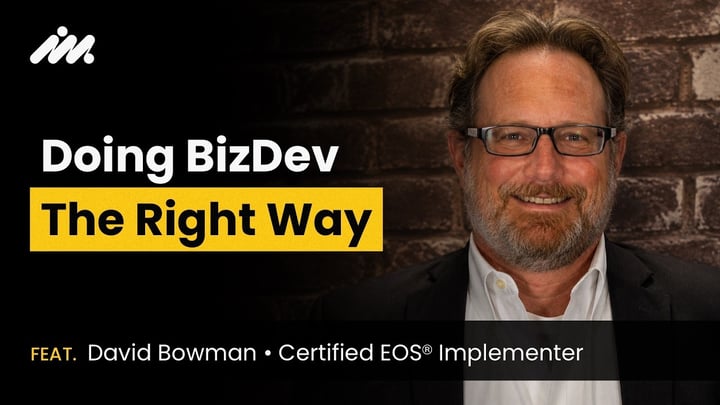
Episode 15 — Doing BizDev the Right Way
David Bowman spent 10 years in the Marine Corps as a helicopter crew chief before realizing he was never going to be the guy sitting behind a desk. After a career in ...