
.jpg)
An entrepreneur peer of mine used to say, “It’s not about how much you make, it’s about how much you keep.” Another I hear often is, "Revenue is for show and profit is for go." Catchy sayings like these are meant to remind us growth-driven business builders that it takes revenue and profit together to build a sustainable business.
That's why waiting until the end of the month or quarter to understand the profitability or cash flow health of your business is a dangerous game. I appreciate OKRs because they can be leveraged to drive growth when applied quarterly. Unfortunately, they often lack the weekly intervals and metrics that help us balance profitability.
OKRs bring us focus, but without an operating system, they tend to create unprofitable focus. That leaves teams chasing growth, but it isn’t always healthy growth. And while teams may move faster, it isn’t always in a balanced direction.
If your team is setting OKRs but still feels out of control financially, this isn’t a goal-setting problem. It’s a system problem. Let’s talk about it, and more specifically, how to fix it.
Why OKRs Alone Don’t Improve Profit
Most leadership teams adopt OKRs hoping they’ll increase focus, accountability, and execution. They do all three, just not always in ways that support profitability.
These common breakdowns tend to show up quickly:
- Teams take on too many priorities.
- Objectives drive activity, but that activity doesn’t always lead to desired outcomes.
- Key results aren’t tied to cost or capacity.
- Financial metrics aren’t part of a steady, predictable weekly review.
- Decisions get made without considering downstream impact.
- Everyone works harder, but the numbers don’t move.
OKRs help you clarify what you want to achieve, but they don’t clarify how your organization will operate to achieve those goals profitably. More specifically, when combined with a meeting pulse, like Level-10 Meetings, you can identify weekly when you're off track and then solve for getting back on track.
This is where EOS® becomes essential. When a leadership team leans on OKRs without a business operating system, the disconnect between goals and execution widens. And then profit takes the hit. But with EOS in place, teams get the structure and cadence they need to turn ambitious OKRs into profitable execution.
5 Ways EOS Helps You Regain Control of Profit
EOS brings teams the discipline they need to execute on their goals. When teams use OKRs and EOS together, they gain the consistency and visibility they need to make profitable decisions week after week.
EOS strengthens profit in five ways:
- The V/TO® ensures OKRs support financial reality: The Vision/Traction Organizer® makes teams align their OKRs with the 1-Year Plan and the 3-Year Picture. Profit goals are clear, which means OKRs can’t float above strategy. They have to reinforce it. This means teams stop setting objectives that don’t support the financial model.
- The Accountability Chart® removes costly overlap: Profit fades fast when ownership is unclear. The Accountability Chart creates: clear Seats, defined roles, and one owner for each major outcome. This stops duplication and rework, two of the fastest ways profit disappears.
- Rocks turn OKRs into realistic, high-impact commitments: Profit requires focus. Rocks force the team to choose what truly matters for the next 90 days. When OKRs map to Rocks, you can break the work down into milestones that span 13 weeks at a time. This focus is the difference between working hard with little progress and actually winning.
- Scorecards provide a weekly line of sight to margin drivers: EOS Scorecards are built with leading indicators or action-based measurables. They're not about reporting. They're about discovering. Healthy teams track labor cost trends, utilization, gross margin, customer churn, leading indicators tied to revenue quality, and more. This gives you real-time visibility along with the ability to course-correct while it still matters.
- IDS® fixes the issues that eat margin: Unresolved issues drain profit more than teams realize. IDS ensures problems tied to cost, capacity, or inefficiency are addressed quickly with no surprises or end-of-quarter firefighting.
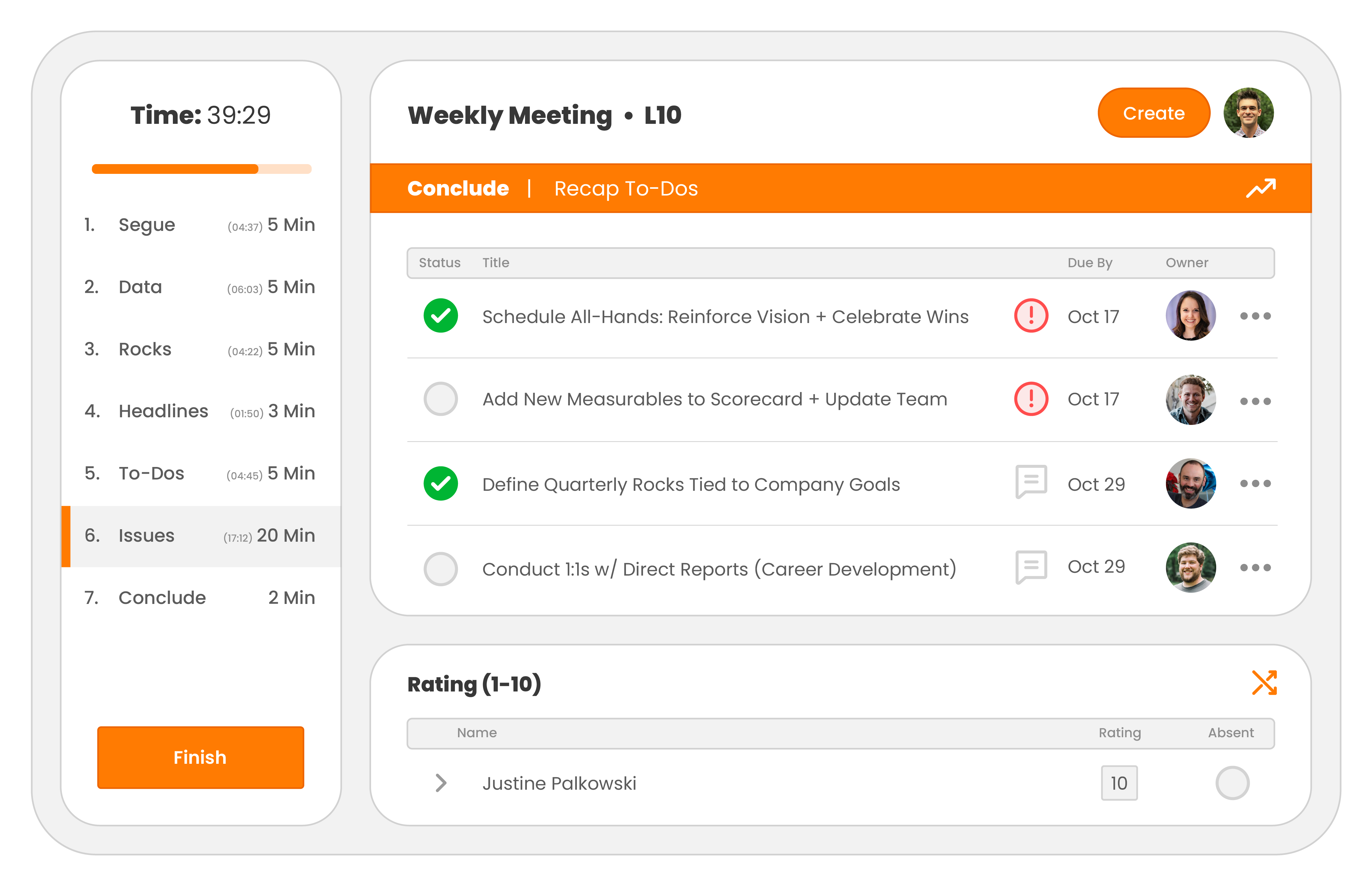
- The Level 10 Meeting® creates the cadence profit depends on: Consistent behavior drives consistent financial performance. The weekly Level 10 Meeting is where that consistency shows up. It makes sure every team regularly reviews their Scorecard, Rocks, and To-Dos. This way, they can make decisions aligned to the plan.
This is the structure most teams are missing when OKRs aren’t producing financial results. When you put these tools to work, profit stops being something you analyze after the quarter ends and becomes something you manage in real time.
EOS gives teams the structure to make better decisions, stay aligned, and catch issues early. Layer OKRs in, and you finally have a system where goals, capacity, and financial performance move in the same direction. That’s how teams regain control and start running a more profitable business.
How Ninety Helps You Close the Profit Gap
Once teams understand how EOS brings structure, clarity, and discipline to their OKRs, the next question is simple: Where do we run all of this week after week?
That’s where Ninety comes in. It gives teams a single, consistent workspace where OKRs and EOS tools come together in ways that directly support profitability.
Here’s how Ninety helps you connect your goals to the financial reality of the business:
- OKRs become Rocks with real ownership and clear next steps: Inside Ninety, your OKRs map directly to quarterly Rocks. Every Rock has one owner, clear milestones that mirror key results, and is reviewed every week in the L10. No ambiguity or extra work, just disciplined execution.
- Key results turn into Scorecard measurables: Instead of waiting for a quarterly review to look at data after the fact, Ninety brings key results into your weekly Scorecard so you can track measurables and patterns tied to profit. And most importantly, you can course-correct before financial damage is done.
- The Accountability Chart is connected directly to the work: Every OKR and measurable ties back to a specific Seat. This prevents the misalignment, duplication, and hidden cost centers that eat margin. Teams know exactly who owns what, and it’s visible to everyone inside the organization.
- Level 10 Meetings run on real-time data, not opinions: Ninety powers a consistent weekly rhythm that includes reviewing the Scorecard, Rocks, To-Dos, and issues. When OKRs live inside this operating system, teams can make decisions based on facts, not assumptions. The business adjusts faster and stays aligned to the financial plan.
- The V/TO® keeps every OKR aligned with long-term profitability: In Ninety, your V/TO is always just one click away. That means every objective and key result can be traced back to your long-term vision, 1-Year Plan, and financial targets.
When your OKRs and EOS tools live in one place, the work becomes simpler and the outcomes become more predictable. Ninety gives leadership teams a single source of truth where OKRs, Rocks, Scorecards, Issues, and the V/TO all reinforce each other. With real-time visibility and a consistent operating rhythm, the organization finally has the structure it needs to execute with discipline and protect margin as it grows.
Building a More Profitable Quarter with OKRs Powered by EOS
If your team is setting thoughtful OKRs but still finds itself fighting for consistent profit, you’re not dealing with a motivation issue. You’re dealing with a structural one. EOS gives you a system to achieve those outcomes with discipline. And Ninety brings everything into one place so your team can manage financial performance in real time, not after the quarter is already gone.
When you run OKRs with EOS, you create a business that makes better decisions, stays aligned week after week, and protects margin as it grows. That’s how teams regain control, strengthen financial performance, and build a healthier business that can scale sustainably.
So pick your favorite revenue versus profit saying as your mantra for the year ahead. Choose the one that reminds you that you need balance and a complete operating system. You don’t need to get rid of OKRs, but you do need to integrate them into an operating system like EOS powered by Ninety.
If you want your next quarter to be more profitable than your last, start by anchoring your OKRs inside a system built for clarity, accountability, and Traction®. Then run that system in Ninety. It’s the fastest way to turn your goals into profits the whole organization can feel.
If profit is slipping or stalling, it’s time to bring structure to your goals. Try Ninety and see how OKRs and EOS work together to strengthen financial performance.


.jpg?width=500&name=large_Traction%C2%AE_Gap_EOS_Blog_Header_1920x1080%20(1).jpg)
.jpg?width=500&name=large_OKR_Blog_5_EOS_Blog_Header_1920_x_1080%20(1).jpg)