
Autocratic, Bureaucratic, Democratic, Pacesetter, Servant, or Coach? Which leadership style are you?
As leaders, we tend to shift our styles depending on circumstances and organizations, but no matter what, it's important to remember this: People lead and OKRs guide. OKRs are simply a tool leaders use to execute on the goals their team has already agreed to for the year and the quarter.
When OKRs are introduced without an operating system, frustration usually grows quickly. Why? Because teams expect alignment, but they still experience duplicated work, miscommunication, and stalled progress. The right goals are in place, but the organization keeps losing time figuring out who owns what. Structure comes first, people second, and data third.
If your team uses OKRs but still struggles with alignment issues, you aren’t facing a goal-setting problem. You’re facing a structural problem. EOS® gives you the clarity and accountability your company needs for people to work well together and stay on the same page.
Let’s walk through how you as a leader can remove the uncertainty that often surrounds OKRs and build an environment where everyone stays coordinated and fully engaged.
Why OKRs Don’t Fix Team Alignment Issues
Leaders often assume OKRs will create alignment because the goals themselves are clear. The problem is that clarity on outcomes does not create clarity around ownership. OKRs tell you what you want to achieve, but they don’t explain who makes decisions, how work gets prioritized, or how departments should coordinate when priorities compete.
Leaders charge ahead with good intentions, but two people still believe they own the same objective. Key results get assigned without considering capacity. Work begins to overlap, and valuable time disappears as different functions unknowingly tackle the same tasks. Everyone works harder, but the organization keeps circling the same discussions because responsibility was never fully defined.
OKRs are powerful, but they require a strong operating system to support them. Without structure, teams end up relying on personal preference, historical patterns, or individual interpretations, and that’s how alignment breaks down.
If you want your OKRs to improve how your people work together, you need a system that removes guesswork, clarifies accountability, and establishes a clear process for making decisions. That’s where EOS comes in.
EOS Brings Clarity to Roles and Agreements
Most alignment issues trace back to unclear structure. When roles, decision-making processes, and cross-functional handoffs aren’t fully defined, people default to their own assumptions. That’s why teams feel tension around ownership even when the OKRs look solid.
EOS solves this by using The Accountability Chart® to define a clear structure and then outline agreements for every Seat. It removes ambiguity by showing who does what, who owns which outcomes, and how each Seat supports the work connected to OKRs.
With The Accountability Chart in place, teams gain:
- Defined roles, each with a clear purpose
- One owner for every Seat
- A shared understanding of who leads, who decides, and who supports
- Simple agreements around work that crosses departments
- Visibility into how OKRs map to the structure
When everyone sees the same picture, alignment becomes easier. There’s no debate about who owns an OKR-aligned Rock or who should carry a measurable. Teams stop relying on side conversations or informal arrangements because the structure itself gives them a single source of truth.
With structure comes clarity. And with clarity comes consistent, reliable execution throughout your organization. And that’s how you make real progress.

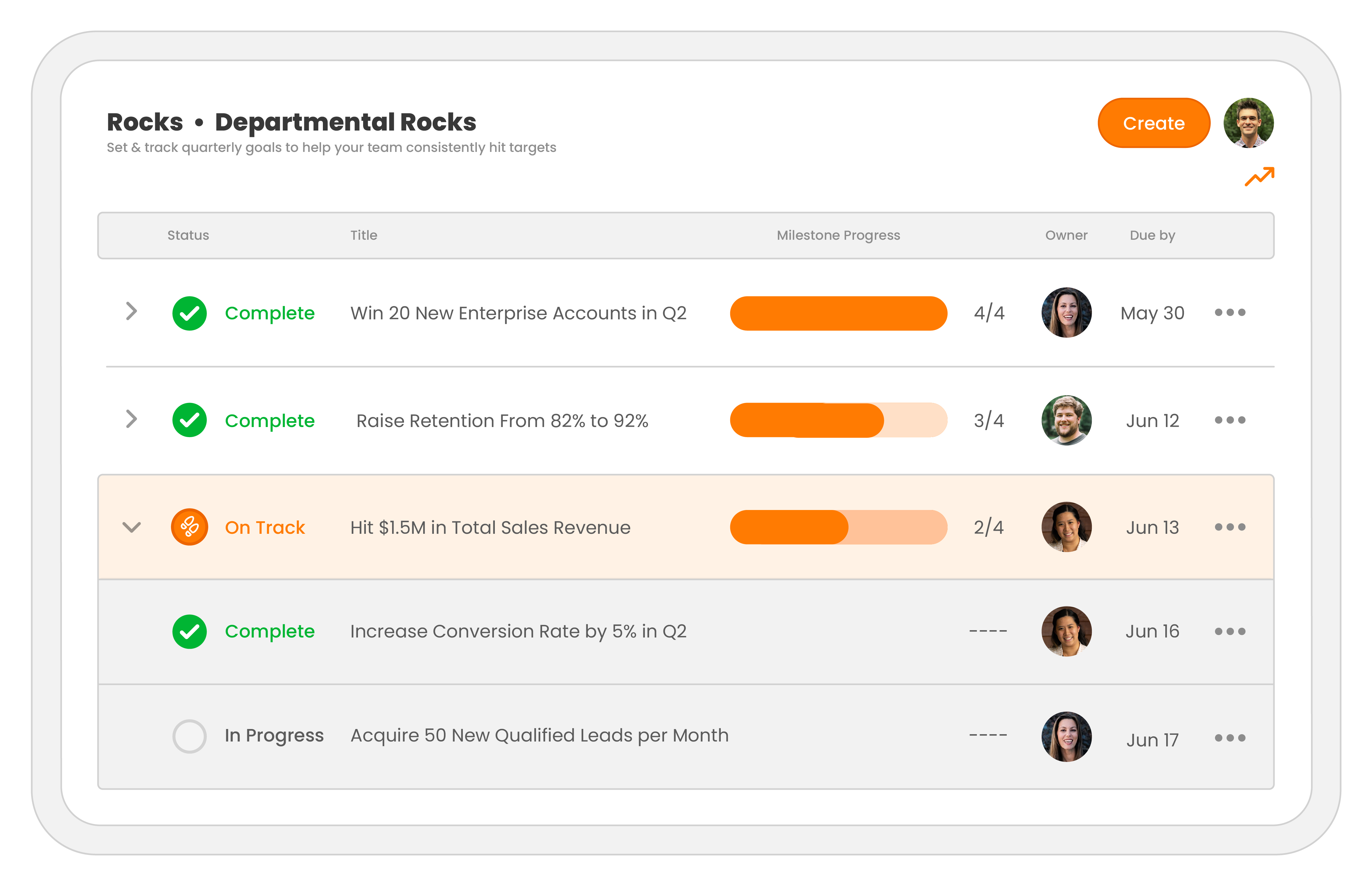
Rocks Turn OKRs into Practical Commitments
One of the fastest ways teams create stress is by taking on too much. OKRs often introduce several ambitious objectives, and without constraints, every objective feels urgent. This creates pressure throughout the team because people try to move too many things forward at once.
EOS fixes this by turning your highest-impact OKRs into Rocks. Your Rocks are limited to 3–7 commitments your team will move forward over the next 90 days. Essentially, they force your team to choose what truly matters instead of tackling everything at once.
When OKRs map to Rocks, teams gain:
- Clear 90-day goals instead of a long list of competing objectives
- Agreements around what will move forward now (and what can wait)
- Accountability and alignment because each Rock has one owner
- Weekly visibility in the L10 that keeps progress in front of the team
Rocks turn OKRs into actionable priorities. Instead of pushing everything forward, the team can focus on the work that matters most to the business right now.
Level 10 Meetings Keep People Aligned Week After Week
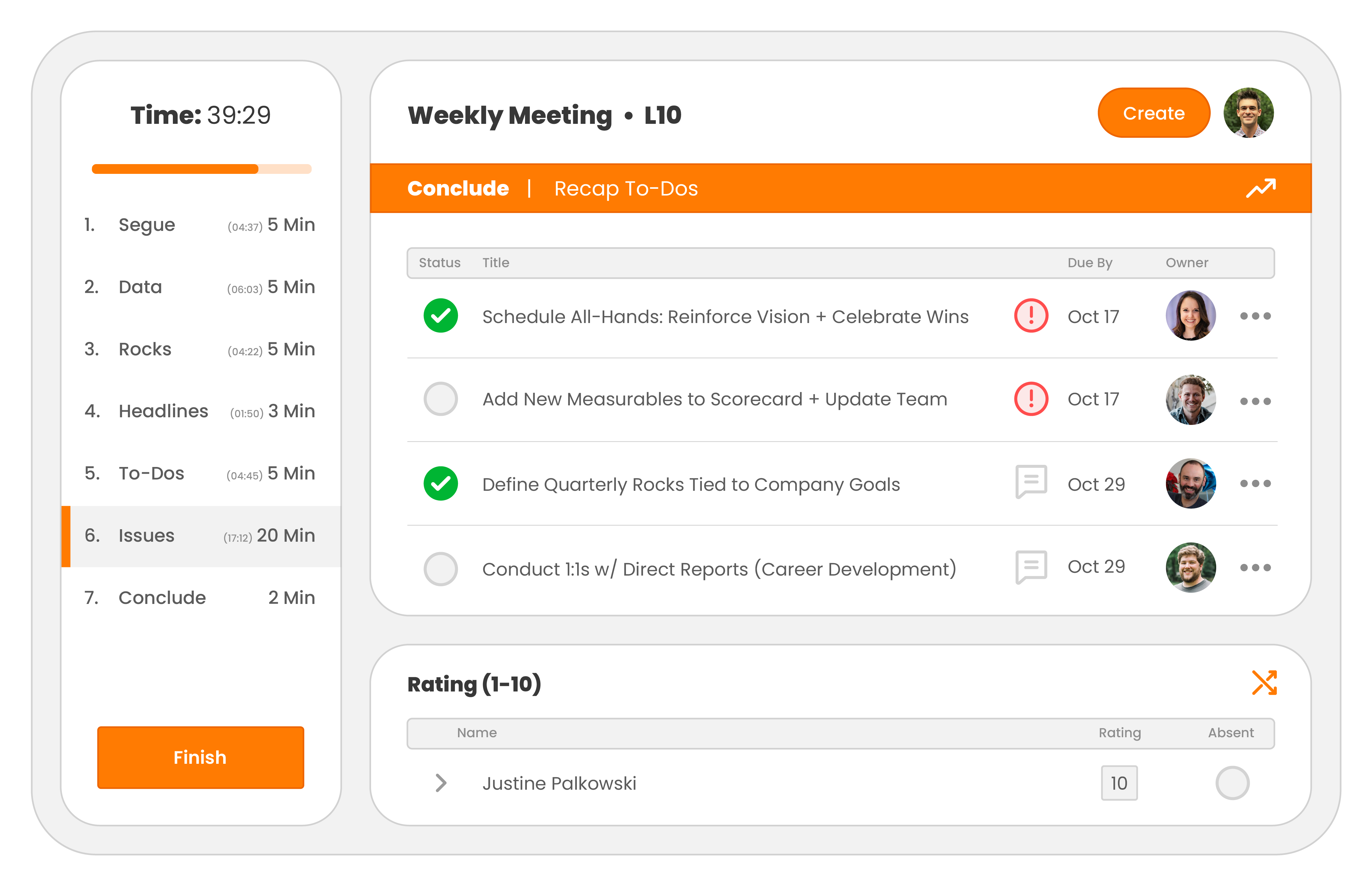
Even the best structure fails without a consistent rhythm. OKRs lose momentum when the team doesn’t have a dependable way to review progress and address issues. Without a weekly cadence, people operate on their own timelines, and small misunderstandings turn into bigger problems.
The Level 10 Meeting® provides a simple, repeatable framework to keep teams aligned. Every week, leaders review Scorecard measurables tied to OKRs, check the status of Rocks, confirm To-Dos, and use IDS® to address issues that are slowing or stalling progress.
L10s gives teams:
- A weekly forum to align on priorities and responsibilities
- Real-time awareness of what’s on track and what needs attention
- A disciplined process for surfacing and solving issues
- A shared understanding of how OKRs are progressing
With a weekly meeting in place, OKRs stay visible, agreements remain clear, and people stay in sync.
How Ninety Brings OKRs and EOS Together in One Workflow
Even when teams anchor their OKRs inside EOS, the next challenge is keeping everything connected throughout the quarter. Using separate tools for Rocks, data, issues, and OKRs leads to scattered information, inconsistent updates, and unnecessary rework.
Ninety solves that by bringing all of your EOS tools and OKRs into one simple workflow. Teams get a single place to build structure, track progress, and run the weekly meeting that keeps people aligned.
Inside Ninety, teams can:
- Turn OKRs into Rocks with clear ownership
- Break Rocks into milestones that align with key results
- Track measurables in Scorecards every week
- Run Level 10 Meetings with real-time data
- Connect every Rock and measurable to the V/TO®
- Keep issues visible and IDS them quickly
- See roles and agreements clearly through The Accountability Chart
With everything in one place, alignment becomes stronger and decisions become faster. Ninety keeps your OKRs connected to the same system your team uses to run the business every day.
Build a Team That Stays Aligned Week After Week
If your team is using OKRs but still struggling with alignment, you need a system that keeps your people accountable and informed as the work progresses. And as a leader, you're accountable for the system.
Start by anchoring your OKRs inside a business operating system that brings clarity and discipline to how the work gets done. It's the fastest path to a healthier, more aligned team.
Choose your tool carefully, but more importantly, choose the operating system that elevates your leadership style and drives your organization toward clarity and the win.
EOS provides the structure, and Ninety brings that structure into your daily operations. Together, they help teams build healthier relationships, make faster decisions, and maintain clarity. When OKRs live inside EOS and run through Ninety, people work better together and execution becomes more consistent.
If your team is working hard but still not aligned, it’s time to strengthen the system behind your goals. Try Ninety and see how OKRs and EOS stay connected in one simple workflow.


.jpg?width=500&name=large_Traction%C2%AE_Gap_EOS_Blog_Header_1920x1080%20(1).jpg)
.jpg?width=500&name=large_OKR_Blog_5_EOS_Blog_Header_1920_x_1080%20(1).jpg)
.jpg?width=500&name=large_Restore_Financial_Discipline_EOS_Blog_Header_1920_x_1080%20(1).jpg)